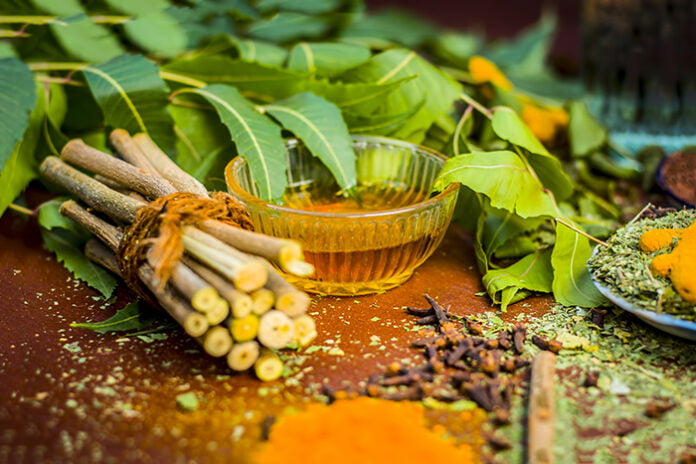
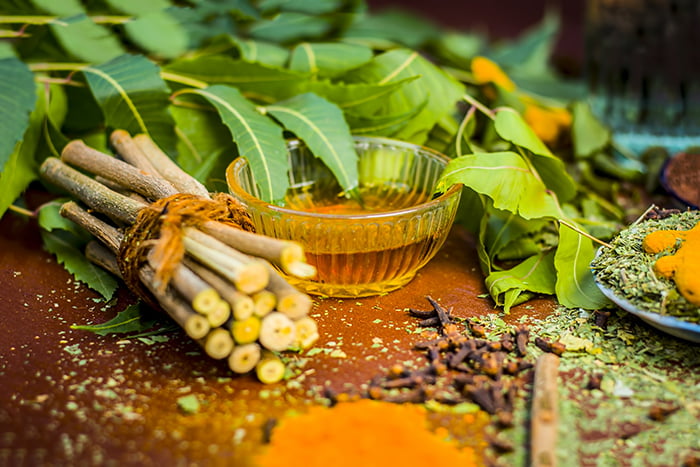
Close up of ingredients of ayurvedic treatment i.e neem,neem leaves,neem powder,bark,clove,turmeric,water.
The traditional Caribbean “bush” natural remedies of our grandparents seem ever more appealing in these uncertain times. While a strong immune system is one weapon in the war against illness, conventional supplements have been coming under fire for the number of additives they contain. Warm herbal elixirs offer nostalgic and soulful comfort, as well as a boost of body-loving nutrients. Here’s a look at some essential Caribbean all-natural salves, their potential health benefits, and risks.
Cerasee
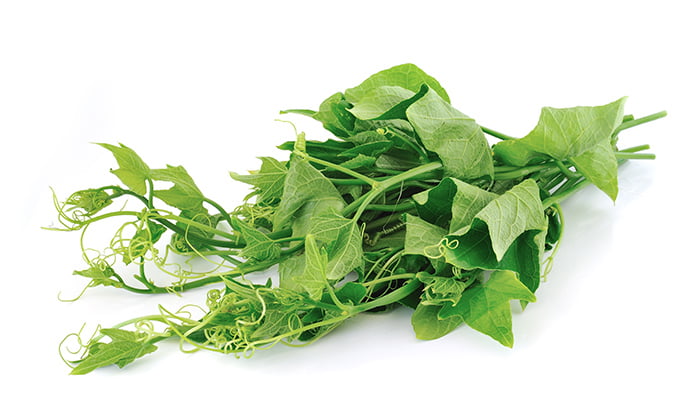
Whether growing along the side of a country road or neatly packaged for sale in grocery aisles, cerasee (known to Haitians as asosi) remains a bush tea staple for islanders. Native to Africa, the herb is known as a natural detoxifier, containing vitamins A and C, as well as phosphorus and iron. The popular leaves have traditionally been drawn in a hot beverage sipped to calm symptoms of hypertension, diabetes, liver problems, fever, and constipation. It is also claimed to reduce menstrual pain and urinary tract infections. An old school cerasee “bath,” where the leaves are steeped in hot water, has been used to soothe skin irritation caused by conditions like eczema. When it comes to consumption, however, experts warn that prolonged and continual use could possibly lead to liver damage, so caution is advised.
Lemongrass
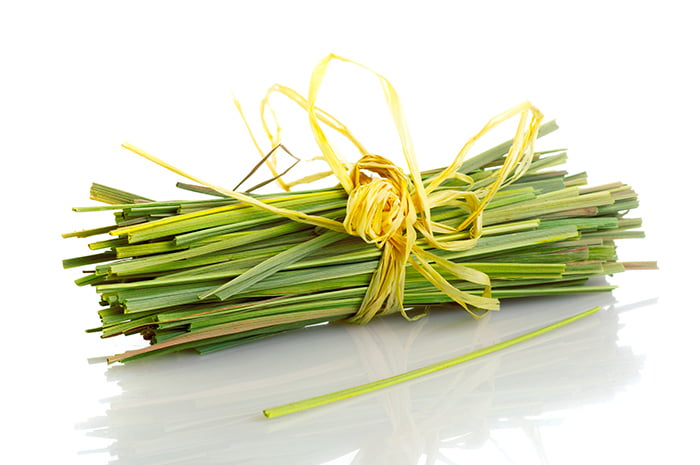
A longtime staple in South Asian cuisine and medicinal remedies, lemongrass is better known to some Caribbean folk as fever grass, named as such for its fever-reducing properties. Rich in natural antioxidants, tea brewed from lemongrass stalks is used to alleviate some cold and flu symptoms, such as coughs and headaches. The tea also acts as a digestive aid, known to relieve bloating, stomach cramps, and constipation. The roots of fever grass can be made into a tea and used as a mouthwash for gum problems and periodontal disease. Like everything else, however, moderation is key. Drinking an excessive amount of lemongrass tea can cause stomach aches.
Soursop Leaves
A favorite of Caribbean kids everywhere, the sweet guanábana or soursop fruit is as nutritious as it is delicious, packed with immune-boosting vitamins B and C as well as calcium and potassium. Aside from the sweet nectar of its fruit, the leaves of the soursop tree are also purported to have remarkable health benefits. Most often made into tea, the leaves aid in calming several ailments related to the digestive system, including constipation, hemorrhoids, and gallbladder problems. Keeping your gut happy is crucial to maintaining overall immune health. As a cautionary note, excessive consumption is linked to nerve damage, which presents as tremors or stiff muscles. Also, the seeds should never be consumed due to their toxicity.
Neem
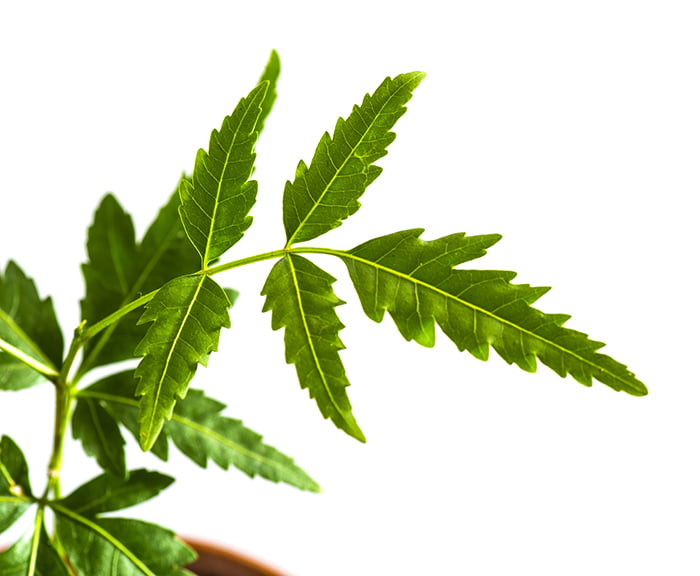
They say whatever tastes bitter must be good for you. By those standards, the benefits of neem tea offer a strong testament. Commonly known as Indian lilac, neem is consumed as a tea throughout the West Indies and has become an Ayurvedic essential. The plant is high in antioxidants and possesses natural anti-inflammatory and anti-bacterial properties. Drinking neem tea is believed to help with a variety of conditions, including fever, diabetes, liver problems, constipation, bloating, and stomach and intestinal ulcers. Like many other natural remedies, however, drinking neem tea for a prolonged period can affect the kidneys and liver.
It is important to keep in mind that natural ingredients vary in potency and can affect individuals or interfere with medical treatments in unexpected ways. With this in mind, please consult your physician before making any dramatic changes or additions to your diet regimen.
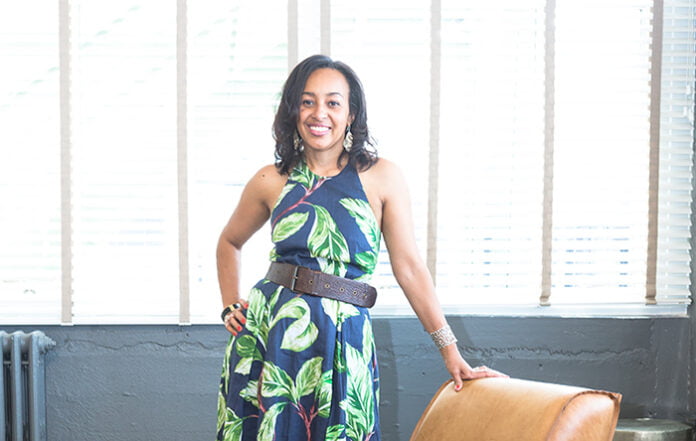
Interior Designer Marie Burgos. Photographer: Francis Augustine.
When asked what drew her into the world of interior design, Marie Burgos replied, “Fate.” Her career fashioning beautiful living spaces was a far cry from her former life as a corporate business manager. A more artful path was in the cards for the designer born and raised in Paris, France, with roots in the beautiful island of Martinique. Surrounded by a family of creatives, from painters to musicians, she developed “a desire for true creative expression.” When Burgos eventually followed her calling, the natural beauty of the Caribbean became a vital touchstone. The designer credits that island aesthetic for her love of color, shape, and functionality.
Marie Burgos brought her keen designer eye to reimagining a pre-war apartment on Park Avenue in Manhattan. The homeowners, a young professional couple, were struggling with a big decision ahead of the birth of their first child. Should they stay in their perfectly located, but seriously outdated and impractical apartment? Or relocate to a more suitable and modern home in a not-so-perfect neighborhood?
“I made their decision to stay very easy by proposing a design that would transform the space to be exactly what they wanted in only three months’ time,” Burgos said. She focused on improving the overall livability of the home while creating a safe and welcoming space for their new addition. This meant “opening up the living space and modernizing the entire apartment with technology and contemporary style.”
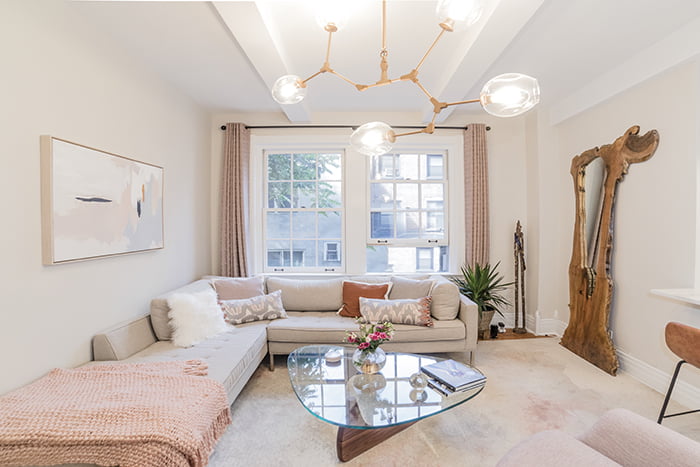
Living Room: Fresh Canvas
Photographer: Francis Augustine
Creating a fresh canvas, she composed a color palette filled with “light and subtle nuances of white to create a serene environment.” To infuse more personality into space, she balanced contemporary furnishings with several handcrafted accents, like the bespoke walnut-framed mirror in the living room gifted to the couple by one of their parents.
This care for details carried through to the sculptural lighting fixtures, like the stunning yet budget-friendly Thurston 5 Lights Chandelier in glass and brass. More lighting integrated into custom millwork created focal points for displaying artifacts, books, and other beloved items.
Photographer: Francis Augustine
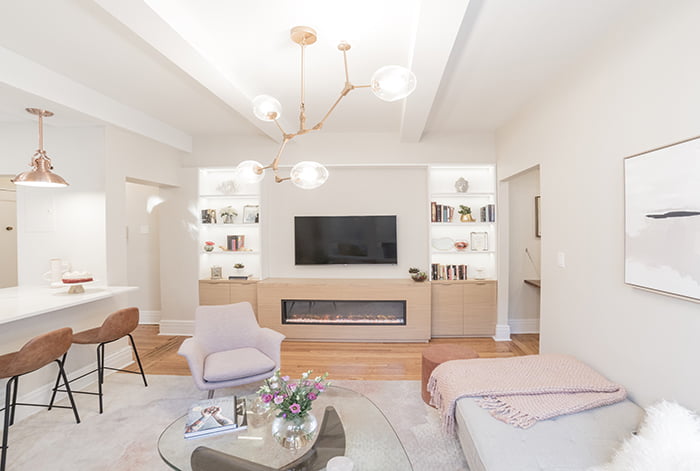
To improve flow, Burgos “created a brand new layout, reoriented the living space, and opened up the foyer to the living room to make the entire apartment feel more spacious.
“I also created a focal point in the form of a new fireplace and a millwork entertainment center,” she said. Get-togethers and dinner parties are now hosted much more comfortably.
Using her knowledge of Feng Shui, Burgos also wove the concept of yin and yang throughout the design. “Simple, clean lines were paired with curves,” she said. “A mixture of hard surfaces such as glass, stone, and wood were contrasted with fabrics that are soft to the touch, each selected to create harmony and balance.”
Kitchen: A Flood of Lights
Photographer: Francis Augustine
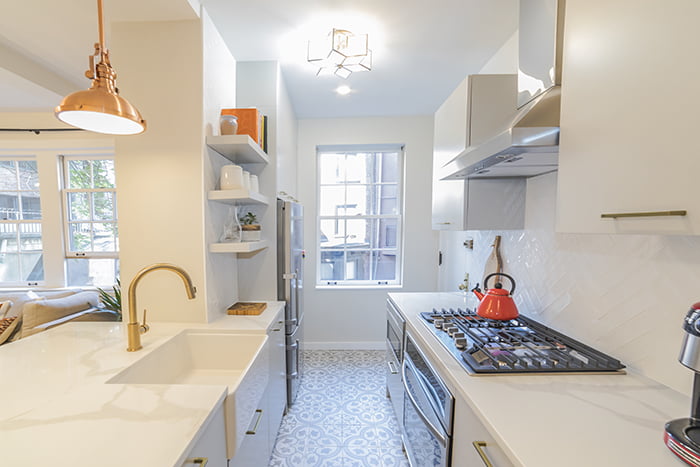
The kitchen was completely opened up to create a clear line of sight to the living room (ideal for keeping an eye on the little one) and to flood the apartment with natural light. “Looking from the living room, the first thing that catches your eye is the copper pendant lighting hanging over the large island, which creates a beautiful frame.”
To deemphasize the small footprint of the apartment and to enhance its usability, Burgos redesigned the kitchen to double as a dining area. “So now everything has a place.”
Bedroom: Fit for a King
Photographer: Francis Augustine
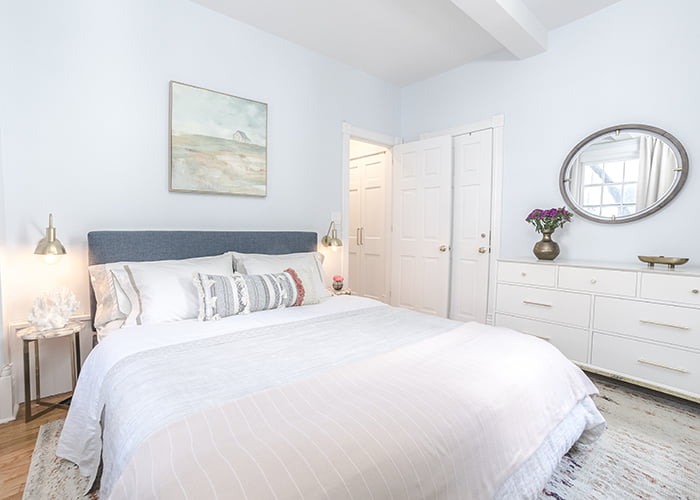
While redesigning the bedroom, Burgos insisted the couple replace their queen-sized bed with a more spacious king, overruling their concern that the larger bed would never fit. “I’ll make it fit! Once you have kids, you need that space,” she joked.
Several newly acquired vintage elements and some of the home’s existing decor pieces, including a giant mirror, added personality to the couple’s sleeping quarters. Purposefully incorporated, these items added history and heritage to balance the contemporary design of the room.
The Perfect Nursery
Photographer: Francis Augustine
Space previously used as an office and guest bedroom was transformed to create the perfect nursery, with every detail dedicated to the new baby. The office was relocated to an alcove in the corridor.
“Designing is not just about pretty objects,” Burgos said. “It’s about creating a space that changes your mood, makes you feel happy and makes your life more purposeful.”
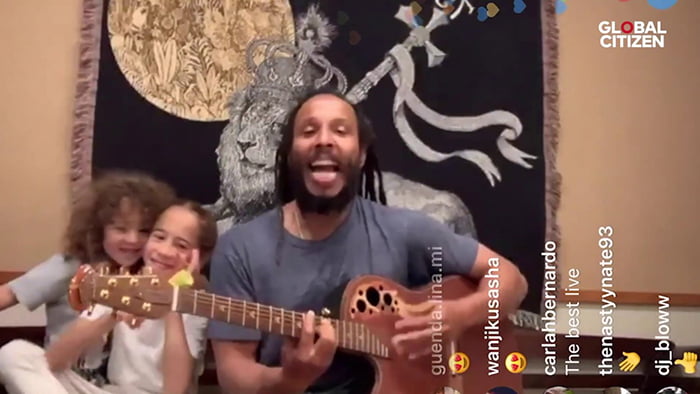
This past May, amid the desperate uncertainty surrounding the expanding COVID-19 pandemic, reggae music fans found a moment of escape when dancehall legends Beenie Man and Bounty Killer faced off in their now iconic Verzuz sound clash, which was live-streamed around the world. As they volleyed verse for verse, the showdown attracted nearly half a million viewers hunting for riveting musical entertainment in a landscape of cancelled tours and live appearances following the outbreak. The crisis clearly has not stopped Caribbean stars from connecting with their audiences—from Bad Bunny’s three-hour surprise Livestream to Ziggy Marley’s virtual music classes and acoustic family concert at home with his kids. Finding new ways to entertain since the pandemic began, however, isn’t just about nurturing creativity. It’s also about securing the financial viability of the Caribbean music industry.
Artiste Ziggy Marley performing with family on live stream to fundraise for Global Citizen.
Lost revenue, typically generated by touring, has hit Caribbean performers particularly hard, said attorney and music business consultant Lloyd Stanbury. “Most artists do not generate significant earnings from royalties,” he said. They don’t make much from their recordings. Instead, most of their money comes from performing, “so the curtailment of live shows around the world for the past several months has cut their main source of income.”
Live From Lockdown
Coronavirus lockdowns have presented a greater challenge to the region’s genres as they do not get as much mainstream exposure nor earn as many mainstream dollars. Both well-known international artists and up-and-comers in Caribbean music “will have to be more innovative and technologically aware to function in the future,” Stanbury said. In this new era, “some of the practices we became accustomed to in the presentation and distribution of recorded music and live music performances will disappear or become less effective.”
As a result, many have turned online to replace the income they would have earned from live concerts. Some have said they are actually earning more money from digital services during the pandemic than they did before the outbreak.
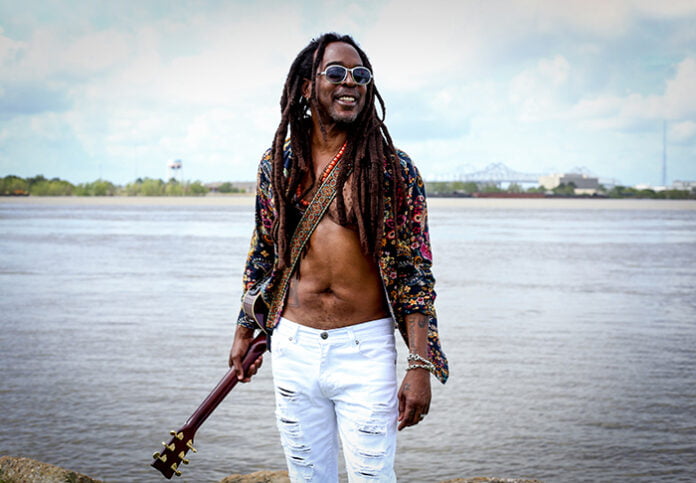
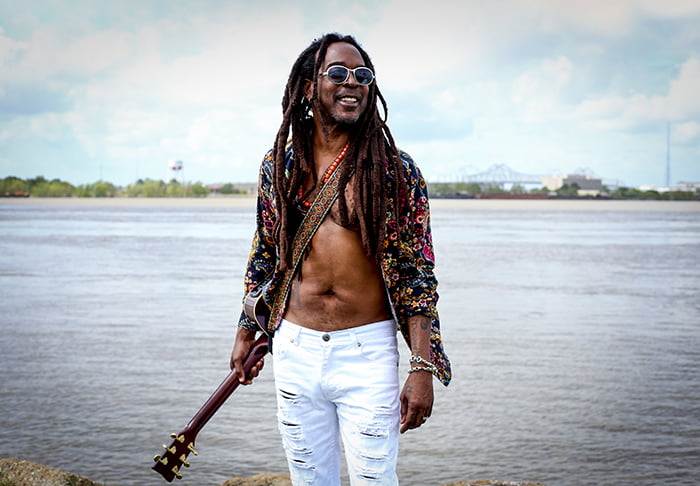
Afro-Caribbean folk artist Ben E. Hunter.
After his live gigs were canceled in New Orleans, La., Afro-Caribbean folk artist Ben E. Hunter began performing online. Now, he has made more money through PayPal and Cash App donations for his virtual concerts than he did from performing a set at the New Orleans Jazz & Heritage Festival in 2019.
Streaming Services
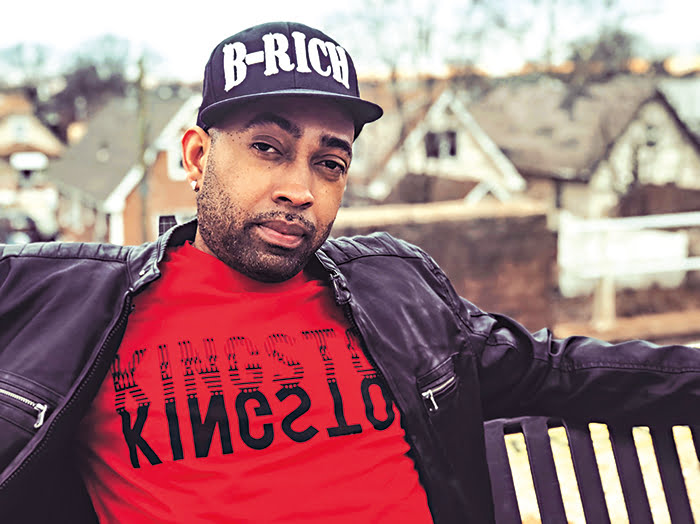
Kingston-based producer Richard “Shams” Browne.
Kingston-based producer Richard “Shams” Browne believes these direct donations can work as a viable solution. “If an artist has a strong enough fan base, they can do virtual concerts and promote them as an exclusive event, and either have a subscription fee or pay-per-view,” he said. “In today’s world, content is king, and most artists have their own home studios or access to one. They can use this time, while not touring, to create and release more music available for streaming.”
Earning revenue solely through streaming, however, has its limitations, said Grammy-winning producer and Jamaican radio personality Wayne Jobson. “Virtual concerts have been great and (virtual) Reggae Sumfest was brilliant, ” he opined in light of the connection fans and artists can maintain through these media. “Respect to [Josef Bogdanovich] and the Downsound crew.” Unfortunately for the artists, “streaming does not generate a lot, as one million Spotify streams only generates U.S. $4,000.”
Masters of Their Own Fate
That’s why, under the U.S. Copyright Act of 1976, Jobson has been actively helping artists reclaim recording catalogues and publishing rights—which generate residual income for writers and performers—often held by their labels and producers. In terms of musicians protecting themselves financially in post-pandemic culture, professionals agreed that ownership is crucial. For instance, Ziggy Marley has complete control of his master recordings and publishing as an owner of the Tuff Gong Worldwide label.
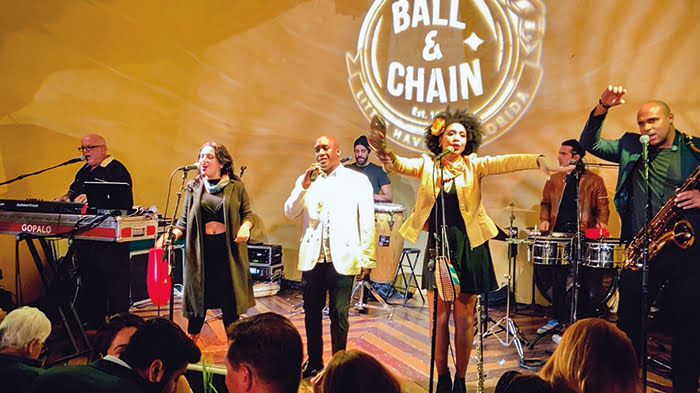
Afro-Cuban Funk band PALO! in performance.
Ownership and independence have proved invaluable for Steve Roitstein, a Grammy nominee and leader of Afro-Cuban Funk band PALO! Like most acts, Roitstein said the band “has seen all of our live events cancelled until further notice.”
“Inquiries keep coming in, but there is hesitation from all parties to commit to booking events when no one knows when things will be safe.”
They now have been focused on promoting sales of their recorded music, and those sales have been steadily increasing. “Ironically, our historically highest revenue months from digital music have been during the pandemic. So implementing digital marketing strategies is part of our long-term plan. It’s been a worthwhile investment of resources,” Roitstein said.
Stanbury said that as the music industry continues to evolve and the digital music market gains more importance in terms of revenue-generating possibilities, the development and ownership of innovative content becomes a lot more important.
“It is wise for artists to retain an interest in the content they create or participate in creating,” he said. “It is also incumbent on artists to exercise good judgment and secure professional representation.” He said that’s the smartest way to negotiate and capitalize on the masterpieces they create.
A proud daughter of immigrants and the most high-profile Black woman in American politics, Kamala Harris is at an extraordinary time in her life. She walked into history as the first Black, Indian, Caribbean soror to become a vice-president in the U.S., and now in 2024, she has set her sights on the presidency. At this moment, for the Democratic party and for Caribbean-Americans, Kamala Harris is the golden child.
She has Caribbean ancestral heritage through her Jamaican father and Indian roots through her mother. This mixed East-and-West Indian heritage, combined with diverse life experiences, has no doubt given Harris a deep appreciation of the human tapestry she could soon represent at a national level. In summarizing her vision for the nation back in 2020, she said, “If we are to be a strong country, if we are to reach the ideal, [then] we need leadership that recognizes the dignity and the value of each human being.” And that sentiment still holds true.
Following Joe Biden’s July 21 decision to step aside as the Democratic nominee under a cloud of low poll numbers and a dismal first debate performance, he endorsed his second in command, who quickly gained unprecedented momentum. Harris’ first week as a candidate for US presidency set historic high marks: the Democratic nominee raised $200 million dollars, registered over 100,000 voters, and recruited 170,000 volunteers to assist with door to door canvassing, phone banking and other campaign efforts.
Her first fundraiser in Pittsfield, Massachusetts on July 27 raised a whopping $1.4 million dollars. During the event she dismissed comments on childless women from Donald Trump’s running mate, Senator JD Vance, as “weird” and “wild lies,” continuing to state that “this is a people-powered campaign and we have momentum.”
Enthusiasm for Kamala Harris is high, with many Democrats touting her expertise, experience and relative youth contrasted against her opponent’s qualities. Her first campaign video, set to Beyoncé’s “Freedom,” has resonated particularly well with young voters. They have praised her strong stance on democracy, acceptance, healthcare, gun control and overall freedoms. This has generated a wave of optimism and hope among voters as they look forward to Harris challenging Trump in the upcoming November elections.
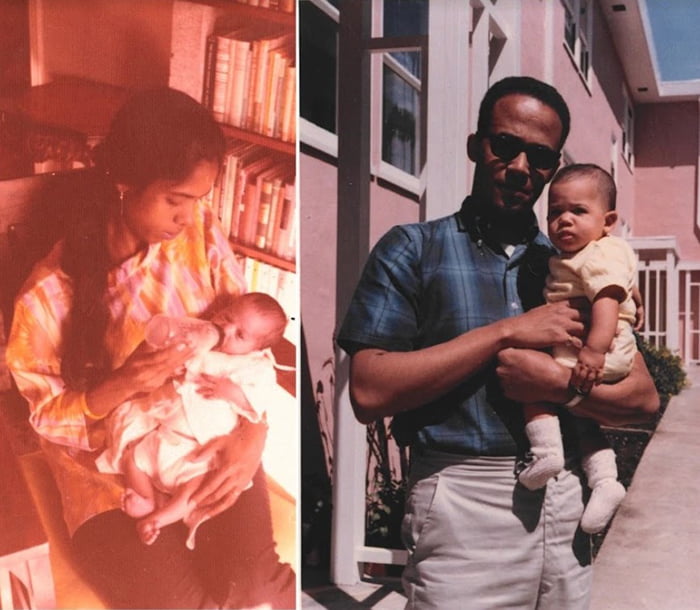
Family Roots: young Kamala Harris with mother Shyamala Gopalan (L) and father Donald Harris (R).
Caribbean Connections
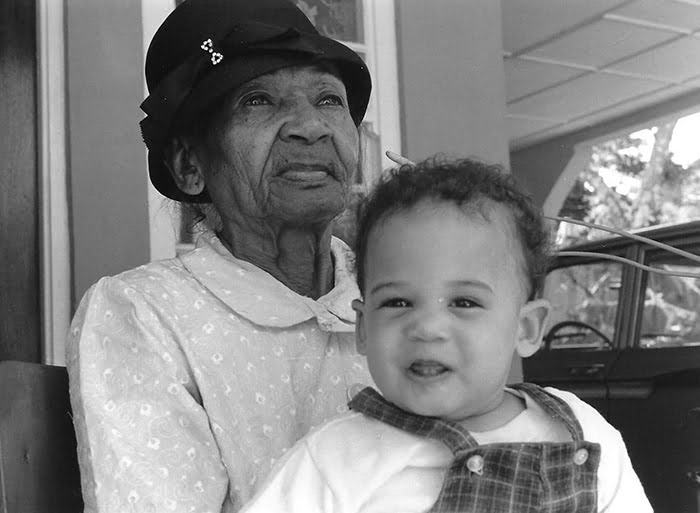
The name Kamala means “lotus” in Sanskrit. Harris’ father, Donald, was born in St. Ann’s Bay, Jamaica, and grew up in Brown’s Town in the same parish. It was at the University of California in Berkeley, during his Ph.D. studies, that he met and married her mother, Shyamala Gopalan, a biologist then pursuing her doctorate in endocrinology. Harris herself was born in Oakland, Calif., and raised between the United States and Canada, spending occasional holidays with her paternal grandmother in Jamaica.
Young Harris with Jamaican paternal grandmother, Christiana Brown.
In an interview with attorney and community activist Marlon Hill, Harris recalled both her parents actively involved in the civil rights movement. “Their influence on me from the time of my birth has been about making sure I was part of that fight,” she said. One of the key lessons she learned from them would drive her love of the law. From their example, she still believes “we have to dedicate ourselves to the struggle for justice and equality.”
Her multicultural background has been a boon for the Democratic party, which continually seeks to expand its tent in the era of identity politics. And in the Caribbean community, the excitement is palpable. No sooner had Joe Biden announced her as his 2020 VP pick than memes about oxtail and curry goat on the White House menu began circulating in WhatsApp and Facebook timelines.
“I know that in America, her nomination has really lit aflame with Caribbean people,” remarked self-described “Jamerican” U.S. Congresswoman Yvette Clarke of New York. “Whether you’re first-, second-, third-, fourth-generation American, all of us can relate to wanting to see ourselves in leadership in our adopted home.”
Political activist and CEO of Blue Mahoe Capital Partners, David Mullings, see the excitement among West Indians. “It’s a reminder that we Caribbean people contribute to America,” Mullings said.
“It should also help to heal some of the divisions that exist about us not being Black enough or acting white. Kamala is a reminder that we really are ‘out of many, one people,’” he said, nodding to Jamaica’s national motto.
A Series of Tensions
The divisions Mullings mentioned are part of a complex undercurrent that runs through Black America. Caribbean Blacks and African Americans often see themselves and each other very differently. Unifying these groups has been a hot topic among civic-minded leaders who believe we are stronger together. Mullings remains optimistic that beyond the politics, Harris can mend fences at this socio-cultural level. “Certainly, it’s going to force us to talk about it and confront it in the open now, not behind closed doors,” he said.
Acknowledging the current racial tensions in America, Hill, the activist, and attorney, also believes her election would move the narrative in a positive direction. “She is a woman for some who may not be Black enough and for some too Black. We need to let her be who she is and to demonstrate what she is giving of herself, which is the best in America.”
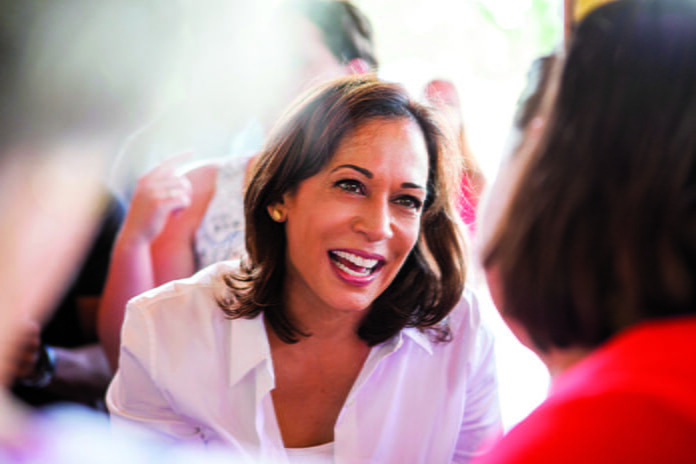
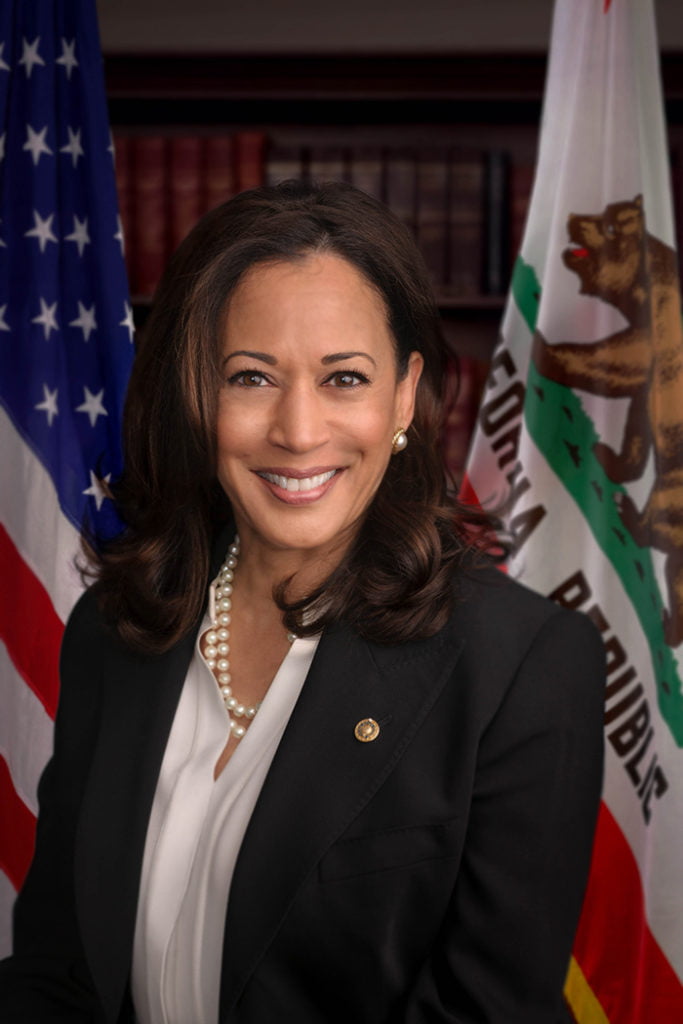
Kamala Harris
The tension among Blacks of varying origins and skin tones is as complicated as that between liberals of various progressive stances within the Democratic Party. On one hand, the party seeks to be welcoming and inclusive. On the other, its supporters seem to over-police intricate details of their leaders’ lives. At times, their judgments appear counterproductive to the party’s ultimate goal of electoral victory. So for many, while Harris’ diverse background is attractive, her tough-on-crime prosecutorial record is a bitter pill to swallow.
Harris began her career as a district attorney in California before being elected state attorney general in 2010. Working in the American criminal justice system revealed the less-than-level playing field for people of color. Some believe that Harris spent years at the helm as part of the problem, handing down stiff penalties for minor offenses. During her tenure as attorney general, however, Harris launched OpenJustice, an initiative creating accountability for California’s legal system and increasing transparency to the public.
Hill believes her years of experience guided her toward a more even hand and that she should be measured by more recent actions and accomplishments. “We should be allowed some leeway to evolve and learn, and to embrace issues that may have been counter to who we were in the past,” he said.
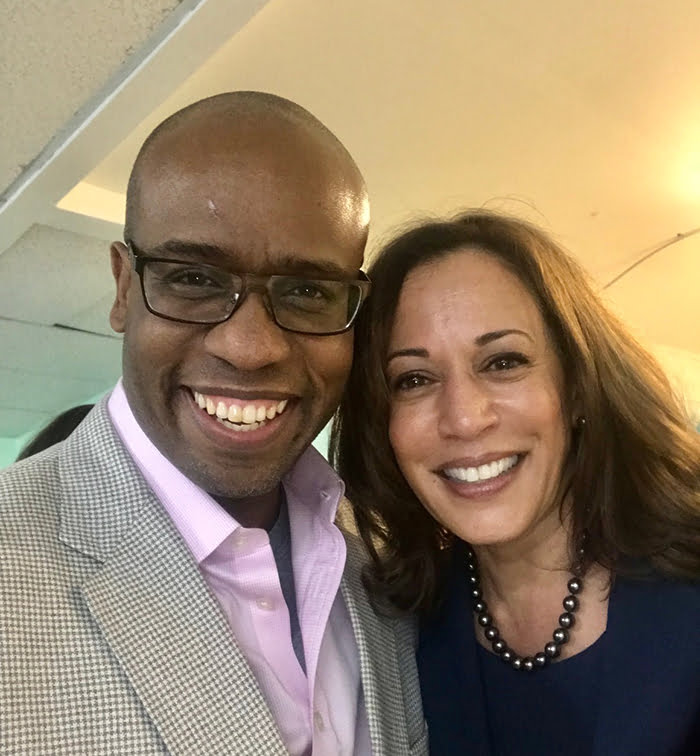
VP Candidate Kamala Harris in an interview with Marlon Hill
Her direct, no-nonsense approach is seen as an asset by supporters, including Mullings. “We need somebody who can go out and set the stage and just hit some people hard,” he argued. “She has proven more than capable of holding her own and crushing people with just the facts.”
We saw this side of her during the 2019 judiciary committee hearing, where she fiercely questioned U.S. Attorney General William Barr about his handling of the Mueller report, and again in her blistering remarks during the impeachment trial of President Donald Trump in January 2020.
As Senator, Harris sponsored or co-sponsored progressive legislation that supports civil rights issues. This includes reuniting immigrant families separated at ports of entry, decriminalizing cannabis, establishing a COVID-19 racial and ethnic disparities task force, and reforming law enforcement. The Justice in Policing Act of 2020, which she and colleagues in the House introduced in July, would ban chokeholds; prohibit racial, religious, and discriminatory profiling; and give attorneys general more power to investigate police wrongdoing.
“Before she was running for vice president, she had an affinity for addressing issues specific to the Black community,” Clarke observed. “And, in the era of Black Lives Matter, her lens provides entree into those spaces in a new way because it’s articulated through her lived experiences.”
On the Shoulders of Women
Clarke compared her fight, and that of Harris, to Nanny of the Maroons, the Jamaican national hero who successfully led rebel troops against their British colonial oppressors before emancipation. Unlike Nanny, Harris has taken the path of tackling the system from within.
She stands on the shoulders of trailblazing Caribbean-American women in politics. Those like Congresswoman Yvette Clarke and her mother Una, both leaders in Brooklyn, N.Y. And like Shirley Chisholm, the daughter of Caribbean immigrants, who became the first Black woman elected to Congress in 1968, and the first to run for president. Their work to improve resources for inner-city residents in their districts is at the heart of the fight for equality Harris brought to a national level in the Senate.
The women of color who hold her up extend far beyond West Indians. Harris is a member of the oldest Black sorority in the United States, Alpha Kappa Alpha. Her nomination has spurred legions of sisters to action. “Beyond her sorority and her university, there are networks of Black sororities and HBCUs that see themselves in a Kamala Harris. I happen to be a member of Delta Sigma Theta Sorority,” Clarke said. And they’re equally fired up.
Certainly, her multi-racial and multicultural identity will pull more voters from ethnic-minority communities and likely from among women voters as well. Looking toward the office she hopes to occupy, Harris sees the role of the vice president as a partner to the president, supporting their shared agenda. “For us, the agenda is about building America back better. It’s about making sure that all people are treated with dignity and respect and unifying the country. And I’m looking forward to doing that work.”
Now that she’s a contender in the race for the presidency, the many communities who claim Kamala Harris as their own, including the Caribbean community, are transfixed by the 2024 election.
Follow Island Origins for further updates throughout the campaign.
The 2020 COVID-19 pandemic has quickly changed the world as we know it, throwing our comfortable routines out the window. It tore us apart while bringing us together in ways we never imagined. Such an experience must leave a mark on those touched by the disease, whether fighting the virus themselves or helping others through the ordeal. To explore how the outbreak has affected the Caribbean American community, Island Origins spoke with the people whose lives have been forever transformed from the pandemic: from a survivor of the virus to the healthcare workers fighting on the front line.
A Sense of Connection: Dr. Gilda-Rae Grell
Dr. Gilda-Rae Grell was on the front lines when COVID-19 erupted in early 2020, overwhelming her and her colleagues at the Brookdale University Hospital Medical Center in Brooklyn, N.Y.. The ICU was filled to capacity, and patient beds lined the hallways. By March, the outbreak had completely transformed the resourced-pressed hospital that serves a large Caribbean community. “This is a very poor hospital in a very rough part of the neighbourhood,” said Grell, a native of the island of Dominica.
Her Caribbean background was a useful asset. With the need for clarity and efficiency at an all-time high, her ability to effectively communicate with the people she treated was half the battle. “I can understand what they are saying, and if they are describing their symptoms in a certain Caribbean slang, I can show comprehension and respond to it. And they appreciated it.”
While island kinship was a connector on hospital grounds, outside of work the virus completely disrupted her ability to interact. As the Big Apple fought to “flatten the curve,” businesses, schools, and events all closed. The isolation that resulted took an emotional toll on Grell. “When the pandemic started, I was living with someone, and it was very nerve-racking because you don’t want to infect the person you’re living with,” she recalled about that dark time. “And when people were doing social distancing parties, I wasn’t invited because I was most at-risk.”
Fortunately, she wasn’t actually alone. A deeper bond developed between Grell and her co-workers, who shared the same daily risks and the same challenges at home. As life is slowly creeping back to normal following the decline in confirmed positive cases, her team is still finding refuge in each other and in games of pick-up soccer at the park.
State of Mind: Andrea Munroe Dixon
Andrea Munroe Dixon has seen firsthand how the disease can sully the most basic comforts for those in recovery. The simple act of eating, for example, can feel discouraging when you’ve lost your sense of smell and taste—one of the confirmed symptoms of the virus. “I remembered meeting an elderly Jamaican woman who I encouraged to eat anyway,” Dixon said. A positive attitude is always a powerful key to healing, so she told her to “think about it as medicine more than food.” She took time out from running her home care company to return to her roots as a registered nurse, volunteering in COVID-19 treatment wards in STATE.
Throughout her 19 years caring for others, and as CEO of Sunshine State Healthcare Solutions, she has learned that in addition to medical intervention, emotional support for each person she treats is essential. “Your health and well-being start with your state of mind and how you think positively,” Dixon said. “How you think is how your body reacts. You don’t want to deactivate positive enzymes that create healing and you don’t want to suppress your immune system.”
Dixon’s memories of her childhood in Jamaica include favorite flashbacks of her mother taking her to nursing homes to care for the elderly. This was where she learned that there were more important things in life than dollars and cents. For folks like her, happiness can truly come when you “work from the heart to take care of each other.”
A Survivor’s Counsel: Lester Reid
After surviving COVID-19, what Lester Reid will remember most of all was the constant, terrible fight for air. “I just couldn’t breathe,” he recalled of his two weeks battling the disease at Memorial Regional Hospital and Florida Medical Center. “I had pneumonia. It almost took my life.”
His fear was compounded by having to go through this mortal distress alone with no family allowed in the hospital to provide support and comfort. He had only limited social contact with hospital staff, and the isolation “was a pretty strange experience, because [he] couldn’t speak to anybody.” Relief only came when his father was able to pick him up from the hospital after his recovery phase.
The experience affected him both physically and psychologically. He said caring for emotional needs is important for survivors’ mental health. Since his ordeal, he has counselled other survivors as they continue to heal. He advises them to avoid the onslaught of fear filling the news. “Turn off the television and radio, and pay less attention to the negative talk surrounding COVID-19,” shared Reid. “Protect your mind because, if you’re not careful, that’s when depression comes.” Mentoring others comes naturally for the native Jamaican, who is also an associate professor of accounting at Florida Memorial University.
He sees people through a unique lens now. Asked about non-believers who choose not to wear masks, he said: “I can be sure that they don’t have someone personally in their life who caught the virus and went through that devastating experience.”
And whether you’ve been touched personally by it or not, he offers sage advice. “Life is not guaranteed to last forever. How you live with people and how you share your life with people really matters at the end of the day.”
Life and Death: Hadlin Bowen
In her years as a nurse, nothing has taught Hadlin Bowen more about the quickness of life and death than this pandemic.
Every patient the England-born daughter of Jamaicans was able to guide back to health felt like a hard-won victory. The nurses at her hospital in Long Island, N.Y. started a tradition celebrating each treasured survivor. When patients were able to return home, the staff played the upbeat “Walking on Sunshine” as they left.
Though many survived, many others did not make it in those first months of the pandemic. Medical professionals struggled to save lives from a novel disease with no established treatment protocols. Losing this fight meant “bagging someone up after working with them for so long,” Bowen said. These deaths felt especially cruel “because patients weren’t able to go home and have a regular funeral.”
She knows firsthand the grief brought on by missing those last moments with a dying loved one. It was losing her own father that first brought her to nursing. In the absence of her patients’ family and friends, she tries to bring comfort in their stead. “The greatest thing I like is bringing a smile to their face,” Bowen said. “I enjoy letting them know that someone cares when they don’t have anyone there for them.”
In those precious moments, “I tell them that God loves them. That is why I am supposed to be there.”
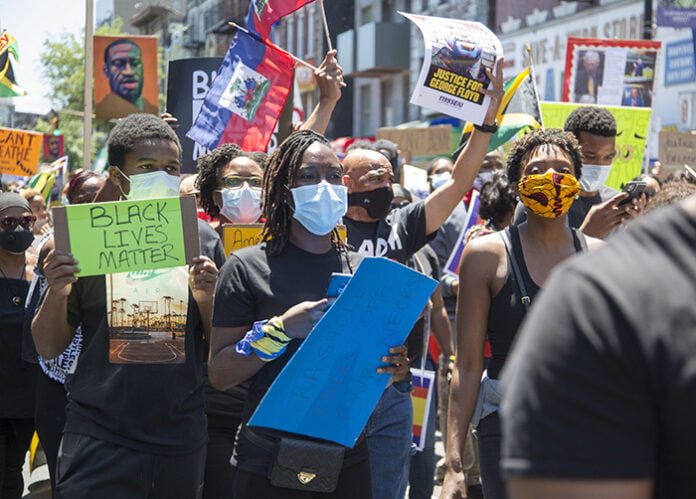
2C32WEX Marchers in the Flatbush neighborhood, predominantly African American, Caribbean & Haitian American, head towards Grand Army Plaza on the 18th day of demonstrations since the murder of George Floyd in Brooklyn, NY.
For Caribbean people, discovering what it means to be Black in the United States is a rite of passage—that perspective-shifting moment when you realize that, unlike the warm and welcoming way your loved ones see you, society sees something very different in the color of your skin. My journey to this moment was a roundabout one. Before I had the chance to become aware of what it meant to be Black and American, my parents packed up our home in New York City and moved us to Jamaica. I was just 5 years old, and my brother was 7.
Veiled Reality
In many ways, our Jamaican family life shielded us, kids, from American racism. My parents had given me an Ethiopian first name and filled our home with books and imaged by Black people. My mother bought me delicate gold chains and gasped at how lovely they looked on my skin. And when I requested a Baby Alive doll for Christmas, I didn’t get the blond-haired, blue-eyed one from the commercials. I got the brown-skinned one my father said looked beautiful, just like me.
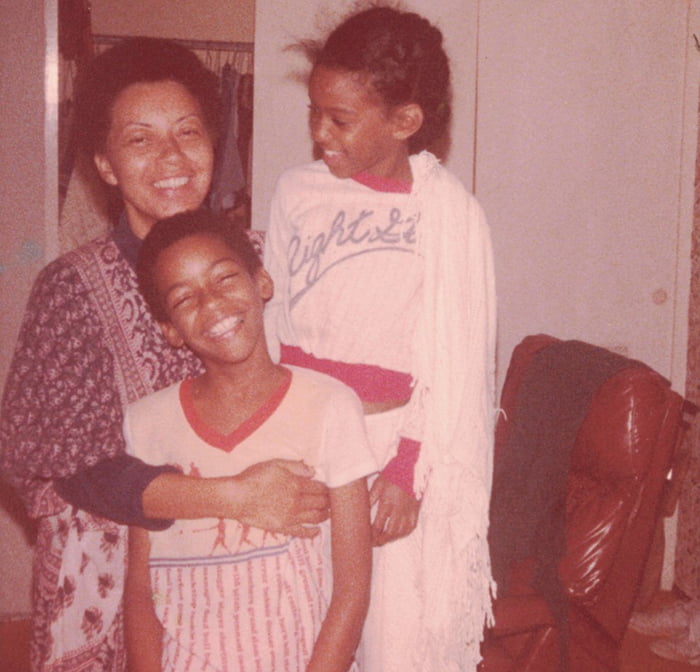
Author Ghenete “G” Wright Muir (right) pictured here with brother Richard (center) and mother Daphne Witter.
However, a form of anti-Blackness lurks as an undercurrent throughout Caribbean societies. I learned of aspersions that would be cast upon me based on the color of my skin—that my mother’s much lighter tone was celebrated here, and, contrary to what she was teaching me, my complexion was not considered as beautiful as hers. I also learned that my long wavy hair and any hair textures that departed from the tight curls of many Black people were valued more. Even so, the very fact of our Blackness did not impact our success or safety here. Every racial background was part of the melting pot, and nothing in Jamaica made me feel that being Black would disadvantage me in any material way.
But at my young age, I may not have seen the full picture. So many darker-skinned people in the West Indies do find that their skin color is an impediment to upward mobility.” Racial issues often get masked in the Caribbean as class issues, ”explained Professor Kimberley D. McKinson, an anthropologist at the City University of New York. “Why is it that the poorest in the Caribbean society are all Black, and the more [light] you get, the more socially mobile you become? Even if we mask it as uptown and downtown, these valuations of race and color are inherently mapped onto these supposedly class[-based] categories.”
Rites of Passage
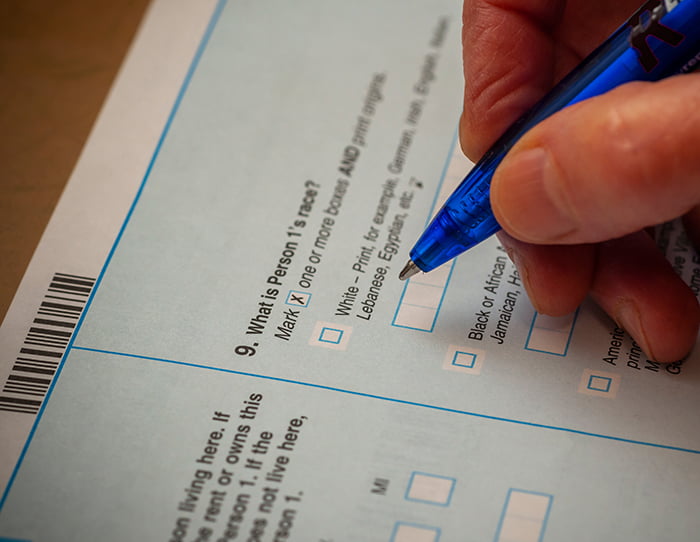
My perspective changed when I returned to live in New York City ten years later. Here, Blackness meant accepting that the faces of alleged criminals who bore my skin tone and who were assumed guilty would regularly be plastered across the nightly news shows. It meant the white lady would wind up her window as my brother crossed the street nearby. Here, Blackness, to the outsider, is dangerous. It’s something to be monitored and policed— the way my new high school registration form requesting my race did.
In the United States, applicants are often asked to specify their race, a requirement unfamiliar in the Caribbean.
These constant requests for racial categorization are another troubling Caribbean Black rite of passage. When we come to America, we are confronted with our Blackness in a culture that is consumed with race and has racism at the core of its existence.
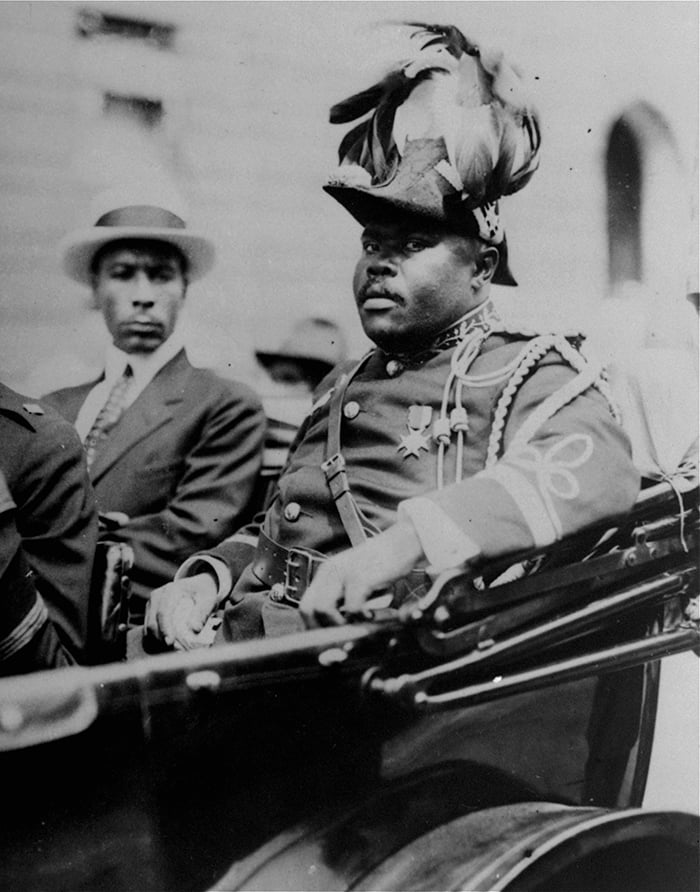
Faced with this reality, Caribbean folks have responded differently over time. In the first big wave to America in the early 20th century, island immigrants “very much understood themselves in racial terms of what it meant to Black in the U.S. politically,” explained McKinson. In response to violent mass lynchings and riots burning down Black enclaves, for safety, we rallied behind figures like the Jamaica-born Marcus Garvey, “who in the 1920s articulated and advocated for a universal notion of Blackness.”
In the early 20th century, Jamaica-born civil rights leader Marcus Garvey provided a model for Pan-African unity. Here, he leads the 1922 opening day parade for the annual convention of the Negro Peoples of the World.
By the 1980s, however, “what starts happening is a greater emphasis on ethnicity over race,” McKinson said. “What does it mean to be an ethnic immigrant? It’s to highlight ‘Oh I’m Caribbean; I celebrate Carnival. I’m Black, but I’m from Jamaica.”
Clinging to Multiculturalism
The reason for this shift is perhaps that we’re holding tightly to a little piece of Caribbean multiculturalism—that intrinsic pride we have in acknowledging the races or cultures that are a part of our heritage. “There’s much more fluid understanding of race as it’s socially constructed in the Caribbean,” McKinson said.
Some of my friends agreed. I spoke to Cheddi, who has Indian, African, and European roots. “Mi mix wid everything,” he said. “I could not be lumped into one group.”
For Ann-Marie, our Caribbean “out of many, one people” perspective feels more welcoming. She sometimes feels darker people in America discriminate against her because of her lighter skin and Asian features. “I don’t really feel as strong a connection to African-Americans as I should, mainly because they don’t accept me,” she said. “There’s an inference that I’m not really Black.”
McKinson confirmed her experience: “A big part of race and racialization is not just about how the individual identifies, but how people looking at you identify you.”
Other friends feel right at home is associated with both groups. Joan said she identifies with the Black American experience because “Whites perceive me as Black, not Jamaican.” And David said, “African-Americans are my people; we are one!”
In America, regardless of how we choose to identify ourselves, the status quo places us into one racial category that is arguably the most oppressed group in the nation. My Trinidadian friend Sandra, who embraces being a part of the African-American community, felt the stigma firsthand when she moved to the United States. “I was prepared to be labeled as Black, but I was not prepared for how everything that I said or did was devalued.”
As we struggle with navigating race in this America, we join an even greater struggle that African-Americans have endured for centuries. Whether the Civil Rights or Black Lives Matter movement, this country’s growing pains are our growing pains. At the end of the day, regardless of our ethnic backgrounds, we’re all in this together.
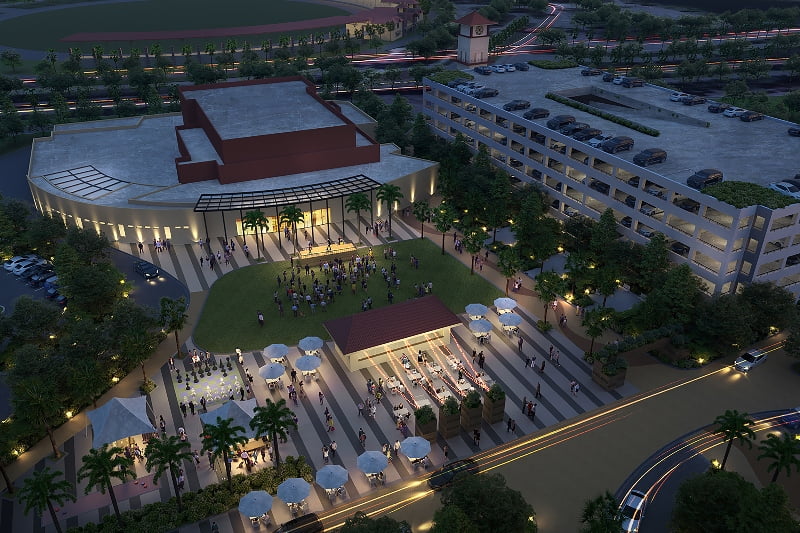
The most traveled gateway to the City of Lauderhill is about to get a major facelift thanks to new plans for an entertainment district. Initiatives including the Commercial Facade Grant Program (CFG) and the Business Improvement District are breathing new life into the city’s cultural, dining and shopping hub. As a result, civic pride and the strength of the local business community are on the rise.
At the forefront of their roster of projects is Lauderhill’s 38th Avenue Right-of-Way Improvement, a $4,000,000 undertaking. The project zone is located off SR7—the city’s main north-south thoroughfare—between 19th and 16th street. Once realized, it will become home to a number of dine-in restaurants, fashion boutiques, comedy clubs and more.
To complete the arts and entertainment district, and to create a fully immersive entertainment experience, Lauderhill plans to eventually connect this corridor to the Lauderhill Performing Arts Center (LPAC) and the Central Broward Regional Park, home of the only International Cricket Council (ICC) Stadium in North America.
With construction scheduled for completion in early 2021, the city has been actively showcasing the new developments coming to the area. Their goal is to attract prospective business owners, new residents and visitors. They also hope to enrich the sense of belonging and camaraderie in the corridor, presenting a consistent series of events for the community to enjoy.
A 320 unit apartment complex on 38th Avenue is already in development. With a full array of luxury amenities, these beautiful residential buildings called LePARC will complement the district, becoming home to working professionals and providing a pedestrian-friendly area where residents can enjoy the perks of the live/work lifestyle.
At Las Vegas Cuban Cuisine, food has always been a family business. The Vilariño family fled Cuba on the historic Mariel boatlift in 1980. By 1984, Antonio, his wife Nadia, and their five daughters proudly purchased their first restaurant in Miami.
“Because we are a large family, we have more resources and are able to get ahead faster,” says Irina, the youngest of Antonio’s daughters. She shared the inspiration behind the restaurant’s name, Las Vegas. “[It’s] what we call in Spanish a fertile land, where crops are grown. There’s usually a ‘bohío’ [shack] and a river stream that flows through it.”
Las Vegas Cuban Cuisine in Hallandale. Photo by David I Muir
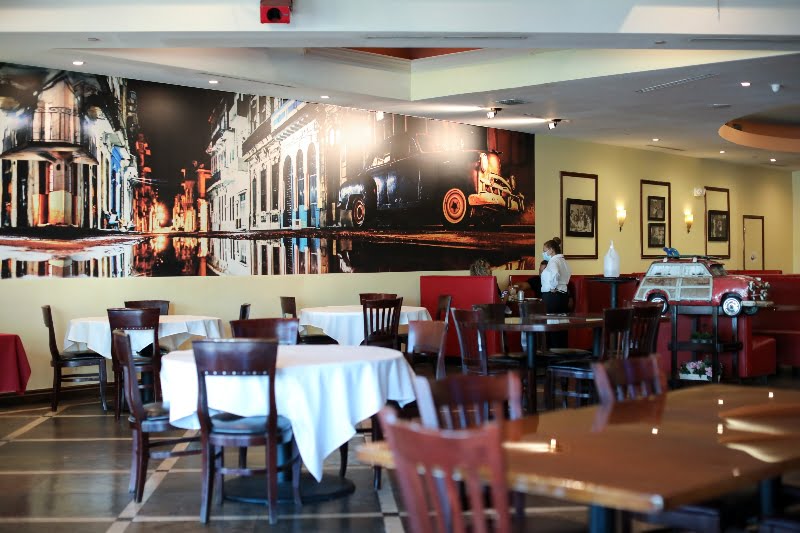
The family now owns 10 Las Vegas restaurant locations throughout South Florida. My visit to their Hallandale spot yielded an excellent dining experience. Upon entering the establishment, I was warmly greeted and offered indoor or outdoor seating. I opted to dine inside, where their large dining area featured lots of seating and island-inspired décor. Soothing romantic ballads and instrumental music washed over me as their server, Nicoll, explained my options.
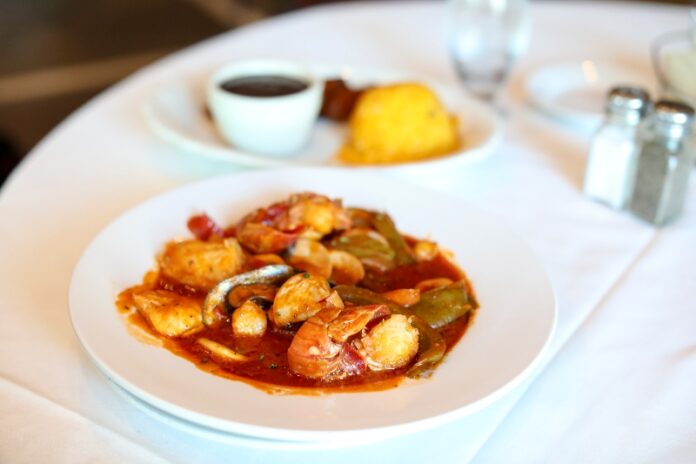
He said I couldn’t go wrong with zarzuela de marisco—a seafood medley of lobster, clams, mussels, scallops, shrimp, and fish filet. Their churrasco skirt steak or roast pork dishes would be equally essential to try. So I ordered all three!
Tamal con Lechón. Photo by David I Muir
My appetizer was the tamal con lechón, which is ground corn mash served with roast pork that is presented on a corn husk, all topped with loads of sautéed onions. The mash was a well seasoned polenta-like mixture of cornmeal and corn kernels with a fairly firm consistency. The flavor of the traditional succulent shredded pork was brightened and elevated by a simple combination of onions, garlic, and lime.
Churrasco with yuca and moro. Photo by David I Muir
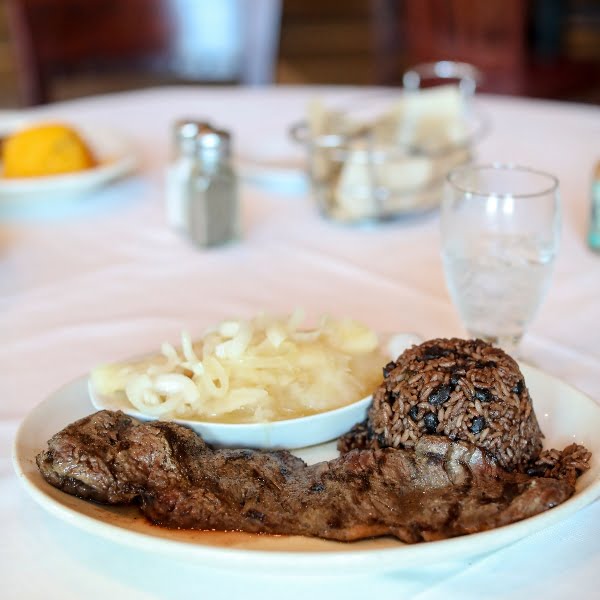
The churrasco, my first main course, was served with boiled yuca and moro, the classic black beans and rice. The grilled steak was thinly sliced, the soft yuca was slightly sweet and sat under a bed of sauteed onion. While both were tasty, their rice is a show stopper, with an array of flavors beyond words. I will single out the bay leaves as a significant contributor to my joy!
However, main course number two came along and claimed its role as the headliner of the day. The zarzuela de mariscos is delightful. The tomato-based creole sauce is filled with onions, sweet peppers, and bay leaves. The mussels, lobster tail, and fish were all tender and succulent. I know I ate too much because I didn’t want dessert until Nicoll mentioned they had guava cheesecake.
Guava cheese cake. Photo by David I Muir
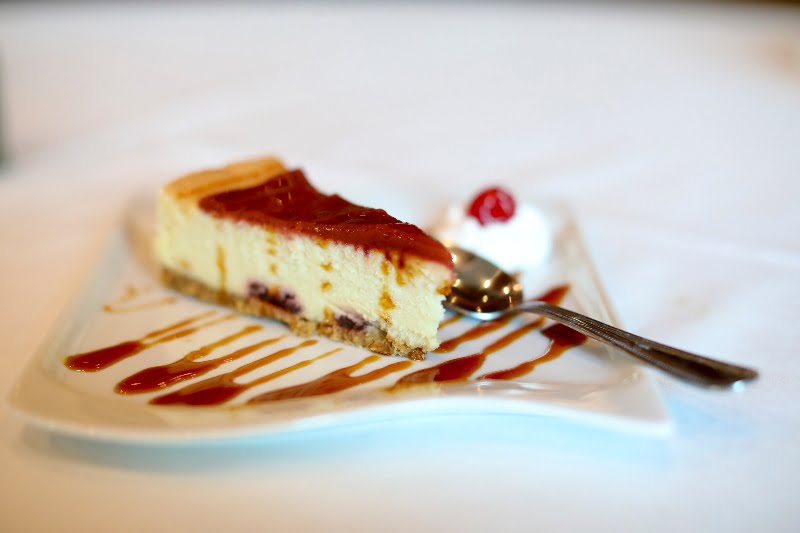
The cheesecake was sweet, delicious, and covered in guava. I’m not usually a fan of caramel, which they used to drizzle the plate for an attractive presentation. However, it couldn’t spoil my sweet tooth.
The staff at Las Vegas are warm, friendly, attentive, and a wonderful treat. The ambiance really made a difference, and the food overall outdid my expectations. The experience is an occasion worth repeating, so I can make their filete de pollo my next conquest.
Las Vegas Cuban Cuisine’s Hallandale location is at 1727 East Hallandale Beach Boulevard. They also have locations in Doral, Hollywood, Miami Beach, Fort Lauderdale, Plantation, and Pembroke Pines.
The Nueva in Lipstick red with Pink Thread embroidery from Isa Tapia. Photo: IG @isatapia
Dreaming of heading to the beach in the Caribbean? Go beyond the gift shop basics and explore the wonderful bevy of handcrafted beach accessories by a new generation of Caribbean creators. Here, we’ve gathered our favourite Caribbean Beach Accessories, who combine traditional craftsmanship with loads of style. All are shoppable online, so stock up for a truly authentic experience.
The perfect day at the beach requires plenty of additional accessories and goodies, from towels to snacks. Bring it all in a stunning tote to boot, like this on from Belize-based brand Maya Bags. Each design offers a modern take on traditional Mayan craftsmanship, handmade by artisans. Made with linen and durable leather, their popular Jewel tote features crocket stitching.
This is not your granny’s fanny pack. Leave the heavy lifting at home and carry just the essentials with this chic Vavvone Dias belt bag by Haitian designer Valerie Blaise. The design features an adjustable strap, so you can wear it around the waist or cross-body for hands-free ease. The fringe style features flattering hues, from sleek black to sunny yellow.
Ditch the basic flip flops for something prettier underfoot. Instead, we love these stylish slides by Puerto Rican-born designer Isa Tapia. Her designs always feel flirty and fun, full of feminine details like hearts, lace, and dainty bows. Fine materials include kid leather, soft denim, and fresh linen, make her styles always easy to wear.
Sun protection never looked so stylish. Keep the rays away with these classic Panama hats made by the Puerto Rican menswear brand, Boronea. Inspired by the Caribbean lifestyle, each hat is handwoven with high quality, natural Carludovica Palmata straw for lightweight wear. Customize your own look, from the brim width to the band colour.


























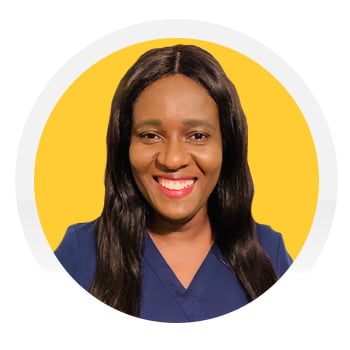 Andrea Munroe Dixon has seen firsthand how the disease can sully the most basic comforts for those in recovery. The simple act of eating, for example, can feel discouraging when you’ve lost your sense of smell and taste—one of the confirmed symptoms of the virus. “I remembered meeting an elderly Jamaican woman who I encouraged to eat anyway,” Dixon said. A positive attitude is always a powerful key to healing, so she told her to “think about it as medicine more than food.” She took time out from running her home care company to return to her roots as a registered nurse, volunteering in COVID-19 treatment wards in STATE.