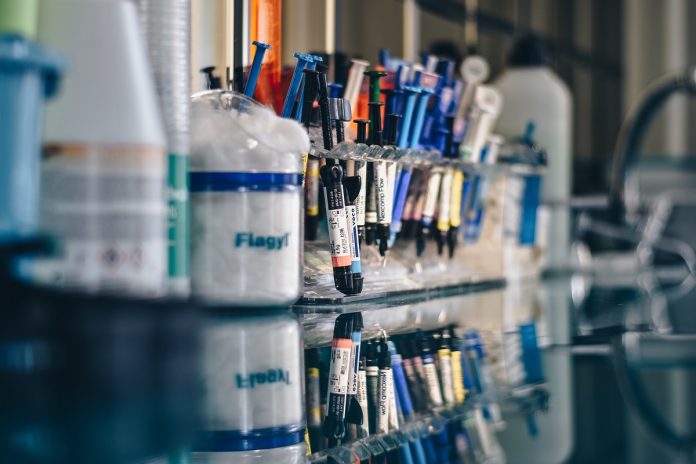
Fort Lauderdale, Florida – Broward Health will donate $250,000 worth of PPE and medical supplies to support earthquake relief efforts in Haiti this Thursday, October 7. About 60 pallets of supplies, including face masks, surgical gloves, ponchos, and other items that can be used for health care, COVID mitigation and preservation of health and wellness, will be shared with Man Dodo and the Haitian American Nurses Association for distribution of medical supplies for Haiti.
WHAT: About 60 pallets of supplies worth $250,000 to be donated by Broward Health to Man Dodo and the Haitian American Nurses Association to support their Haiti earthquake relief efforts.
B-roll from within warehouse to be provided; immediately following press conference, media can capture B-roll of truck being loaded outside.
WHEN: Thursday, October 7, 2021, at 10:30 a.m.
WHERE: Broward Health Headquarters, 1700 NW 49th St., Fort Lauderdale, FL 33309
Press to be held in the Board Room in the 1700 building.
WHO:
Shane Strum, President/CEO, Broward Health
Jorge Hernandez, Vice President of Supply Chain/Chief Procurement Officer, Broward Health (English/Spanish)
Ed Lozama, Man Dodo
Rose Valcin, President, Haitian American Nurses Association (English/Creole)
State Representative Marie Paule Woodson (English/Creole)
WHY: On August 14, 2021, Haiti experienced a magnitude 7.2 earthquake in the western Tiburon Peninsula, a region already experiencing a more than 75% poverty rate. The earthquake left tens of thousands injured and homeless. Almost two months later, more than 800,000 Haitians continue to experience lack of shelter, food/water insecurities and emergency healthcare per the Center for Disaster Philanthropy.
About Broward Health
Broward Health, providing service for more than 80 years, is a nationally recognized system in South Florida that offers world-class healthcare to all. The Broward Health system includes the statutory teaching hospital Broward Health Medical Center, Broward Health North, Broward Health Imperial Point, Broward Health Coral Springs, Salah Foundation Children’s Hospital, Broward Health Weston, Broward Health Community Health Services, Broward Health Physician Group, Broward Health Urgent Care, Broward Health International, and Broward Health Foundation. For more information, visit BrowardHealth.org.The mission of Broward Health is to provide quality health care to the people we serve and support the needs of all physicians and employees.
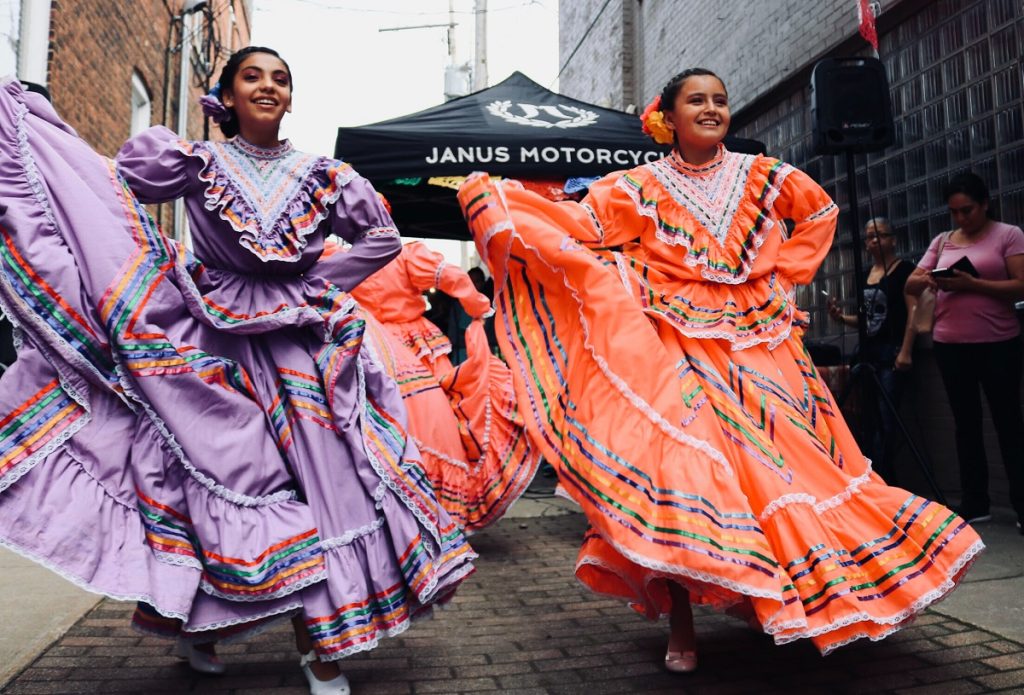
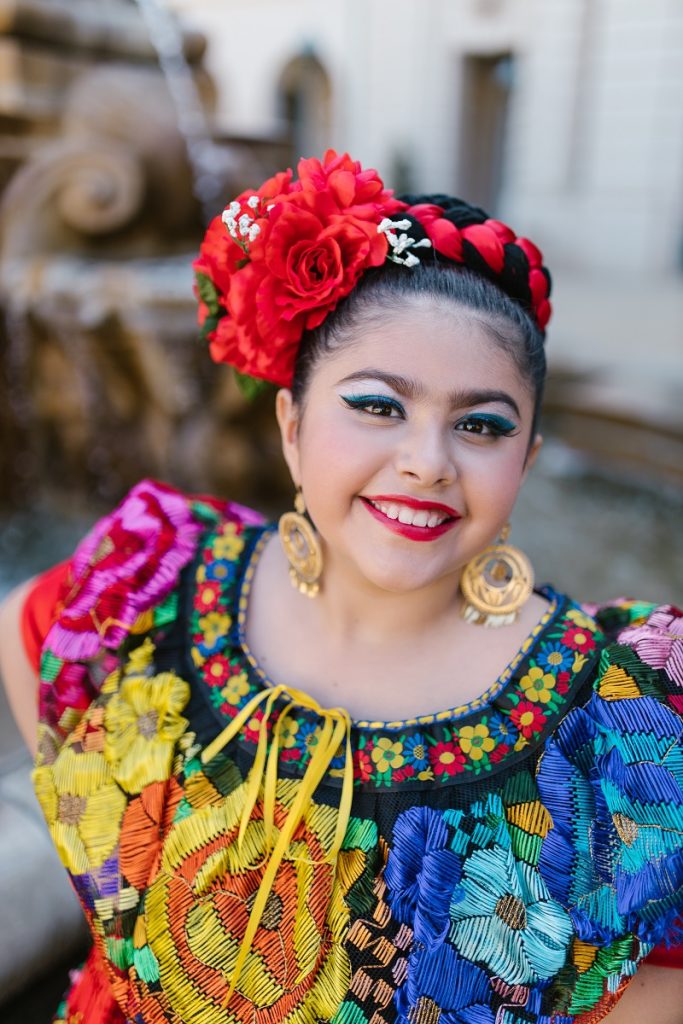
Each year, the Latin community looks forward to Hispanic Heritage Month to commemorate and recognize Latin countries’ freedom from Spain and the cultural milestones they have made since. Observed from September 15 to October 15, the month-long celebration represents when many Latin countries gained independence, a majority on September 15.
First enacted in America as a week-long celebration in 1968 by President Lyndon Johnson, Hispanic Heritage Month was later expanded into a month-long observation by President Ronald Reagan in 1988. Florida and New York remain among the top four states with large Hispanic populations in the U.S., but now, even countries that don’t have a large influx of Latin populations acknowledge Hispanic Heritage Month with celebrations around the world.
The U.S., which is home to nearly 60 million Hispanic Americans, can expect to see people celebrating annually with parades, flags, colorful displays and, of course, lots of traditional foods.
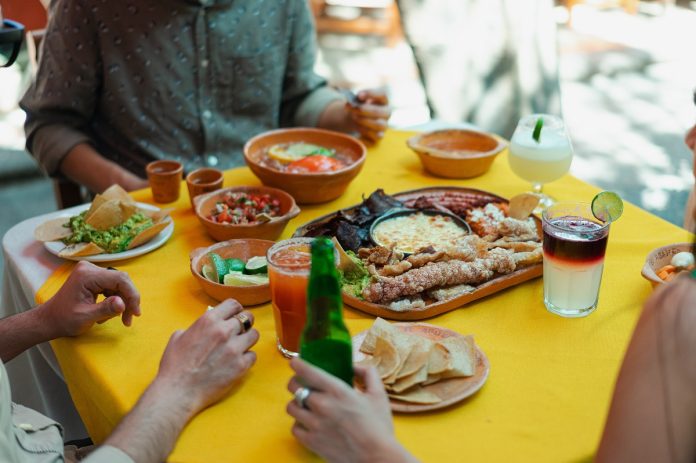
Unlike language and religion that can often be culture-bound, food is a uniting element that knows no barriers. It can connect us to places around the world we might not otherwise experience or make us feel a sense of home simply from the aroma of a specific ingredient. During Hispanic Heritage Month, food is also used as a center of celebration. Latin-Caribbean food expresses culture, reflecting a deep history of Indigenous influence, as well as a multicultural fusion of spices, herbs and flavors brought to the islands from all around the world.
Celebrate and indulge in Latin-Caribbean culture and an exploration of authentic cuisine with these unique Hispanic Heritage Month recipes.
Cuba
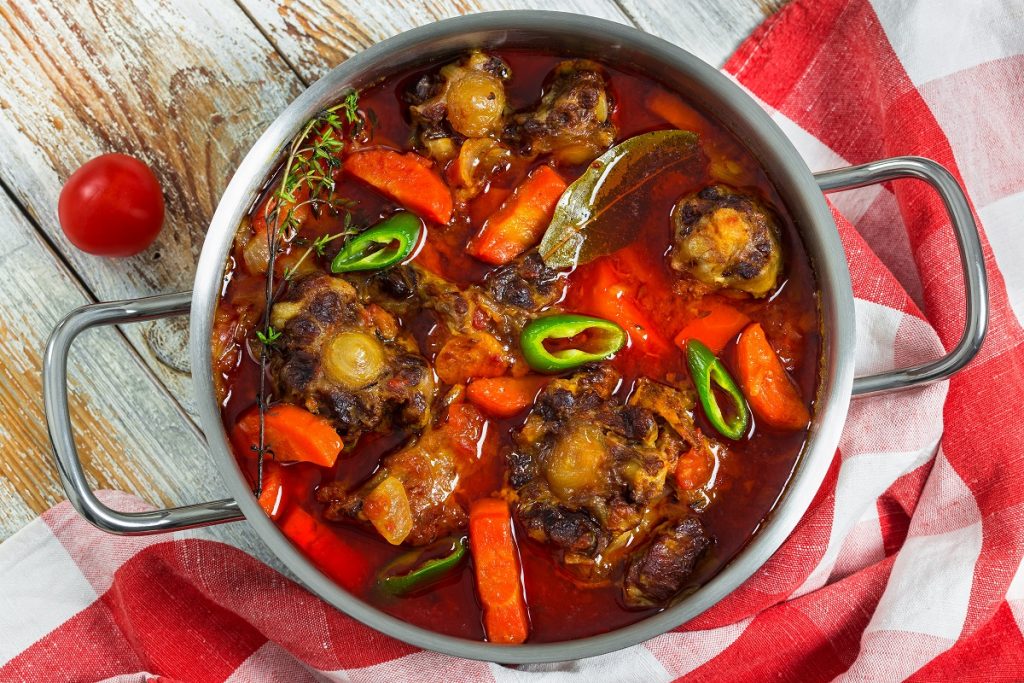
Cuba is the largest spanish-speaking island in the Caribbean, and Cuban cuisine has a heavy Spanish, African and Indigenous Taíno influence. Though ropa vieja (shredded beef with rice) and tostones (twice-fried plantain slices) might be the first that come to mind when thinking of Cuban dishes, there are some delicious lesser-known authentic recipes you will want to keep bookmarked. Like Rabo Encendidio, a savory dish that brings distinct Cuban flavor to a Caribbean classic.
Rabo Encendido – Cuban Oxtail Stew
What you need:
4 pounds oxtail
4 garlic cloves
2 onions, dinced
1 teaspoon ground cumin
1 teaspoon ground oregano
8 ounces tomato sauce
1/2 Scotch bonnet pepper
3 large carrots
7 ounces pimientos morrones (bell peppers)
3 bay leaves
7 ounces of white wine
3 ounces of water
Black pepper
Salt
3 tablespoons of oil
1 bottle of Spanish red wine
What to do:
Trim the oxtail and season with salt and pepper.
Preheat oven to 350 degrees Fahrenheit. Add oil to a cast iron skillet and place on medium high heat on the stove. Add the oxtail, making sure to sear all sides. Once seared, transfer meat to a separate bowl and set aside.
In a separate pan or skillet, saute onions, pimientos morrones (bell peppers), Scotch bonnet pepper and carrots. Add in garlic, salt, pepper, cumin and oregano, stirring to combine. Cook for about 10 minutes.
Pour in the tomato sauce, red wine and bay leaves, stirring to combine.
Transfer oxtail back to the cast iron skillet. Cover and bake for 4 hours.
Sprinkle with parsley, serve with congrí (mixed rice and black beans) and enjoy!
Puerto Rico
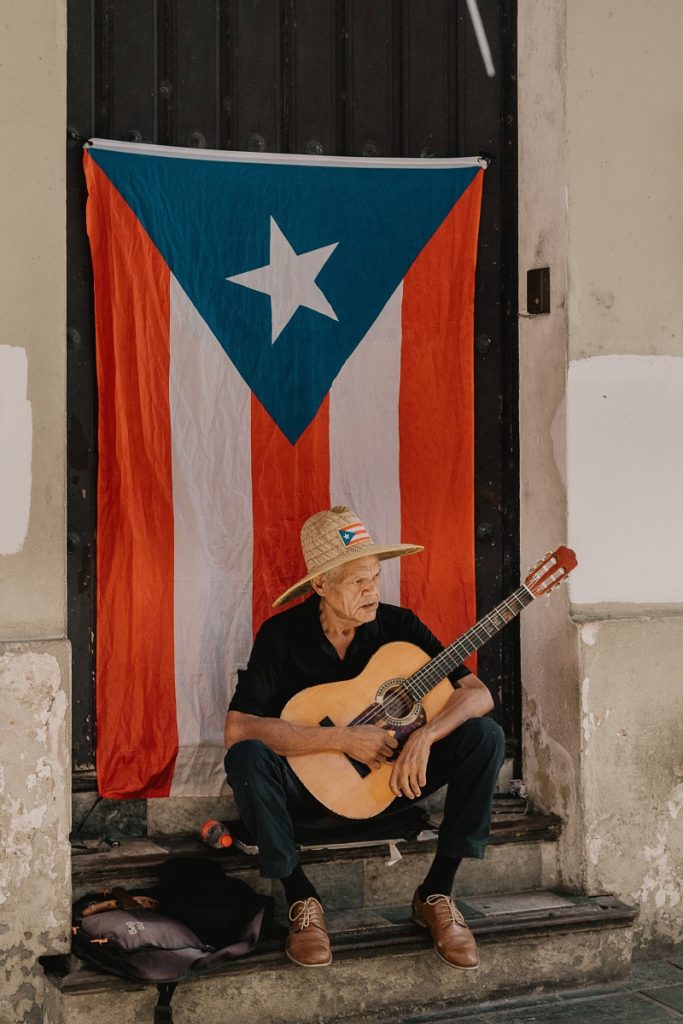
As a colony under Spain’s rule for over 400 years, Puerto Rico’s fare has an overwhelming Spanish influence, though some African and Indigenous ingredients are still at its core. Shortly after Puerto Rico gained independence from Spain in 1897, the island ceded to the United States, becoming a colony the following year and a U.S. territory nearly 20 years later in 1917. As such, Puerto Rican cuisine gained some North American influence, particularly in terms of how meals were cooked, like using locally sourced corn oil for frying delicious, crispy snacks and sides.
While you’ll definitely want to enjoy traditional mofongo (fried plantains), empanadas and arroz con gandules (rice with pigeon peas), bring an extra homestyle inspired dish to your Hispanic Heritage Month party with these stuffed green banana fritters.
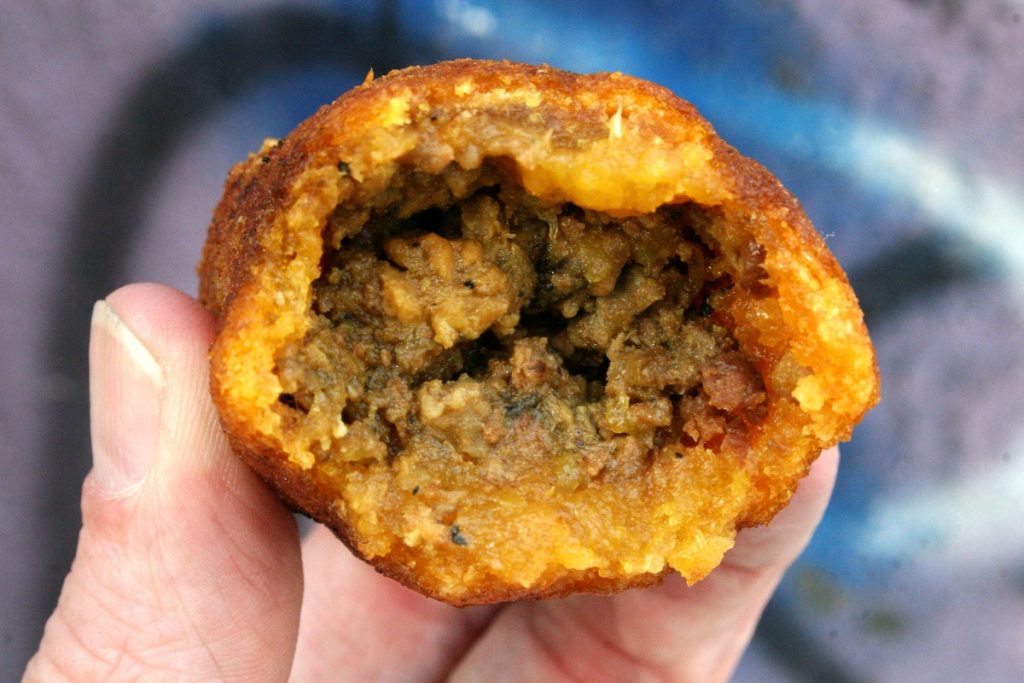
Alcapurria – Meat Stuffed Green Banana and Taro Root Fritter
Photo credit: Badagnani
What you need
For the dough:
6 green bananas
2 pounds taro root
Sazon Culantro/Achiote packet
1 ½ teaspoon salt
1 tablespoon oil
2 tablespoon butter
2 cups corn oil, for frying
For the filling:
1 pound beef, ground
2 tablespoons olive oil
1 teaspoon of salt
Pinch of black pepper
½ teaspoon dried oregano
1 onion, chopped
10 pimentos
What to do
For the dough:
Peel the skin from the green bananas and clean the taro root using a peeler to remove skin.
Put the green bananas and taro root in a large bowl filled with salted water and let sit.
Remove the green bananas and taro root from the salt water and add to a food processor, pureeing until smooth and a dough forms.
Transfer the dough to a bowl, add the Sazon packet, salt, oil and butter and mix. Cover and refrigerate overnight.
For the filling:
Place a pan on the stove and place on high heat. Add olive oil and saute the chopped onion. Once the onion is softened, add in the pimentos.
Add the ground beef with salt, pepper and oregano and brown, stirring continuously.
Once all cooked, add to a glass bowl.
Making the fritters:
Heat a deep fat fryer with corn oil to 375 degrees.
Using your chilled dough that sat overnight, scoop ⅓ cup portions out onto a pan brushed with vegetable oil so they don’t stick. Flatten the dough balls until a thin circular shape is formed.
Scoop 2 tablespoons of the meat into the middle and roll until up. Before rolling completely to the end, fold in the sides, roll the rest of the patty and pinch the ends so they are sealed.
Using a metal skimmer, place the formed fritters into the oil and fry until golden and crispy, about 7 minutes. Drain excess oil from the fritters using paper towels.
Eat alone or pair with your favorite Puerto Rican dipping sauce and enjoy!
Dominican Republic
The Dominican Republic’s major culinary roots stem from Europe, Africa and the Indigenous Taíno inhabiting the Greater Antilles. Many traditions here revolve around tasty, home cooked dishes and sweets with recipes that have been in the family for multiple generations, so for your Hispanic Heritage Month celebrations, make sure to check out all the desserts the DR has to offer.
If you’ve got a bit of a sweet tooth, you’re probably familiar with indulgent Dulce de leche (Dominican caramel sauce), but if you’re looking for a deep-rooted Dominican Republic dessert that will “wow,” add this unusual treat to your Hispanic Heritage Month menu. Noted as one of the most popular Dominican desserts, this strange combinations of ingredients create a nostalgic, sweet and creamy spice flavor that is enjoyed by family and friends as a special dish during Lent.
Habichuelas con Dulce – Sweet Cream of Beans
What you need:
4 cup red kidney beans, boiled
6 cup water, from boiling the beans
½ pound batata (sweet potato), cubed
2 ½ cups coconut milk
3 ½ cups evaporated milk
1 cup sugar
1 ½ teaspoons vanilla extract
2 cinnamon sticks
8 cloves
½ cup raisins
¼ teaspoon of salt
What to do:
Soak beans overnight the night before. Then, boil the beans on high for about 90 minutes, or until they are completely soft.
Strain the beans, reserving the water they boiled in, and add both the beans and water to a blender. Puree and strain again.
Add beans, coconut milk and evaporated milk to a pot on low-medium heat and simmer.
Stir in the sugar, vanilla extract, cinnamon, cloves and salt.
Add diced sweet potatoes into the pot and continue simmering until soft.
Stir in the raisins and cook for 8 minutes. Remove the cinnamon sticks and cloves, then simmer for another 2 minutes, mashing down the sweet potatoes as you stir.
Remove from heat and let cool. Once the mixture is no longer warm, chill in the refrigerator.
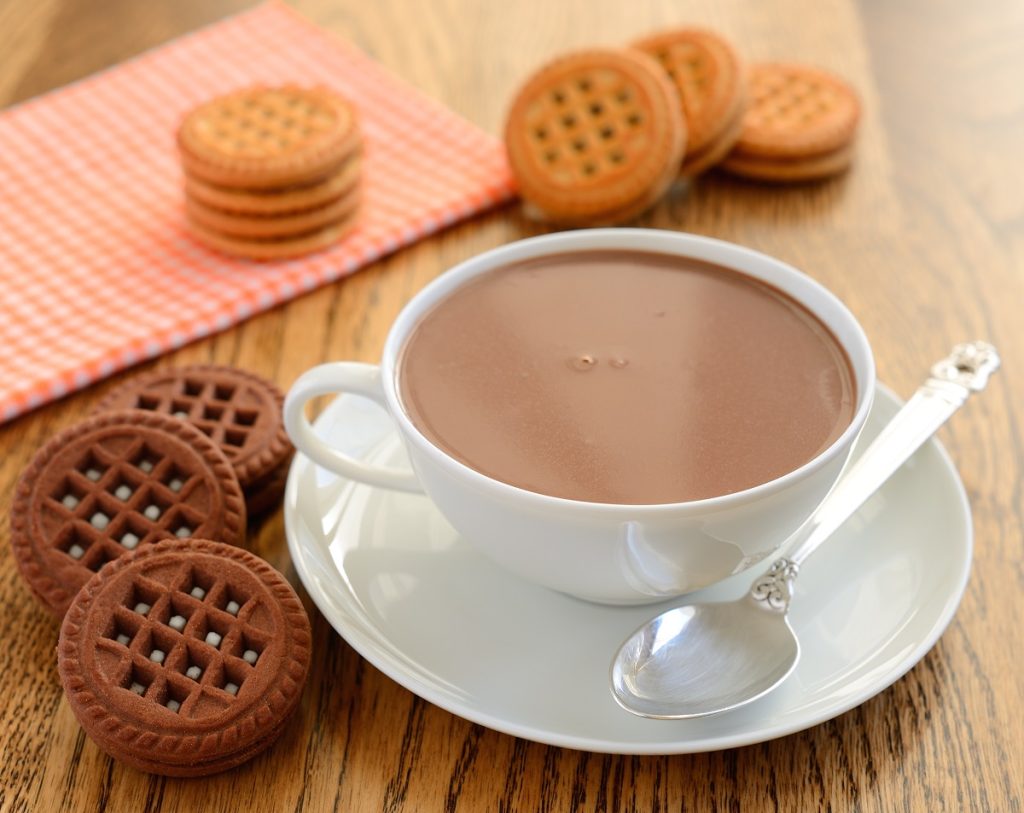
Pour a serving into a cup or bowl, add Dominican milk cookies and enjoy!
What You Need to Know About the #1 Cause of Cancer Deaths Among Caribbean Women
There are pink ribbons everywhere around this time of year. October is Breast Cancer Awareness Month, and during this period, allies show solidarity for those who have experienced loss or recovered victorious from breast cancer by wearing pink. Organizations are hosting activities that educate the general public on how this disease is affecting women and what can be done about it. When it comes to breast cancer in Caribbean women, the statistics are quite shocking.
Trends and Causes
From 2003-2013, in 21 out of 23 Caribbean territories, breast cancer was the number one cause of cancer deaths among Caribbean women. Today, the French territory of Martinique ranks highest in reports of breast cancer incidences, while Barbados has the highest mortality rate. Haiti, despite its many social challenges, has the record for the lowest breast cancer incidence and mortality rates of the region.
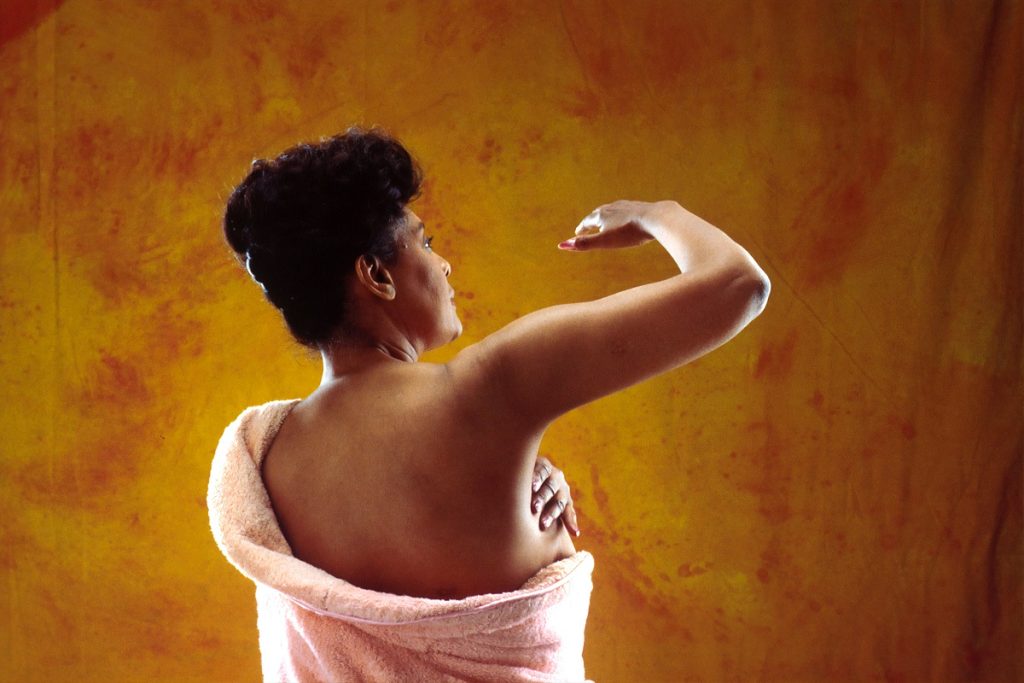
A woman checks herself for breast lumps indicating cancer.
There are many things that cause breast cancer to form. Research shows that the risk of breast cancer diagnosis increases with age and family history, previous diagnosis, a previous benign breast lump, insufficient exercise and excessive use of alcohol and smoking.
Obesity can also increase the risk of developing breast cancer, especially when the majority of weight gain happens around the stomach. Modern diets tend to contain sugary and oily foods, versus traditional Caribbean cuisine prepared from ground provisions, fruits and vegetables. Lifestyle changes and dietary changes have impacted women’s health overall. Many Caribbean women love a Carnival and good party but are not aware that abundant alcohol and cigarette consumption at these events wildly increases their chances of developing breast cancer.
Detection and Care
Breast cancer is a malignant tumor that starts in the cells of the breast. Painless, hard lumps inside the breast are the most common indicators that something is wrong, though sometimes the breast can be tender with soft, rounded masses. There can also be swelling or changes in the skin’s texture and color, but at other times there are no signs at all. That is why monthly breast self-exams and the recommended annual mammogram after age 40 are key to targeting the presence of cancer. Early detection and treatment have proven effective in reducing patient mortality.
Differences in health care across the Caribbean region have affected what treatments are available to women throughout. Surgery remains the leading choice for treatment. Chemotherapy, hormone therapy, medicinal plants, and in many instances a combination of those treatments are options as well. But on the horizon are new offerings of natural medicine. In the twin-island republic of Trinidad and Tobago, a study identified fifty-five herbal remedies, supplements, and functional foods that women tapped into for their healing properties, including soursop, wheatgrass, saffron, aloe vera, garlic, and ginger. These were used both as standalone and complements to ongoing medical treatment.
Our health is our wealth. Through education, screening, early detection, and accurate diagnosis, the mortality numbers associated with breast cancer in the Caribbean can be decreased and treated successfully.
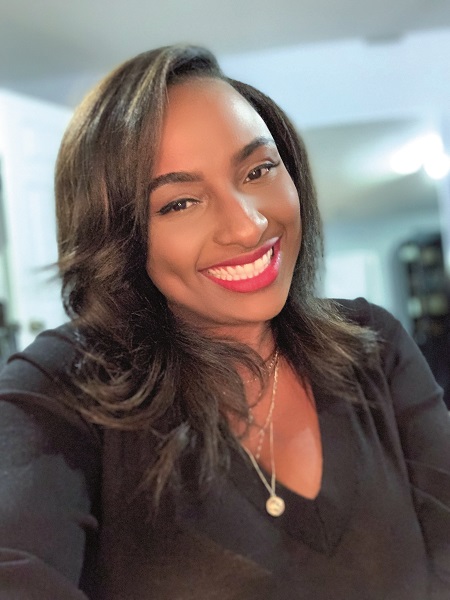
After finally getting the keys to her first house, Moniefia Johnson was left with a question: “How do I make this space a home?”
Through trial and error, she uncovered simple home design ideas that make amazing impact — a delicate blend of style, functionality and self-expression to make your space beautiful, approachable and, above all, personal. Through the experience, Johnson discovered a passion for interior design, soon launching her firm, Lignum and Oaks Interior Design, to help others create spaces that feel like home.
Based in New Jersey, she now consults professionally for in-person clients in the tri-state area and virtual clients online. Johnson still sees her home as a creative playground, using her rooms and walls as canvases for experimenting with her craft. Her home’s style is never permanent. She changes couches, chairs, rugs and accent pieces on a monthly basis.
“When I get to a point where I love it, I try not to become comfortable, and push myself to the next step,” she explains. “How can we make this design better? How can we elevate? How can we change it into a different style? That gives me the ability to be more versatile.”
The Jamaica-born designer aims to add a pop of “wow” — think grand chandeliers or a 7-foot mirror — to every space. “When something is unexpected, the unknown becomes interesting,” she says. In our conversation, we explore the inspiration behind Johnson’s current iteration of home and she even reveals her secret to good design.
Heart Of The Home
Courtesy of Moniefia Johnson
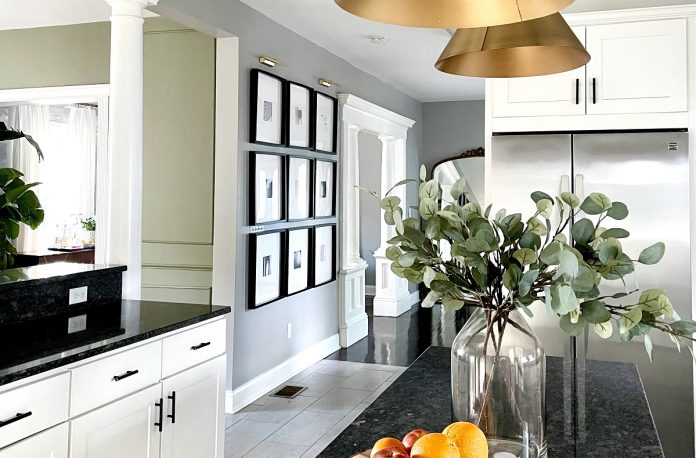
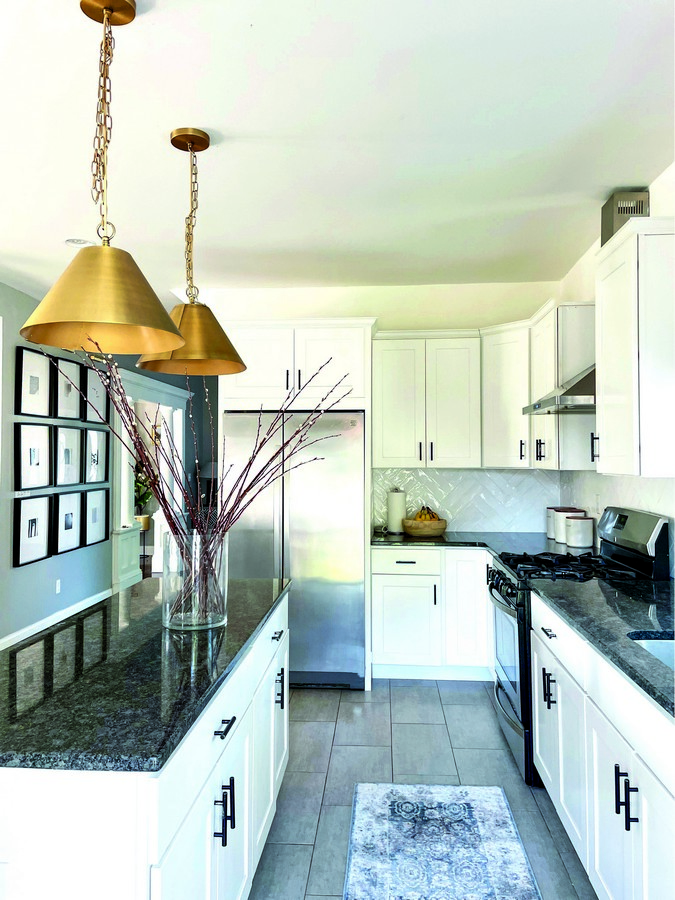
Though kitchens are the heart of the home, they are often lacking in square footage. Johnson’s advice is that you can still create the kitchen of your dreams with the right seating, accessories and lighting. “You want to create a space where it’s functional for you to cook, but it’s also where your family can congregate,” she says. She suggests warm-toned lights for a cozy vibe. In her own home, Johnson chose to go with white cabinets and dark countertops, adding in textured elements like wooden accent bowls and brass pendant lights from Target’s Studio McGee collaboration.
Center Of Attention
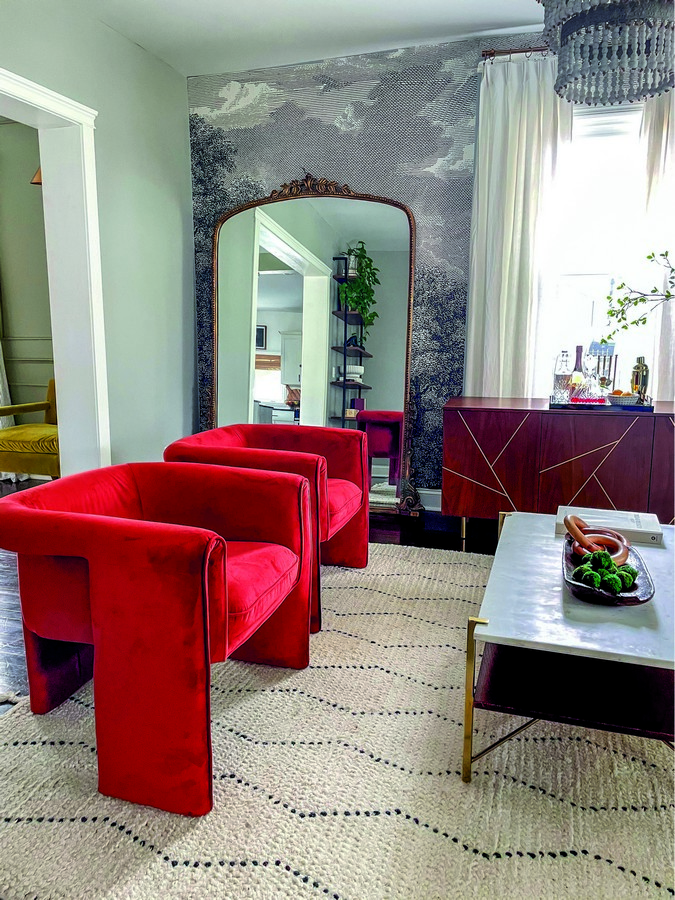
Johnson has an affinity for creating living rooms that reflect her clients’ personalities. In her own home, she showcases her love of color and eclectic design with delicate Etched Arcadia Mural wallpaper from Anthropologie and twin terracotta Floria velvet chairs from Urban Outfitters. A zigzagged walnut-and-brass Dustin cabinet from World Market is the centerpiece of the room, while an off-centered, 7-foot Gleaming Primrose mirror from Anthropologie reflects light into the beautiful space.
Courtesy of Moniefia Johnson
Cozy Corner
In contrast to the living room, the TV room is meant to feel a little more lived-in ― a space where friends and family can casually gather. “That’s where we hide all the junk and where there’s popcorn in the sofa,” she laughs. But less formality doesn’t mean less style. She created a bold statement with deep blue walls, a pink Leonelle sofa from Anthropologie, a contrasting throw pillow and a beaded chandelier. Approachability is high on Johnson’s list of qualities for the rooms she designs. “I think it’s essential to have beautiful spaces, but I’m happiest when I’m told, ‘We love it, we use it every day.’”
Serene Green
Courtesy of Moniefia Johnson
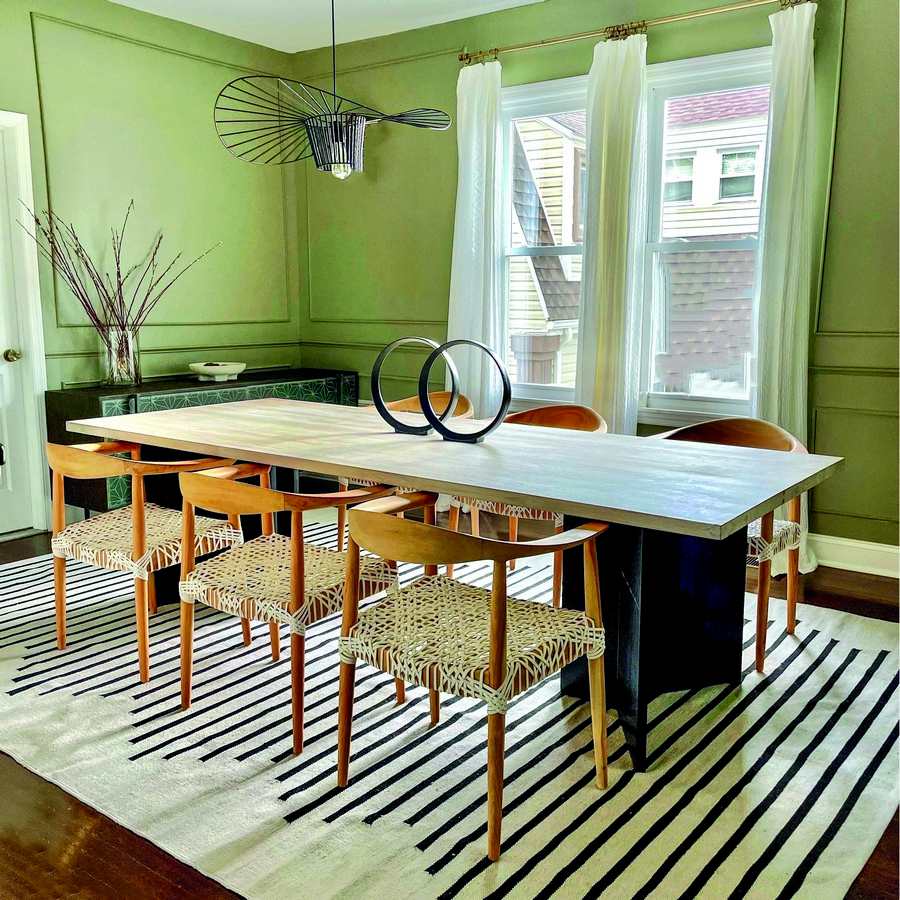
The color green often shows up when Johnson is working with natural palettes. Muted Sage by Behr on the walls brings a sense of calm to the dining room, where she also installed some picture-frame wall moulding to introduce more dimension to the space. The dining set is a playful mix of pieces, with a CB2 Mariana whitewashed teak dining table surrounded by Safavieh Bandelier oak armchairs. Another stunning floor-length Primrose mirror sits in the corner as a focal point.
No Empty Spaces
Courtesy of Moniefia Johnson
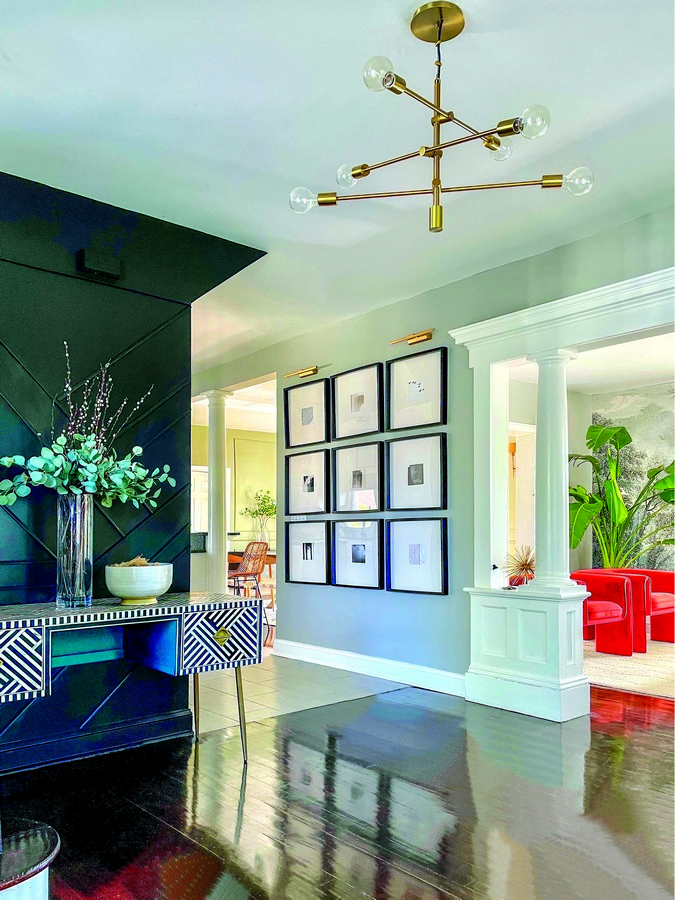
For Johnson, a hallway is never simply a basic passage from one room to the next —even walkways should have their own personality. In hers, Johnson installed a wall of portraits. “It’s especially important in the hallway to create vignettes everywhere. It’s this point of interest that gives a glimpse into what’s potentially next,” she says. In another corner, she created an asymmetrically paneled wall in a matte black finish, paired with a velvet yellow armchair. Giving attention to these overlooked spaces is an essential secret to good design.
Outdoor Oasis
Courtesy of Moniefia Johnson
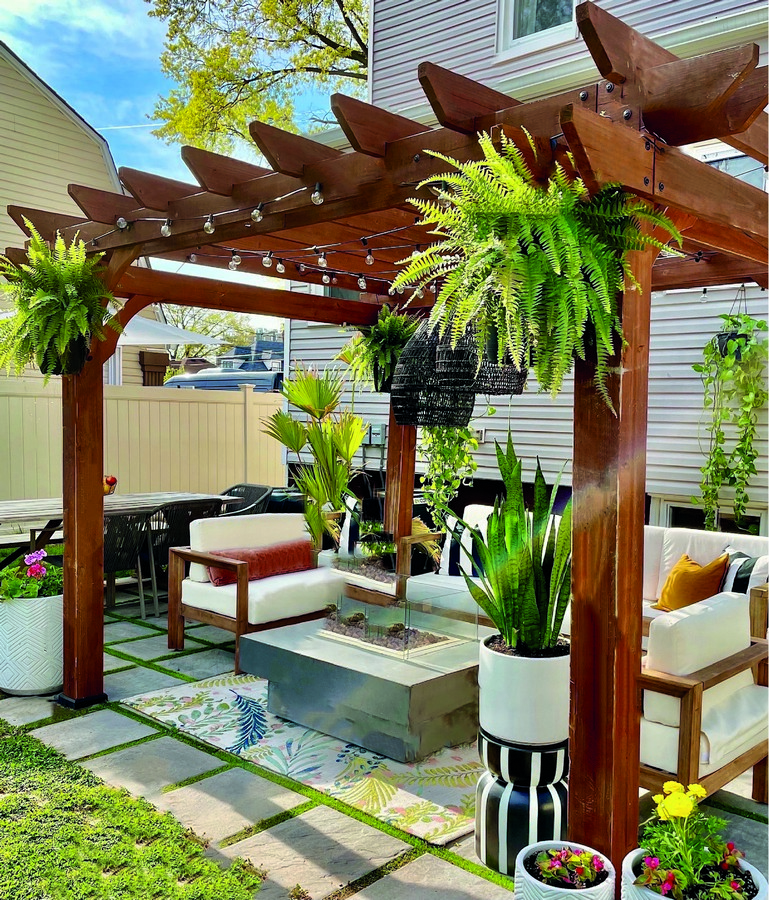
Many people tend to think only of interiors when designing their homes, rarely carrying aesthetic ideals into outdoor spaces. “I think the outdoor space should always be an extension of your home and not just a separate space where we hang out, so I created almost a mirror layout, like I did the inside, with a large sofa and two armchairs,” said Johnson. Her outdoor patio, outfitted with furniture from Wayfair, is perfect for both laying in the sun and barbecuing the night away.
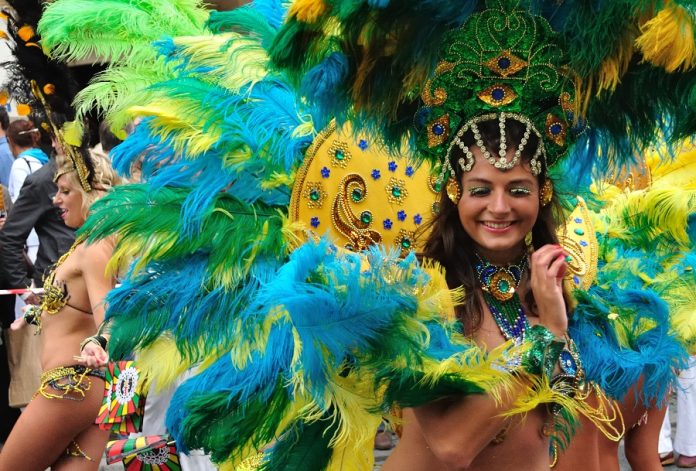
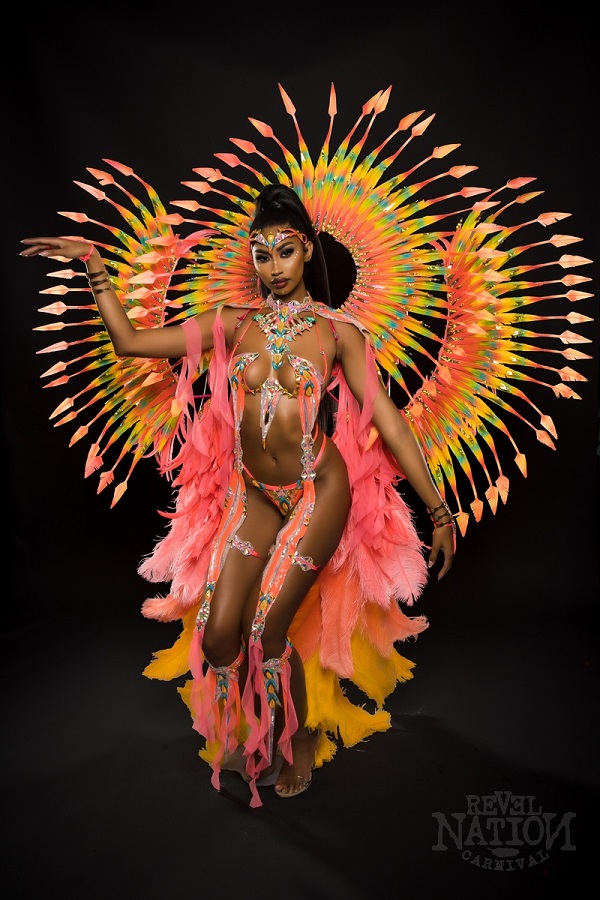
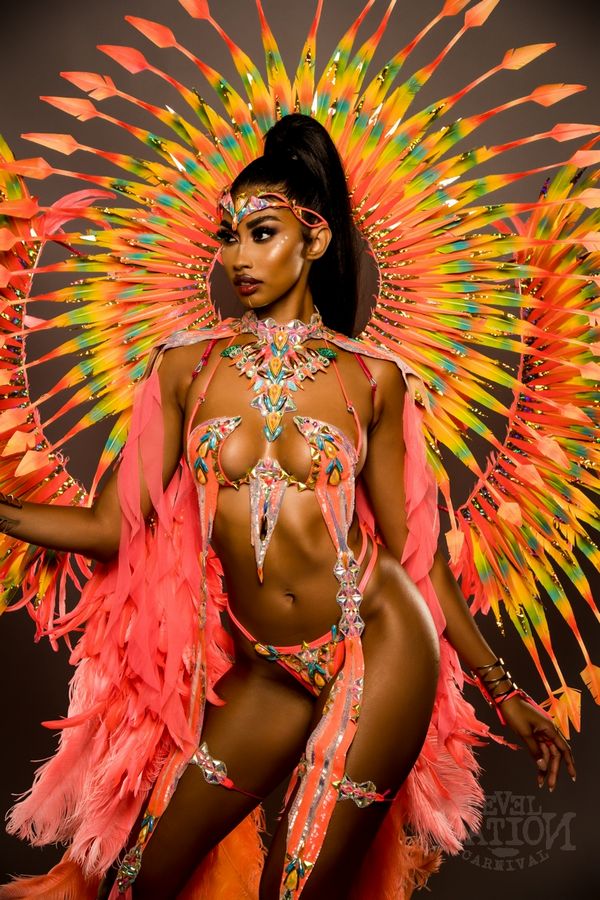
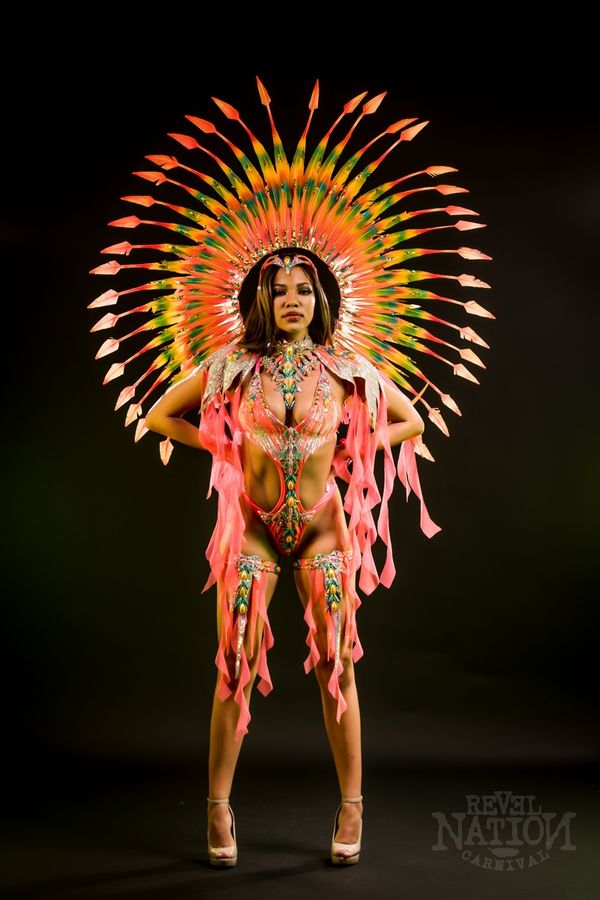
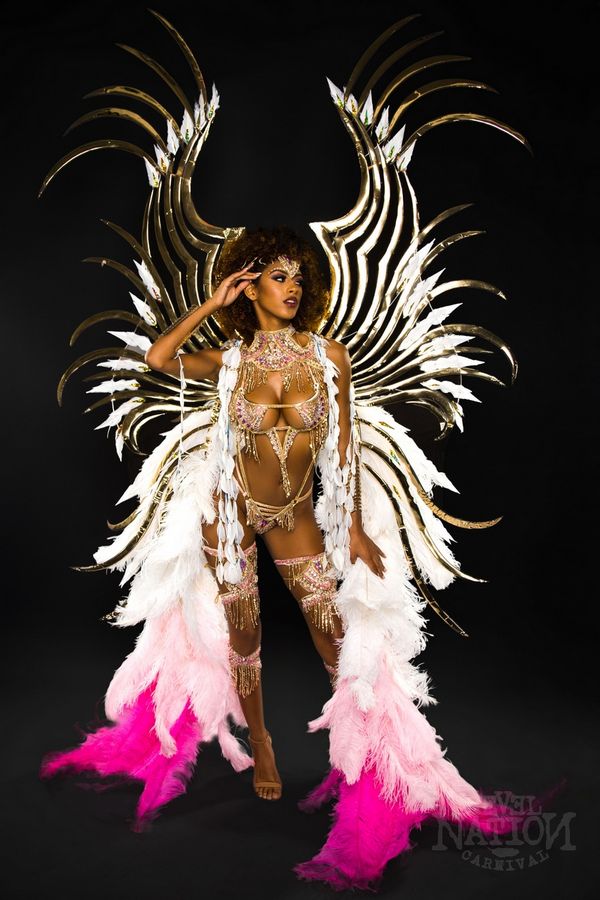
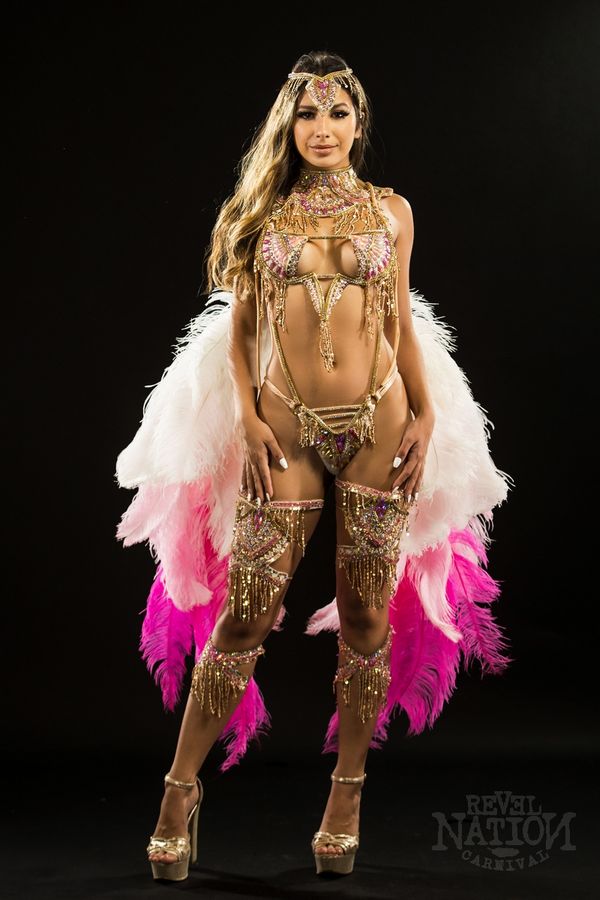
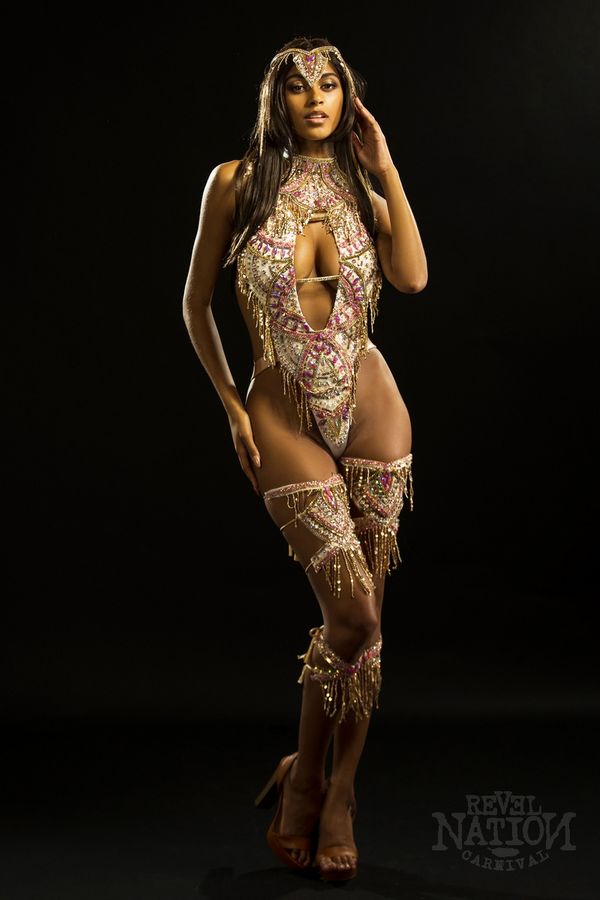
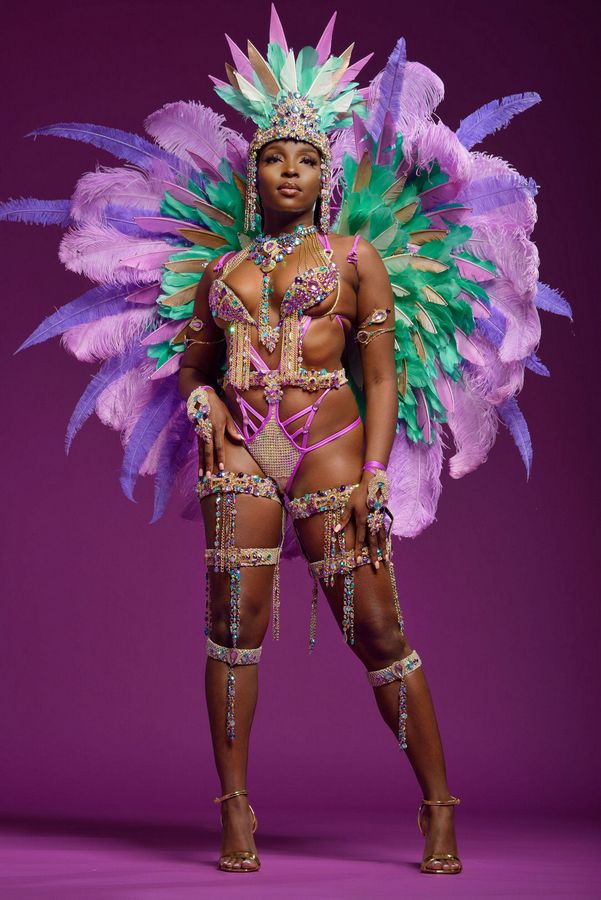
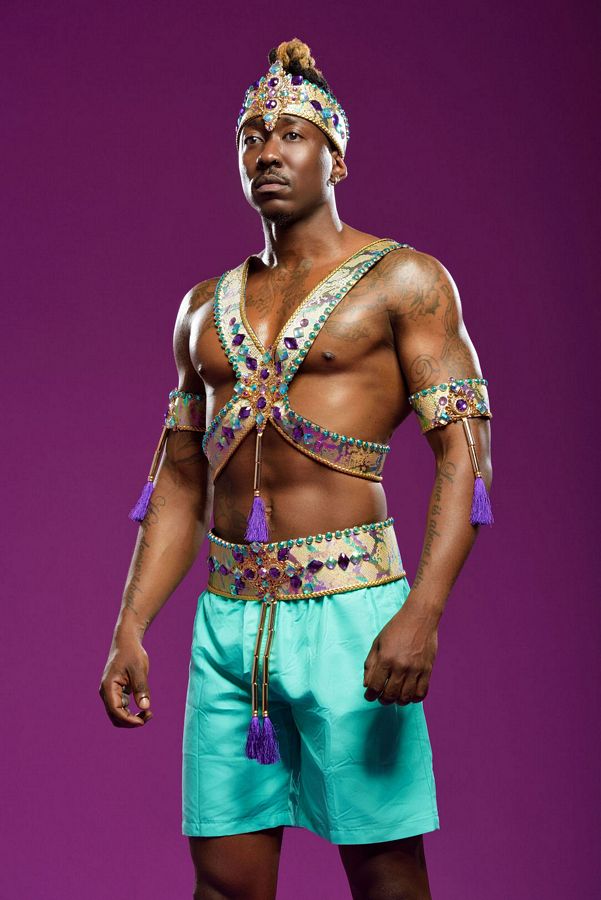
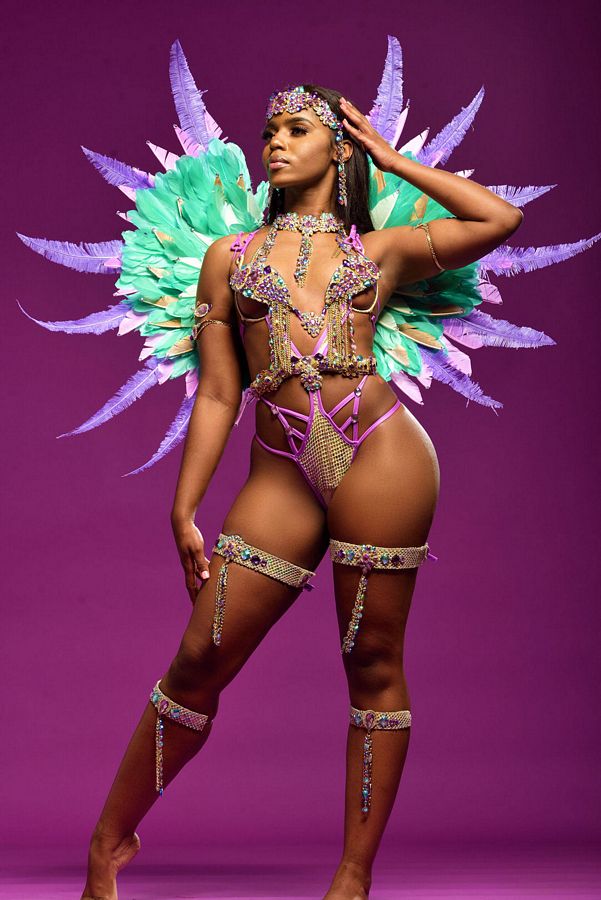
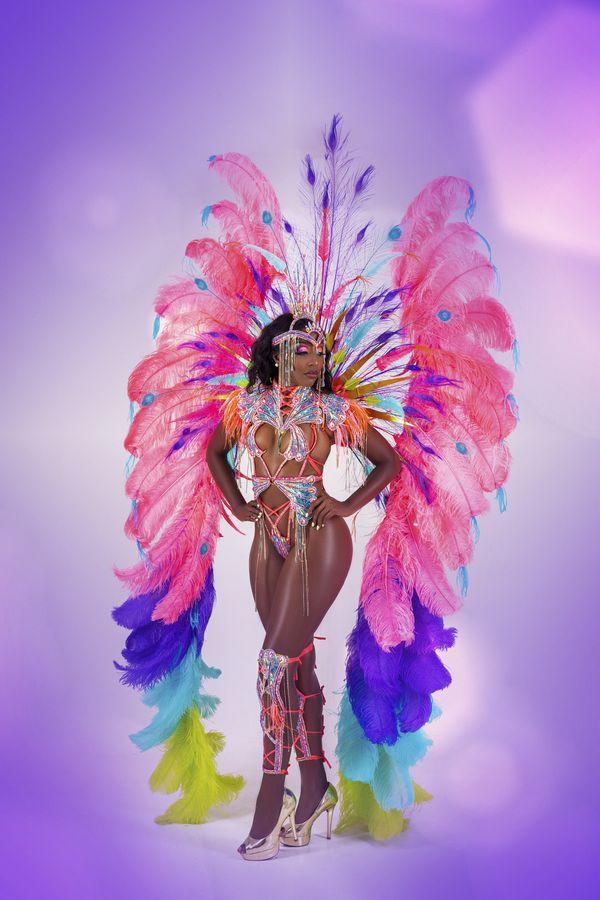
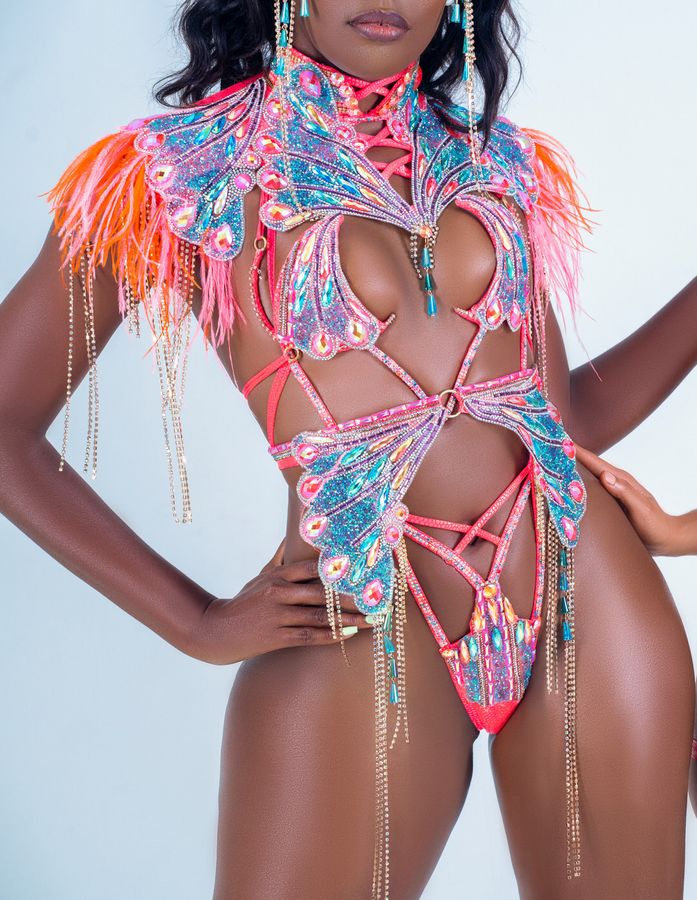
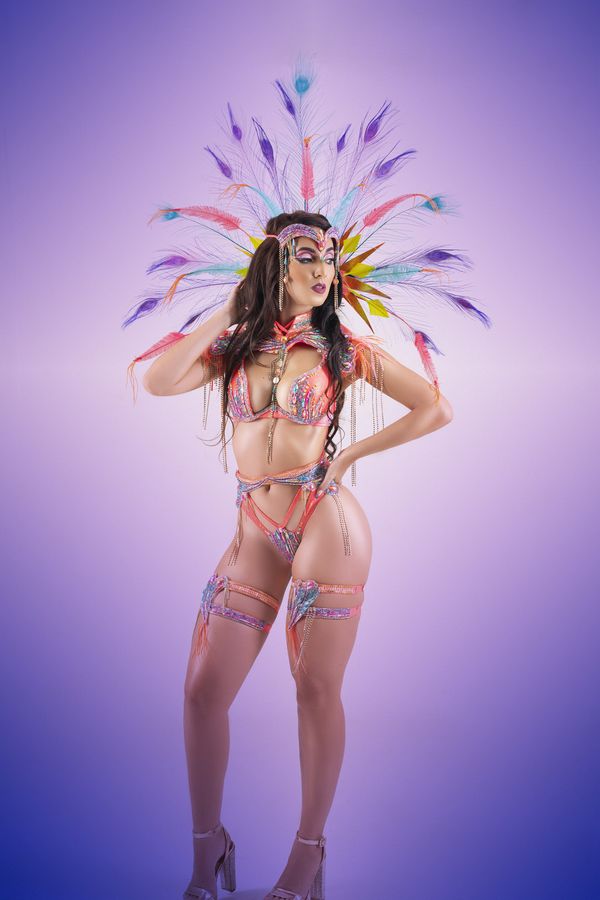
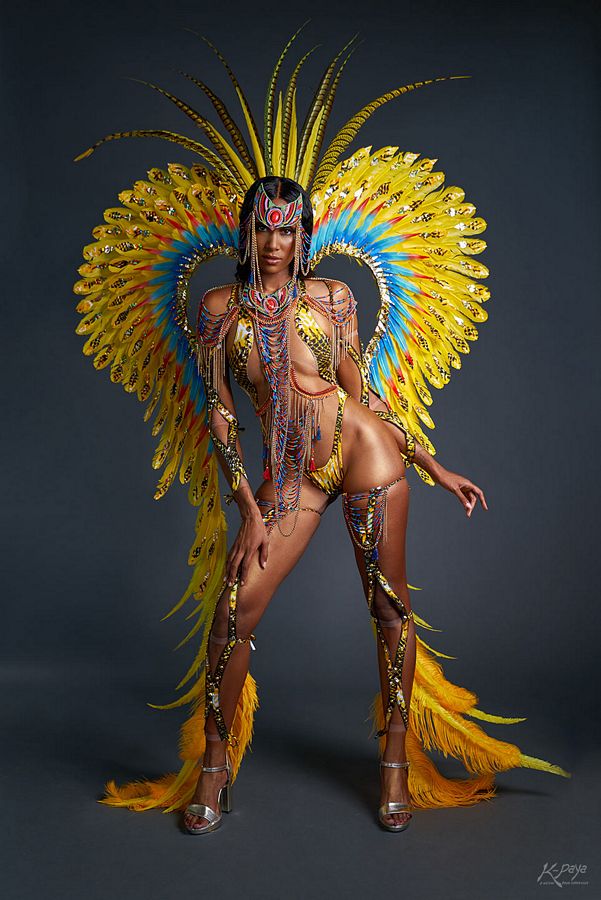
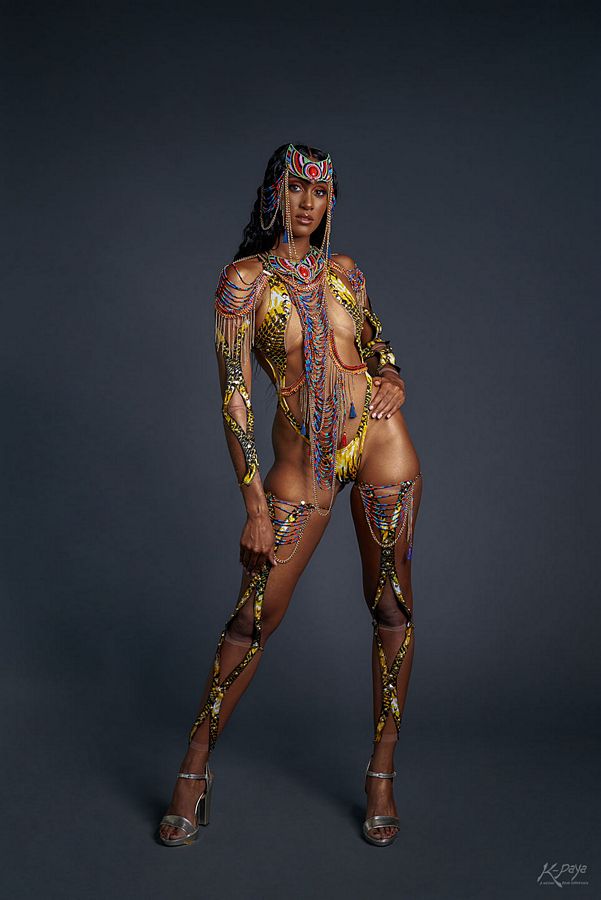
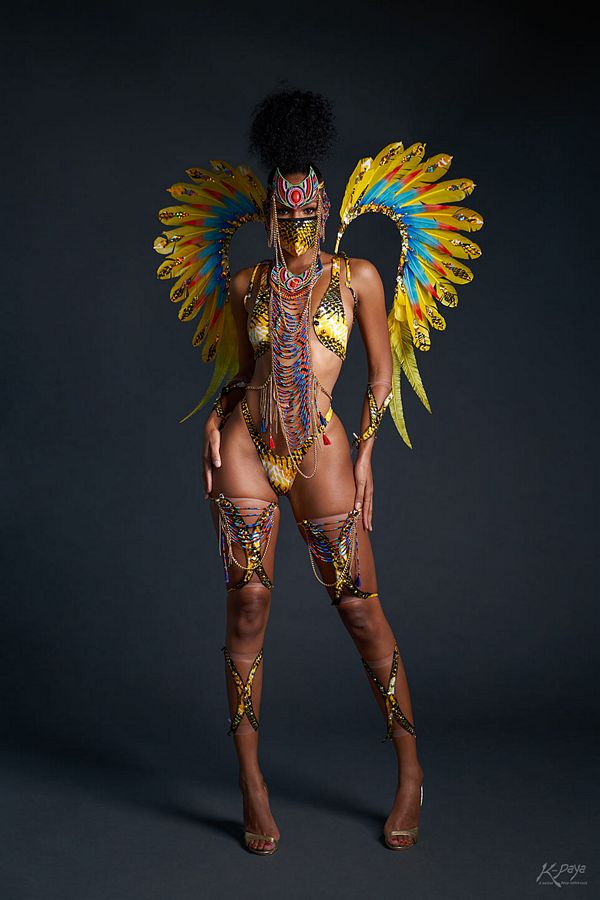
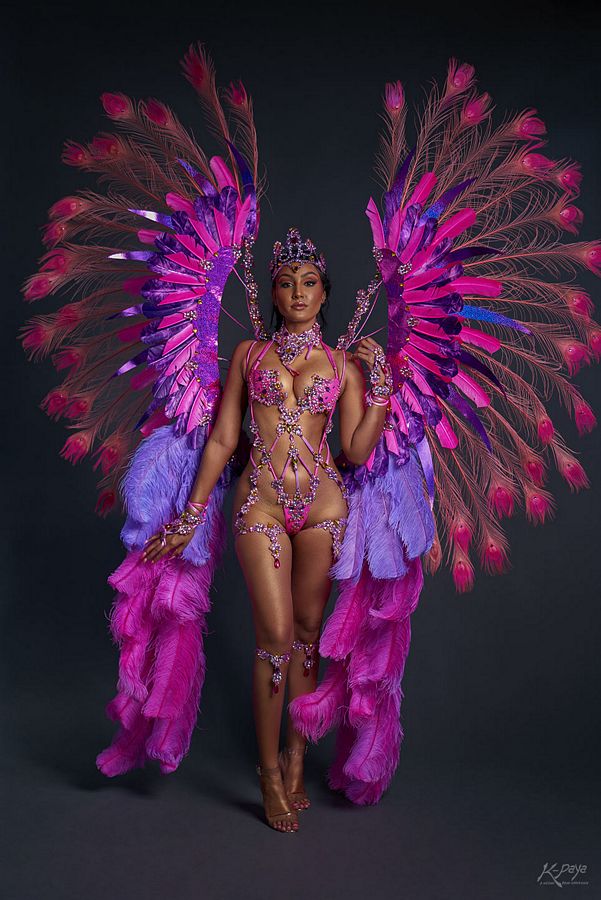
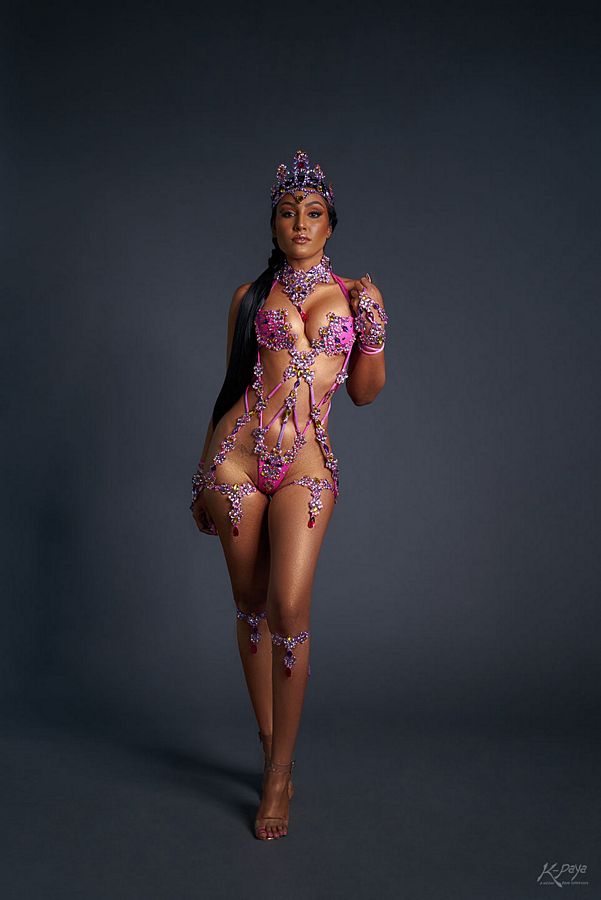
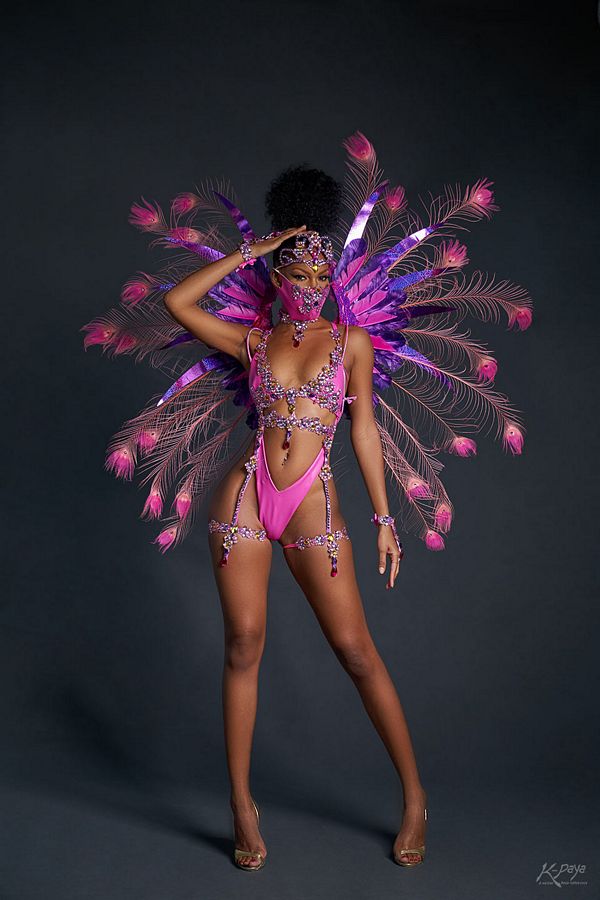
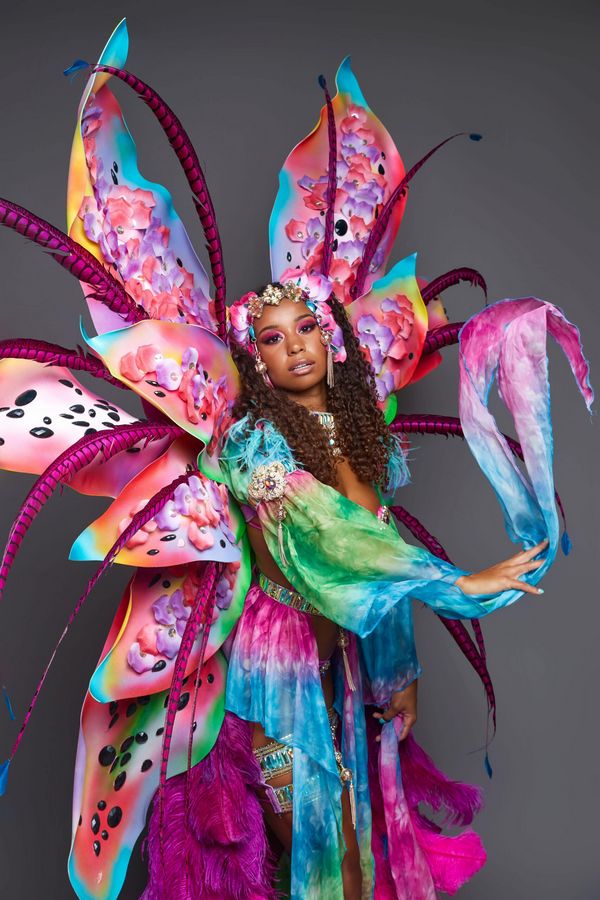
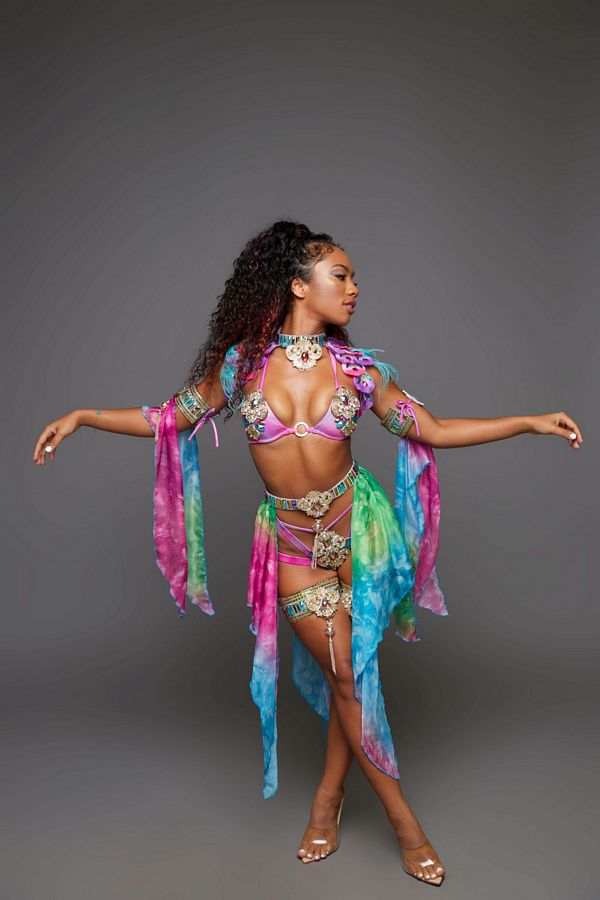
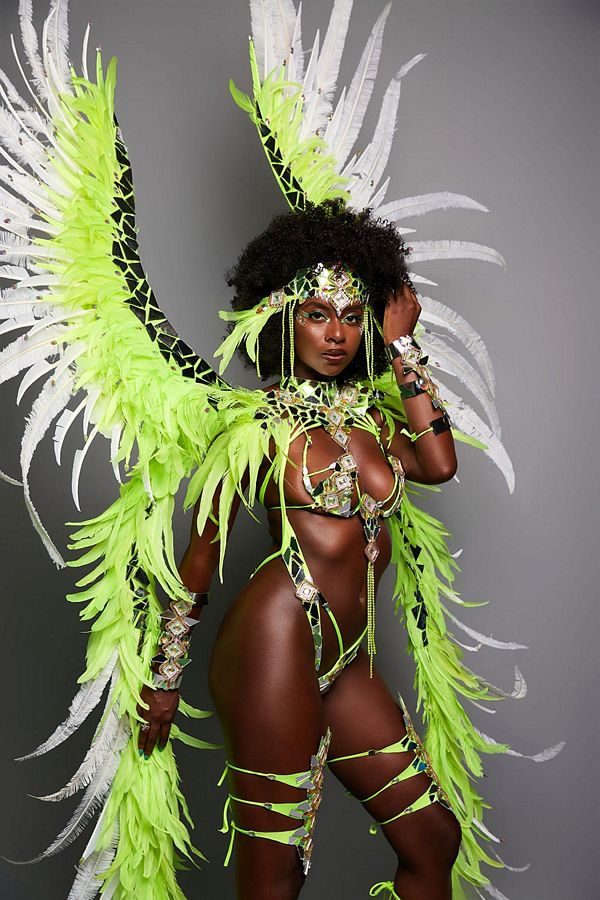
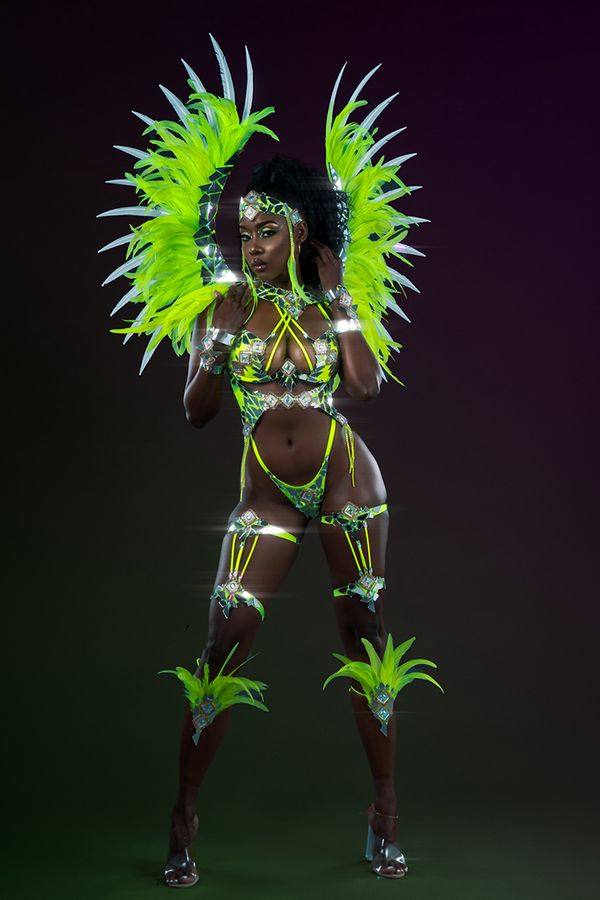
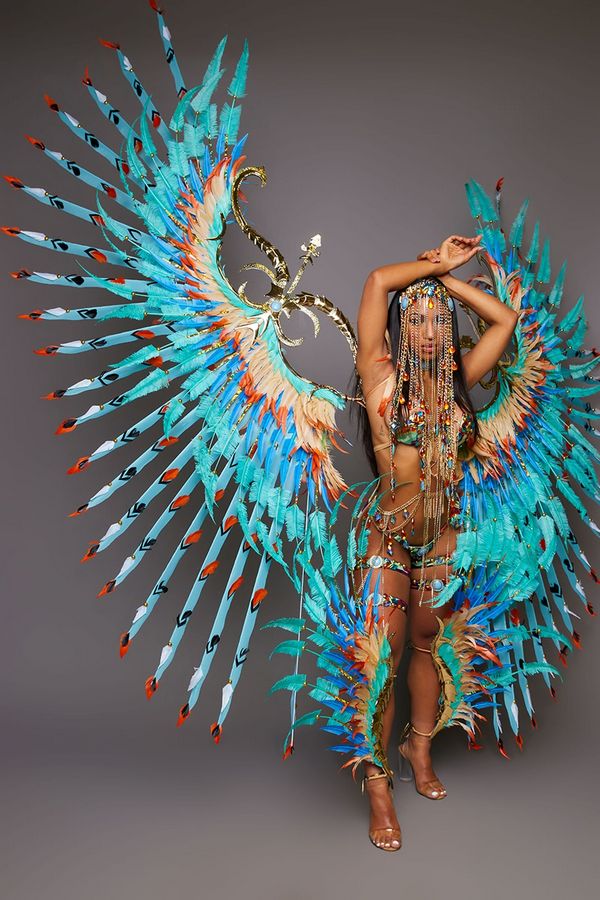
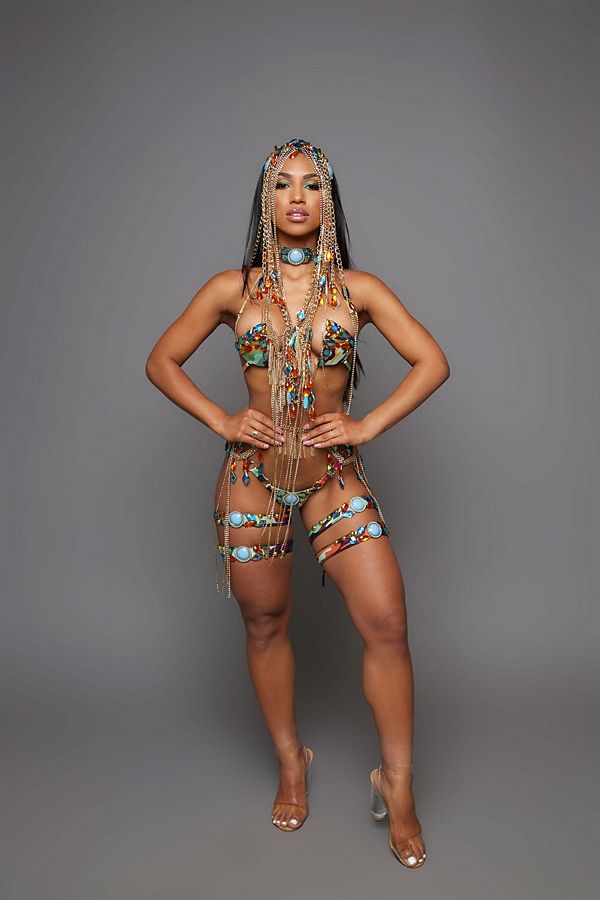
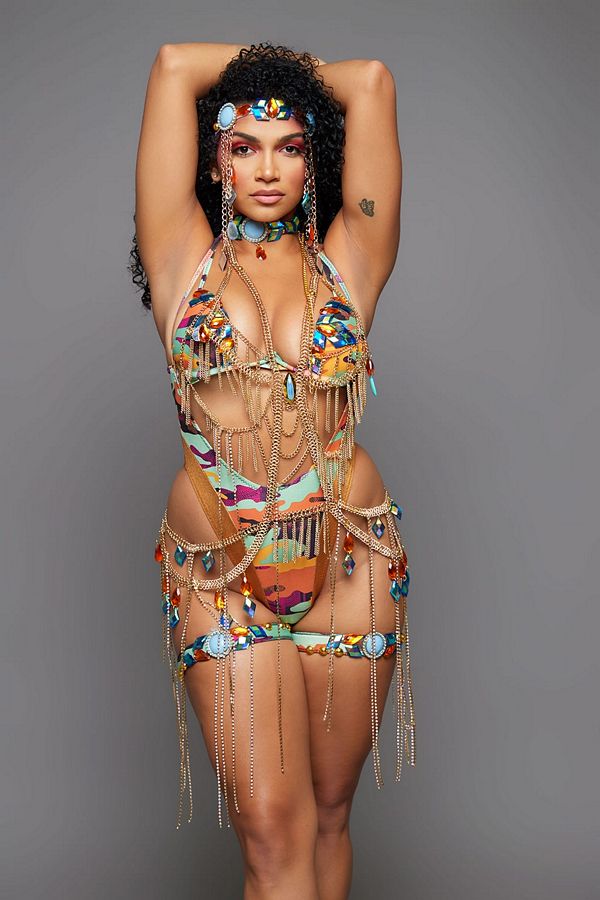
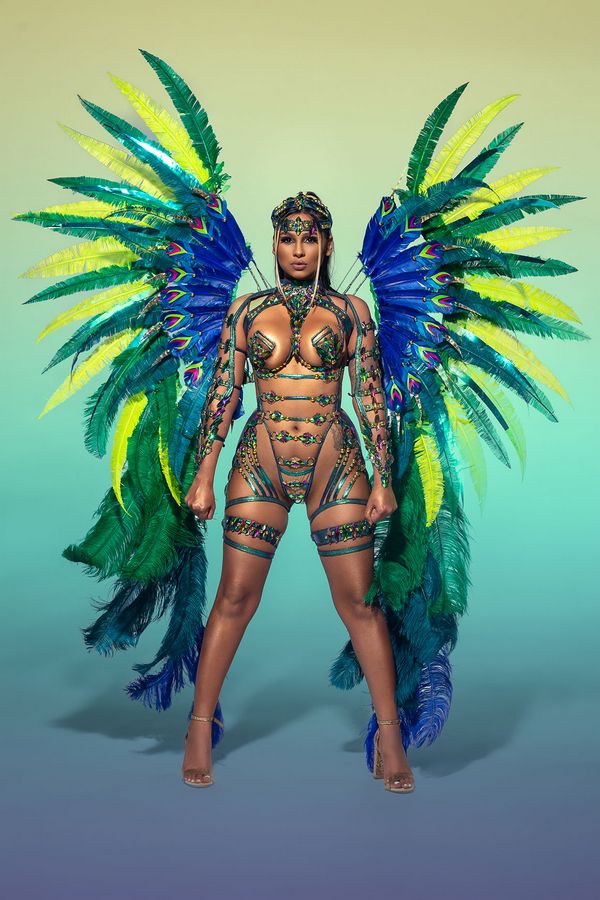
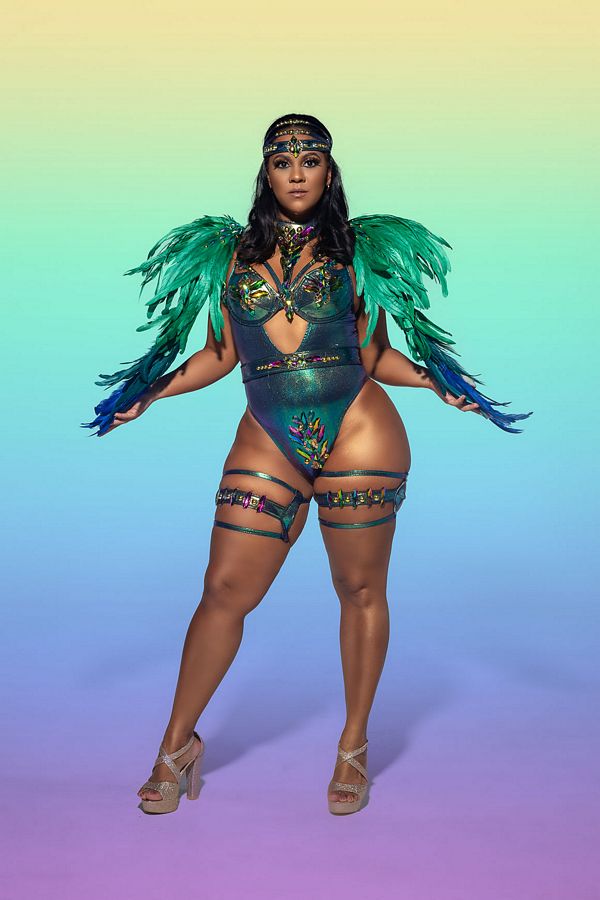
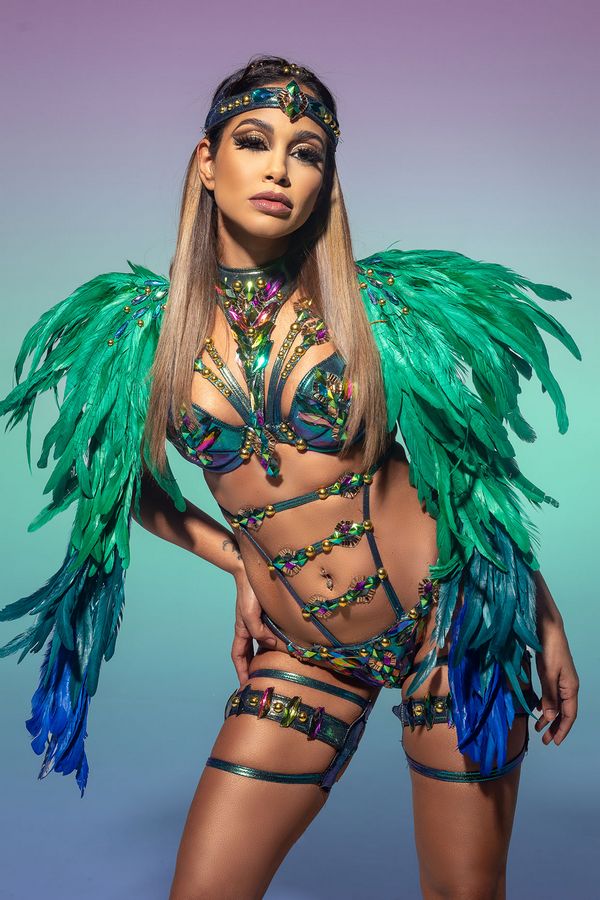
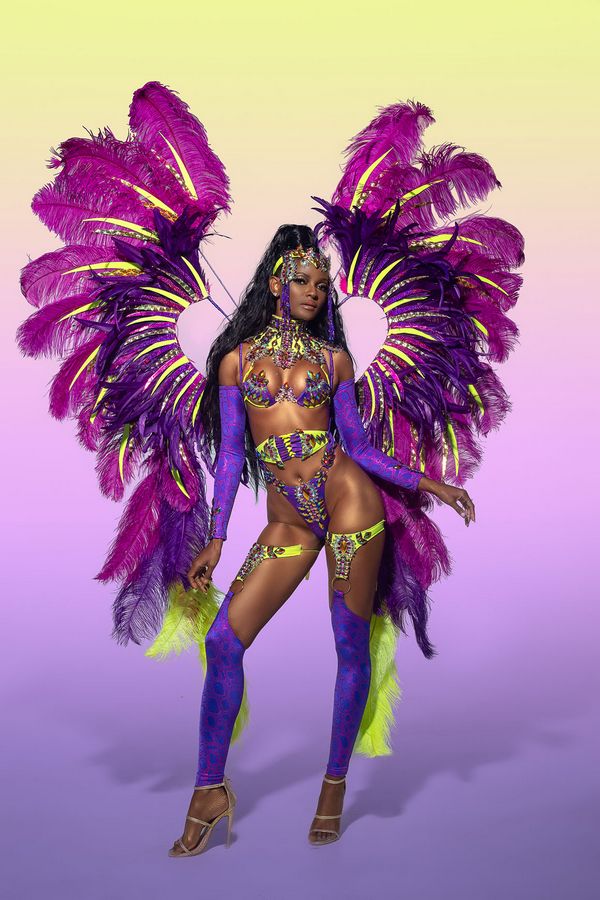
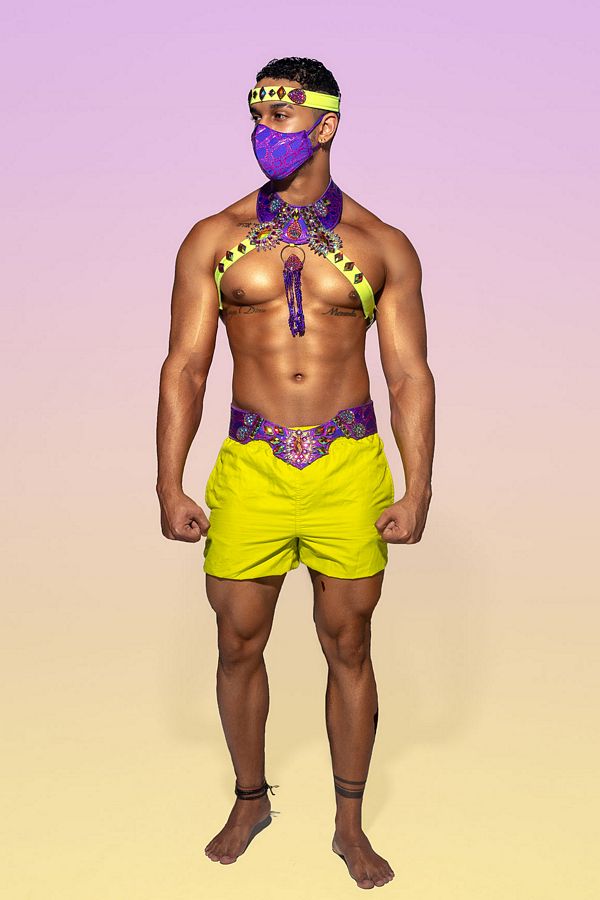
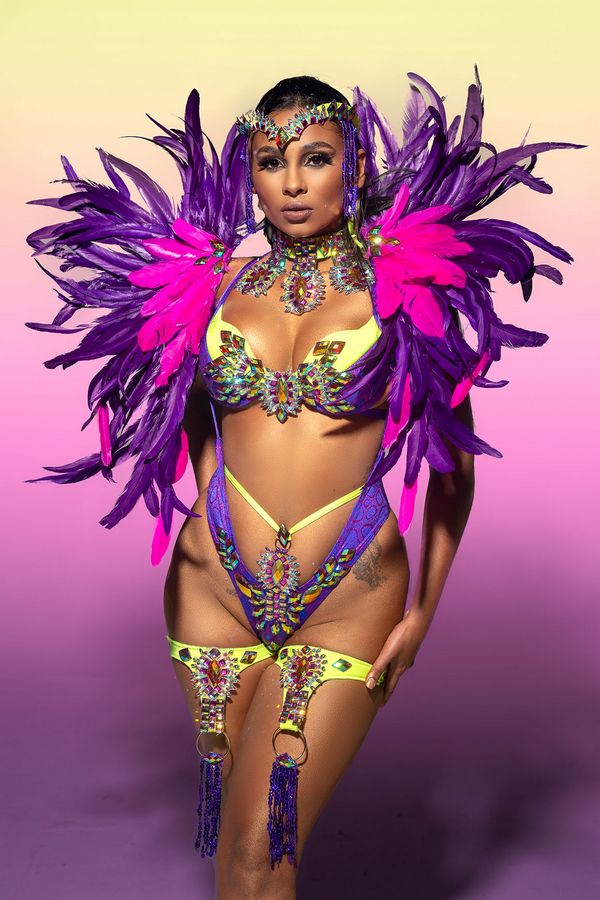
After going virtual in 2020, Miami Carnival is back and ready for di road with its decadent lineup of extreme and elaborate outfits. Styles, colors, and cuts are determined by mas bands — groups of parade-goers with coordinated costumes. Island Origins rounded up some of the sold-out masquerade looks we’re expecting in Miami Carnival 2021 costumes. It’s your preview of the over the top garb we can’t wait to see!
Barbadian beauty Rihanna proves that sensory overload can be an amazing thing with her 2021 Savage X Fenty show. This extravaganza of diverse body sizes, gender identities, characters and designs is not your typical walk down the runway. As one commenter said, her third fashion showing has blown away the Valentinos and Ralph Laurens of the world.
More of a performance art exhibition than a standard display of style, the event takes place in a multi-story building — even on it’s helipad on top and the streets below — with dancers and models wearing a variety of outfits from Savage X Fenty, Rihanna’s lingerie line. A drone camera weaves in and out between the flawlessly choreographed dancers, who pour every ounce of energy from their writhing bodies into the 40 minute Amazon Prime performance, using the staircases, gallery hallways, atrium, glass elevators and stark rooms of the building as their stage.
Cameos by names like Cindy Crawford, Erykah Badu and Adriana Lima, and performances by artists like Nas and Ricky Martin dot the showcase. But the “everyday” models really are the stars. Some were thin and traditional looking, others were thick and curvy, sporting stretch marks and cellulite, and presenting their perfectly imperfect bodies in the most sensual of ways. Men were not to be left out — Rihanna has created sexy costumes for their private pleasure as well.
Dazzling makeup and intricate hair styling spectacularly finished everything off. If you haven’t yet seen it, for an artistic performance extravaganza, it’s well worth 40 minutes of your life.
See James Corden’s hilarious visit to the set of the Savage X Fenty show.
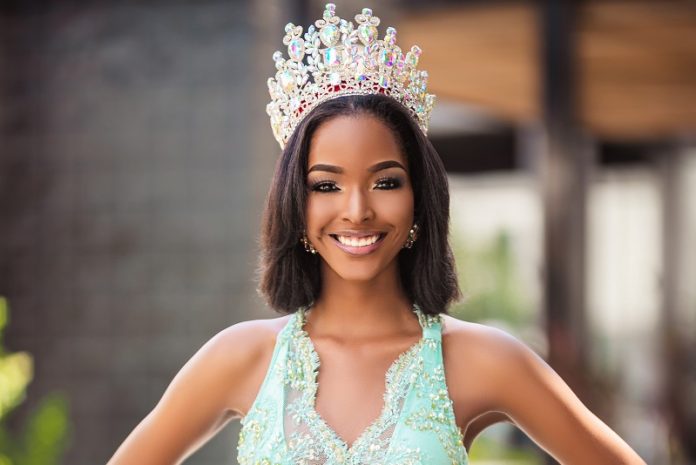
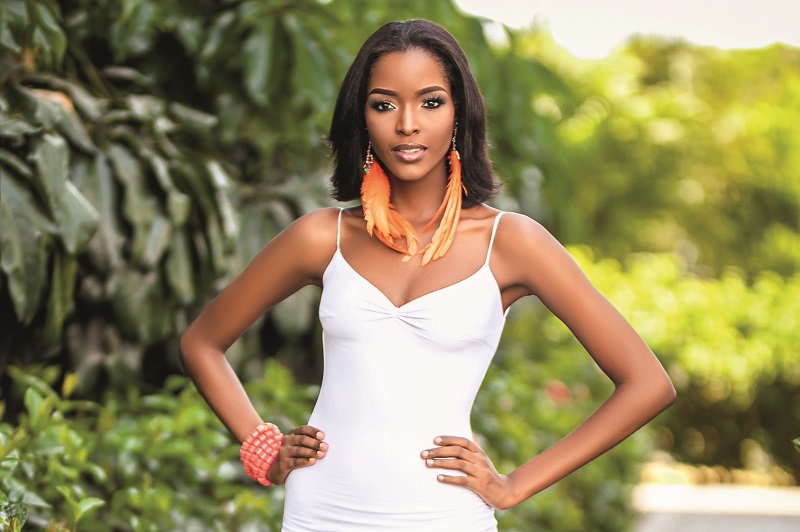
There is an effortless, unflappable poise about Miss Universe Jamaica Miqueal-Symone Williams.
If you watched the 2021 Miss Universe pageant, held earlier this year at the guitar hotel in Hollywood, Florida, the 24-year-old international model clearly stood out — all graceful limbs and gleaming smile as she strutted across the stage to take her top-10 position. During the broadcast, in a glossy introduction video, she outlined her interest in mental health awareness.
The video’s narrative was a familiar one, representing the pageant’s ideals of inner beauty and social activism. But the brief segment revealed the deeply personal reason behind Miss Universe Jamaica Miqueal-Symone Williams’ passion for mental health advocacy — her personal struggle with the sudden, tragic loss of her mother in 2017. Williams’ voiceover shared treasured memories as the b-roll showed snapshots of their life together. One photo showed her mother, perhaps not much older than Williams is now, revealing a striking resemblance between them.
A young Miqueal-Symone Williams with her mother.
When the video ended, switching back to Williams standing under the bright stage lights, her signature polish slipped for a moment. Her expression conveyed a mixture of grief and pride.
“When I look at myself, I see my mother, and I see all my other ancestors who have fought for me to be where I am now. Every time I achieve a goal, I think I achieve a goal for all of us,” she says.
Mental Health Advocate
Beyond the glitz and glam of pageants, it is this sentiment that keeps beauty queens so popular and culturally relevant across the diaspora. For women from all walks of life, Miss Universe Jamaica — her beauty, her success, her ambitions and yes, even her grief — can represent our own aspirational hopes and ideals. At her young age, Williams is well-versed in living with heartbreak and finding renewed purpose after tragedy.
This year’s title embodied a full circle moment in her healing journey. She had entered the same pageant in 2017 but withdrew following the loss of her mother. Embracing therapy and prioritizing her mental health proved to be key to her success.
The following year, Williams won the Pulse Model Search and began traveling the world as a professional model. While starring in campaigns for L’Oréal and walking the runway for Valentino, working in fashion “exposed me to the experiences of so many other people,” she says. “Just hearing their stories and seeing how they relate to [mental health] — it was a very, very helpful time in my life in terms of my grieving process, and that’s what solidified my interest in mental health as a platform.”
Photography: Darrick Foster, DAC X Productions
Recognizing the importance of support systems, Williams launched The Bloom Initiative to support Jamaican children. The project focuses on providing internet service to students so they can attend online classes. Williams hoped the program would also help participants maintain relationships as schools shut down due to COVID-19. “If they couldn’t go to school and even virtually link up with their friends, it would negatively impact their mental health,” she notes.
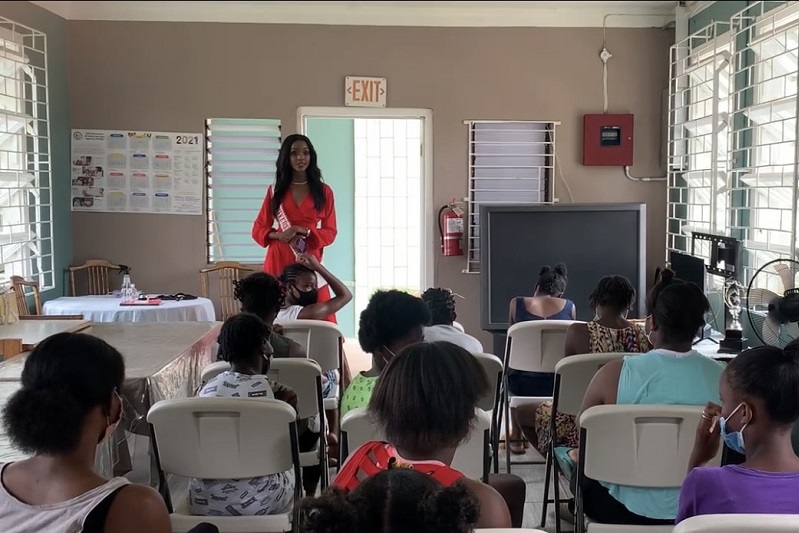
Williams happily puts in volunteer hours as a mentor at the Wortley Home For Girls. Established in 1918, the home provides a space for vulnerable young ladies, including those who have been orphaned. When talking about her mentees, her face instantly brightens. She has connected with them on a deeply personal level through their shared loss. “They’ve had more traumatic things happen in their lives than other children their age,” Williams explains. “With my own experience losing my mother in the way that I did, I can give them that [very knowing] type of support.”
Williams visits the Wortley Home for Girls in Jamaica. Photo courtesy of Miqueal-Symone Williams.
The greatest lesson she shares with them is the importance of emotional openness. “It’s only when you allow yourself to be broken that you can properly put yourself back together again.” Her mother, she laughs, “always gave me my space to go through my emotions.” Looking back, she recalls, “I went through quite a bit of teen angst myself.”
Support Systems
In honor of her mother, Williams hopes to launch a foundation providing psychological therapy and safe spaces for children.
Following the pandemic, greater support for mental health overall is desperately needed in Jamaica. Medical experts warn of a pending public crisis. The Ministry of Health and Wellness reported a major uptick in calls made into the mental health and suicide prevention hotline, approximately doubling at the start of the pandemic between March and April 2020. The challenges of managing these mental health issues are only compounded by the general stigma surrounding them.
Williams hopes her public advocacy can ease this cultural shame and encourage people to seek help. “There’s no reason why you should have to [act] strong when you feel like you need to lean on someone.”
The reigning queen herself leans on her family, including her father Michael, stepmother Maxine and a network of dedicated aunties. “I can’t leave any of them out!” she laughs. Their support has been instrumental in her success balancing the pageant with modeling, all while completing her bachelor’s degree in marketing this year at the University of the West Indies.
Photographer: Darrick Foster, DAC X Productions
Though the country may look to Williams for an image of the nation’s feminine ideal, Williams turns to a community of women for guidance on the kind of woman she wants to be. “There’s a spirit of resiliency, courage and hope that lies with the Jamaican woman,” she says. “And I hope to embody that.”
Photography: Darrick Foster, DAC X Productions Fashion: Dermoth Williams Resort @UzuriInternational Stylists: Mark McDermoth & Karl Williams Makeup: O’Neil Baugh, GlamByOneilmua6618 Hair: Marcia Lengard featuring Design Essential products Location: AC Hotel by Marriott Kingston, Jamaica
Boston Caribbean Fashion Week is back again October 13-16
Boston Caribbean Fashion Week is a multi-day, diverse series of festive fashion events founded and produced by Althea Blackford. In mid-October, stylists, models, and spectators will come together to celebrate, educate, and pay homage to Caribbean design and culture, with representation from Barbados, Jamaica, Haiti, Trinidad and more. Featured designers will include Sharisse Scott-Rawlins, owner of bySharisse, Ayanna O’Brien, owner of ICANDI WEAR, Prince Citi, owner of Viezoe Lifestyle, and Ariel Koonce Fortes, owner of Fashion Fun Pop.
In 2013, Althea created an annual event that celebrates Caribbean heritage while providing a platform for designers to showcase their collections and connect with other fashion professionals. 2021 marks the 8th annual Boston Caribbean Fashion Week, which includes a virtual kickoff event, a style workshop, a style panel discussion, and a runway fashion show. Events can be attended in person, or people can register for online tickets and attend virtually.
In-person activitieswill be held at The Salon at Studio Allston Hotel (1234 Soldiers Field Rd, Boston, MA 02135) and at Final Touch with Class Boutique (17 Warren St, Boston, MA 02119)
“Virtual Kick-Off” on Wednesday, October 13, 2021, at Studio Allston Hotel. Meet the participating designers and enjoy some other fun surprises.
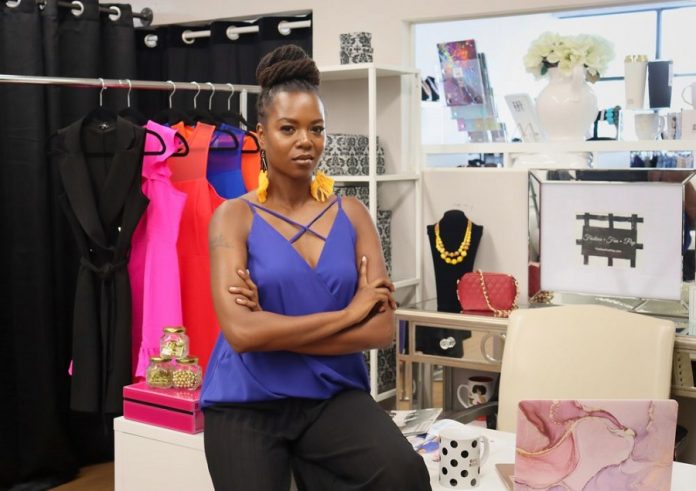
“Elevate Your Style Workshop” on Thursday, October 14, 2021, at Final Touch with Class. Boutique Fashion & Interior Stylist Tricia Cromwell of Trust in Tricia will share easy professional tips on boosting our own style.
“The Art of Style” on Friday, October 15, 2021, at Final Touch with Class Boutique. An evening of shopping, networking, and personal styling tips presented by Style on Demand.
“Fashion Show” on Saturday, October 16, 2021, at Studio Allston Hotel. An incredible evening of fashion with the latest collections presented by local Boston designers.
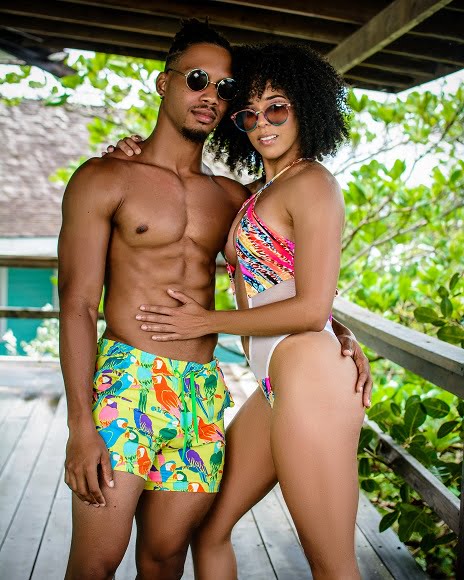
A convenient feature of life in the Caribbean is that the summer season lasts all year. Stay ready for it with pieces from these four Caribbean swimsuit designers, each focused on body positive styles that are perfect for flattering any and every body type.
Keva J Swimwear by Keva Johnson, Jamaica
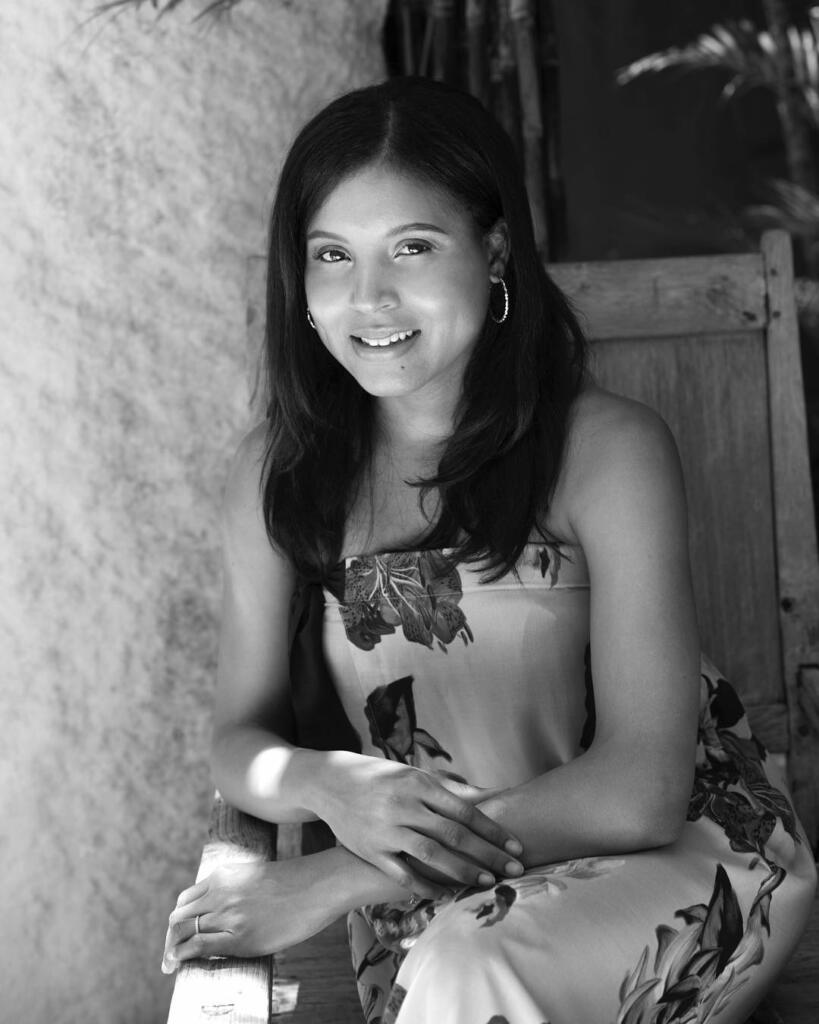
Designer Keva Johnson
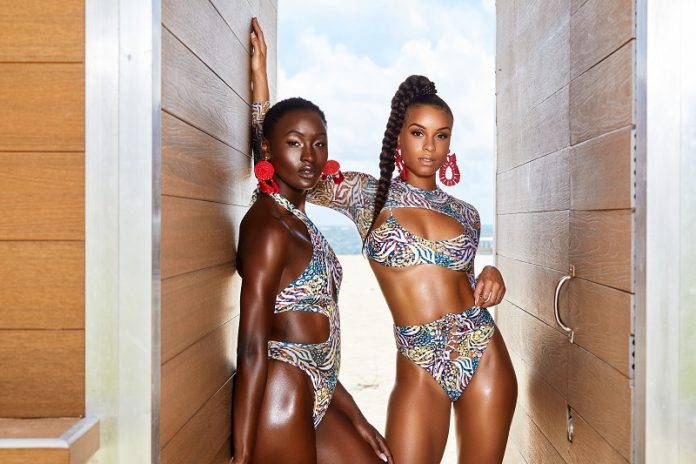
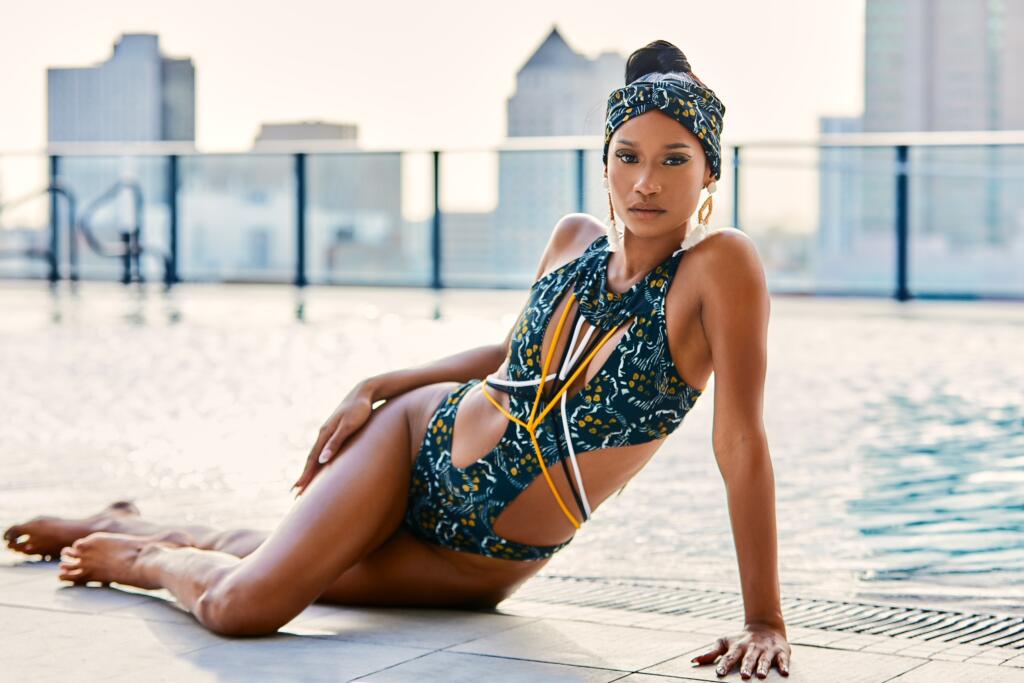
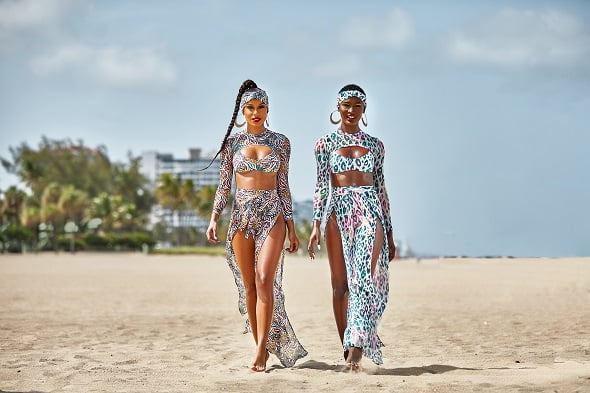
These days, Keva Johnson is proudly inspiring women of all shapes and sizes to feel confident in their swimwear with her Keva J Swimwear line. “Our motto is ‘same suit, different bodies, same slay!’” Reflecting her island roots, bright colors, tropical patterns and flowy patterns dominate her line. Every detail of her newest line, Wild Tingz, was inspired by her home island, Jamaica, and each suit is named for an actual place there.
Bold cuts and prints are signatures of her style. “People know our suits just by the designs,” she says. “Customers send us pictures all the time saying I knew it was your suit as soon as I saw it.” Get beach ready with these two beautiful designs from Keva J.!
“I wanted to create something different that still looked good and is aesthetically pleasing. The perfect diva for this would be a woman that is confident and doesn’t mind showing some skin.”
Photo: Dionysius Burton
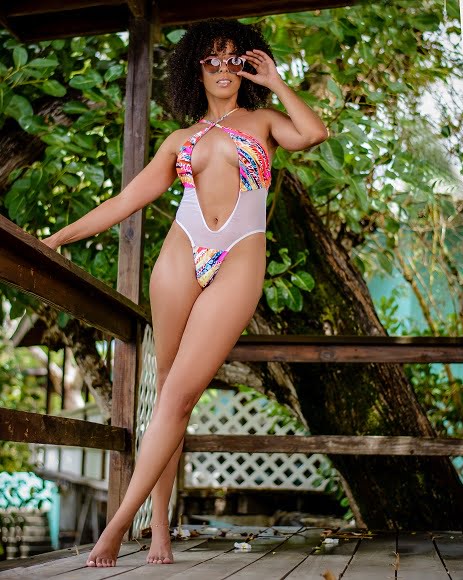
The Kingston Mesh High Waist Bikini
“This was part of our Wild Tingz Collection. It has a retro feel with mesh sleeves and high waisted bottom, so it conceals but it’s still sexy. This style looks amazing on any body type.”
Photo: Dionysius Burton
KaliKrochet by Christa-Joy Burton, Antigua
Designer Christa-Joy Burton
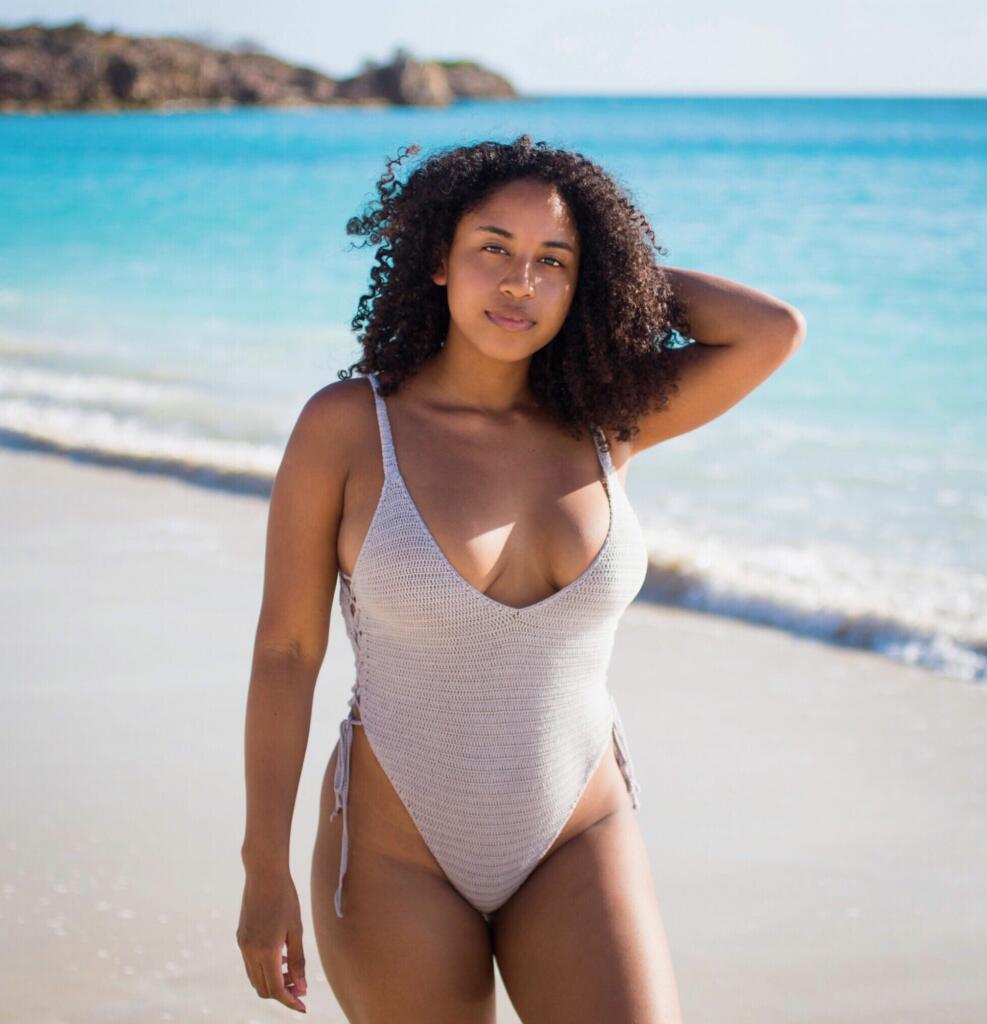
Founded in 2016 by then 21-year-old designer Christa-Joy Burton, KaliKrochet was born from her hobby of crocheting intricate swimsuits for herself and her friend group. The line has since turned into a thriving business known for its custom swimwear, each piece handcrafted by Burton herself.
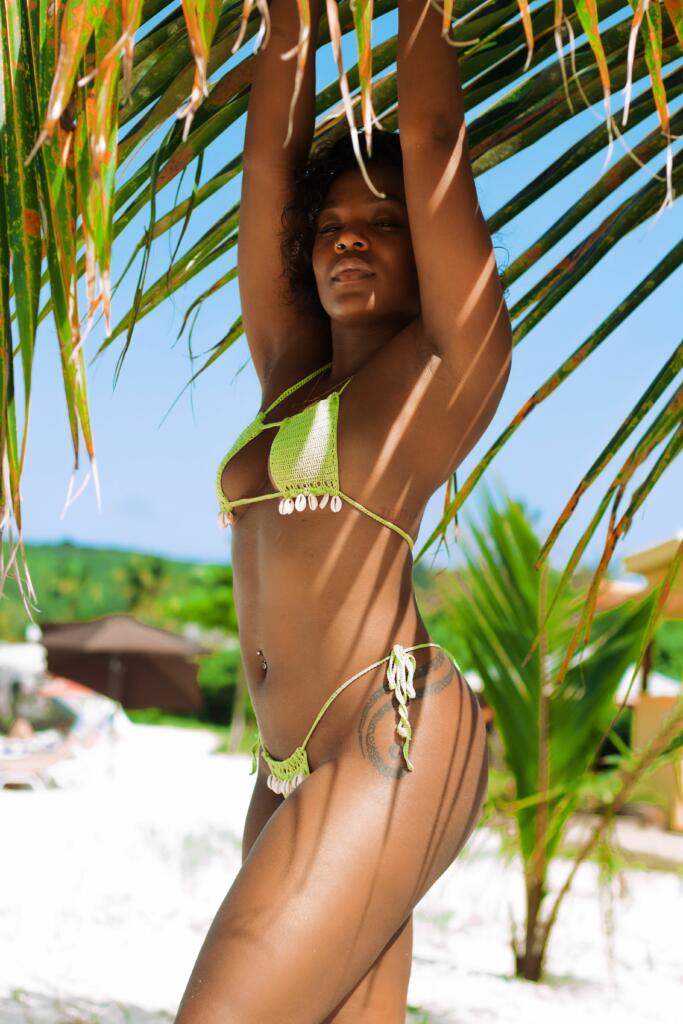
The brand aesthetic reflects Burton’s island origins with unique embroidery and shell detailing. The brand name pays homage to her indigenous Kalinago (native Indian) roots. “My pieces start from thread and transform into something beautiful,” said Burton. “[This] makes me feel connected to the handcrafters in the hills of Dominica.”
Because these suits are custom-made to measurement, KaliKrochet ensures that women of all shapes and sizes will find a suit they love. “Swimsuit season shouldn’t be about an ideal body size, it should be about fun summer days by the water,” said Burton. Get beach ready with these two beautiful designs from KaliKrochet!
“The KIMI Shell Set features a stringy bikini top with adjustable square-shaped cups and KaliKrochet’s signature accent, cowrie shells. Mer-babes who don’t mind showing a bit more skin will love this set.”
The REGGAE Crop
“The REGGAE Crop Top features the colors of the Rastafarian movement. Mer-babes who want a versatile top that can be used as a bikini or dressed up for a night out will love this top.”
Ochie Swim by Hana Lloyd, Jamaica
Designer Hana Lloyd
For Ochie swimwear creator Hana Lloyd, the natural beauty and environment of her home country, Jamaica, as well as other West Indian countries are major sources of inspiration. “The Caribbean contains a melting pot of cultures in a place of unparalleled physical beauty,” she said.
With this in mind, the young designer is especially drawn to vibrant colors and custom prints containing floral, animal and nature themes when creating her striking swimsuits. Each piece is also ethically handmade and adorned with gold cord ends, intricate hardware and other fine finishes that seamlessly blend contemporary with timeless Caribbean style.
Another strong principle at the forefront of Lloyd’s mind when creating swimwear is her strong notion that every body is a bikini body. “I think the idea of a perfect body type or ‘bikini body’ is changing with beautiful, confident, successful women like Lizzo and Ashley Graham gracing popular magazine covers and being role models in the body positivity movement,” she said. For Lloyd, her overarching goal for Ochie is simply to make sure all her customers feel good about themselves. Get beach ready with these two beautiful designs from Ochie Swim!
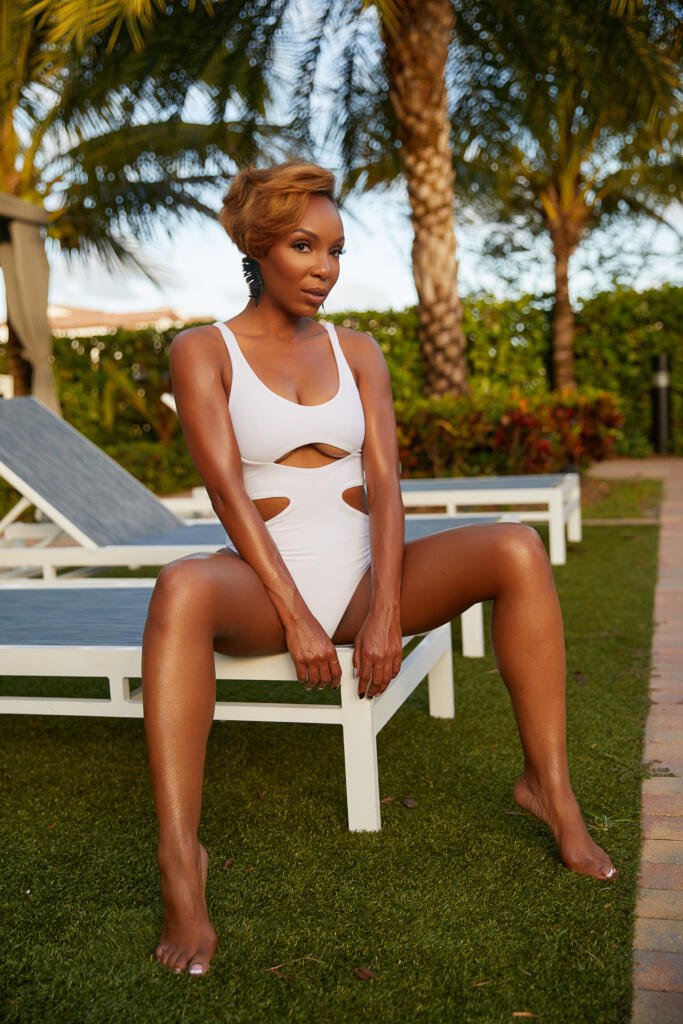
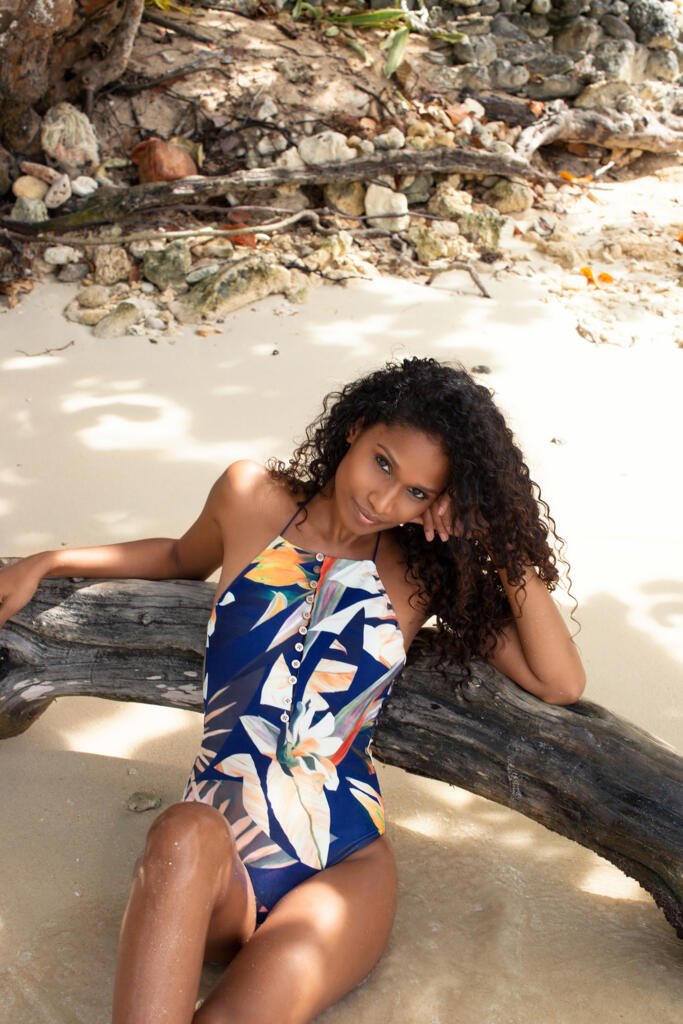
“A unique retro-inspired halter style with functional buttons — that’s how I’d describe the Diana. It has a high cut and medium-cheeky coverage.”
Photo: Daniela Rettore
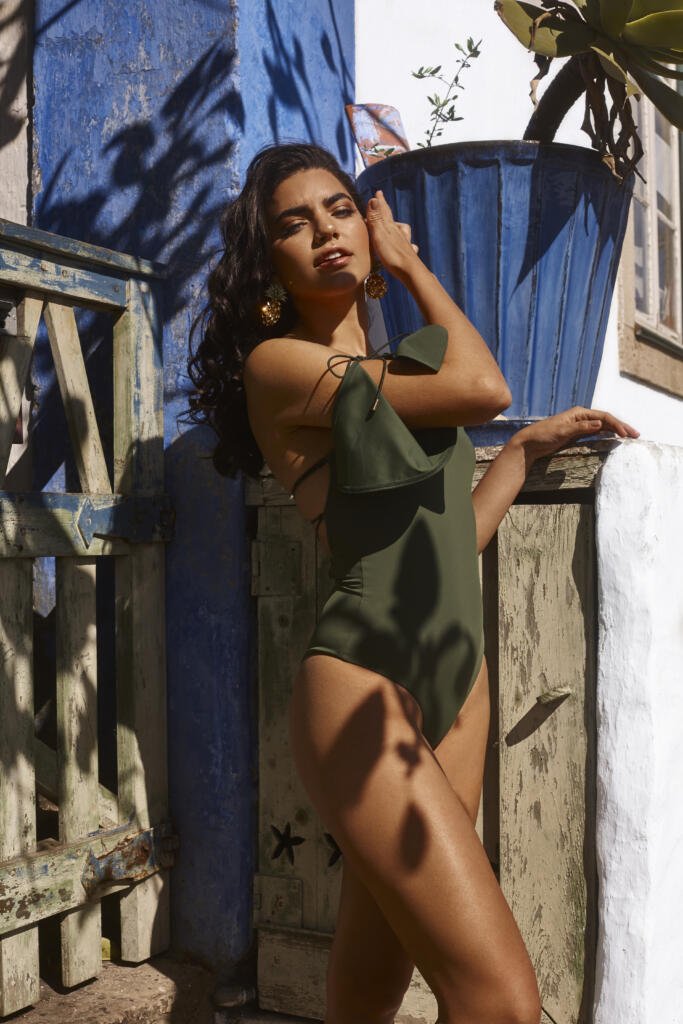
Olivia One Piece
“The Olivia is perfect to accentuate one’s curves with fun and flirty versatile sleeves that can be worn on or off the shoulder. This suit can also be worn out of the water as a bodysuit.”
Island Pop Swimwear by Melissa Bonadie, St.Vincent & The Grenadines
Designer Melissa Bonadie, Photo: Travis Roberts
Vincentian born designer, Melissa Bonadie, was originally inspired to open Island Pop Swimwear in 2019 simply due to the lack of swimwear stores and options for purchasing suits in her hometown of St. Vincent. “If you needed a swimsuit, your best option was ordering online,” she said. This eventually led to exploring designing her own swimwear, leading to the creation of a brand focused on intricate designs, endless style and fun colors and fabrics inspired by the beautiful landscapes of St. Vincent.
Her new, introductory line, Oshün, emphasizes body positivity and confidence through its sexy cuts and silhouettes. “We are a culture of confident women, whether you are a size 0 or size 14. I wanted a line that accentuated the body and allows the wearer to walk confidently in her sexiness and femininity. It isn’t about the perfect body, it’s about being you,” Bonadie said. Get beach ready with these two beautiful designs from Island Pop Swimwear!
@islandpopswimwear
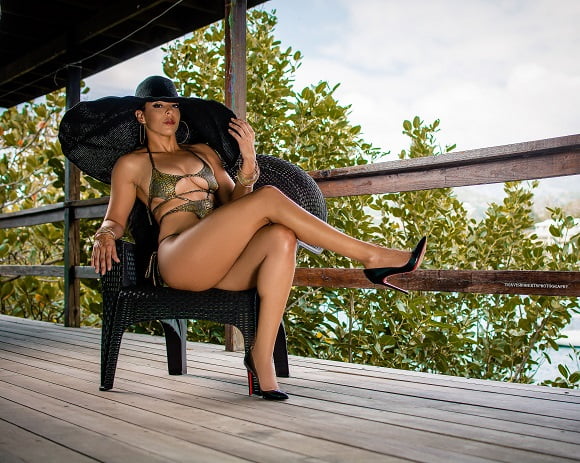
NissiSwimsuit
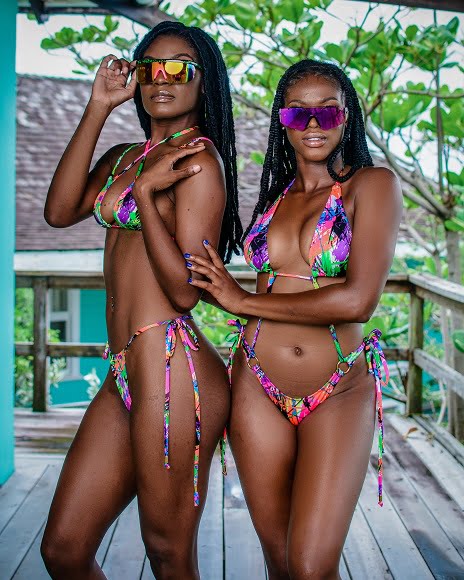
“Inspired by coral reef snakes and designed for the sexy diva.”
Photo: Travis Roberts
Photo: Travis Roberts
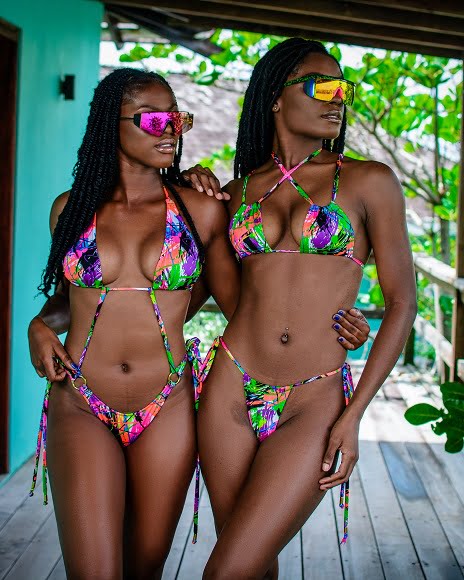
The Kaiyo and Kai Bikinis
“These bikinis, Kaiyo (left) and Kai (right), are inspired by colorful sea anemones and perfect for the flirty diva.”
The city of Miami is home to a large population of Caribbean American residents. Representing this group, one of the most anticipated events in the city is Miami Carnival, held annually in early October.
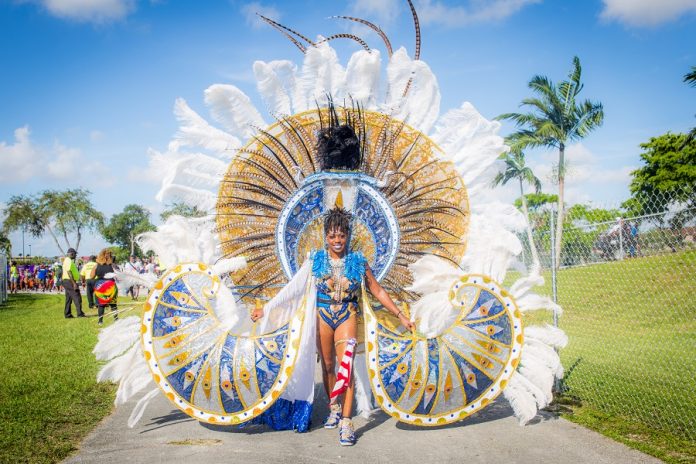
As the largest celebration of Caribbean culture in the United States, and one of the greatest in the world, Miami Carnival events see locals and tourists traveling from all over to tap into the vibrant and exciting Caribbean experience. The events that make up the week of activities are inspired by similar traditions in Trinidad, the mecca of Caribbean carnivals in the island region. Official Miami Carnival 2021 activities include four main events: Junior Carnival, the Panorama Steel Band Competition, J’ouvert, and the Carnival Grand Parade and Concert. All are exciting, dramatic and thrilling, and together, they offer something for everyone.
Junior Carnival
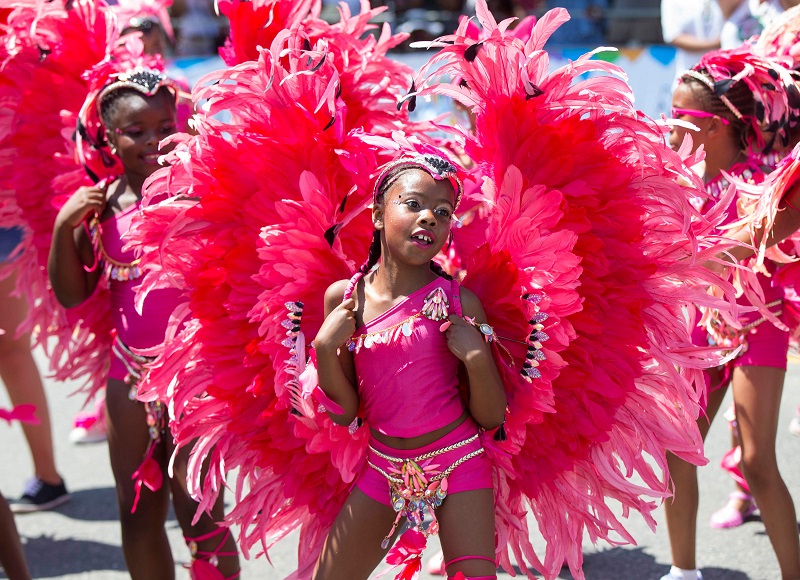
Children have their own place to party as the Junior Carnival, dedicated to those too young to attend the main events, is held one week before the adults come out to play. This “Kiddies Carnival” features adorable bands of children in colorful band costumes parading, dancing and performing, merrily partaking in the Caribbean experience. Junior Carnival also has great generational significance, encouraging the youth to celebrate and embody their culture at an early age. Children who participate will take their early experiences of Carnival and carry on the vibrant traditions in their own time.
Junior Carnival will take place on October 2, 2021 from 1:00 p.m. to 10:00 p.m.
Photo: Zou Zheng/Xinhua/Alamy Live News
Panorama
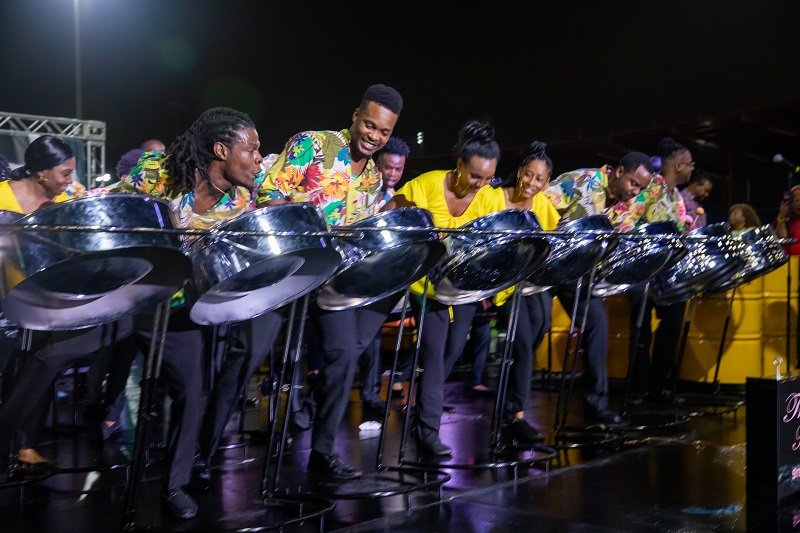
Enjoy pulsating energy and breathtaking music from Trinidadian steelpan — the unofficial instrument of the Caribbean — while witnessing the exciting battle of the bands at Panorama. The event is a major highlight of Carnival where people come to watch the main event: the Panorama Steel Band Competition, where some of the best steelpan bands in the world battle for the title of “Champions of the Panorama.” Attendees also spend the evening eating, drinking and dancing the night away.
Photo: Scott Oliver @theStudioMQ
The bands that participate practice all year round. Their performances are judged based on criteria such as visual impact, creativity, craftsmanship, the relationship of their performances to the theme of the competition, portability of their instruments, and overall presentation.
Panorama is truly a sight (and sound) to behold. The competition is routinely held on the Friday of Carnival week. This year, visit Panorama on October 8, 2021 from 4:00 p.m. to 11:00 p.m.
Photo: Mark James
Miami Carnival J’ouvert
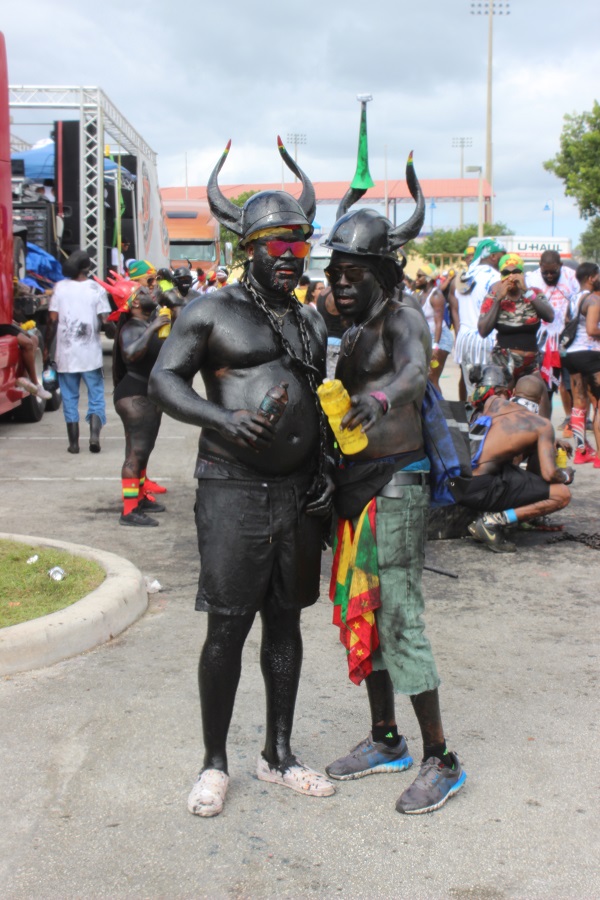
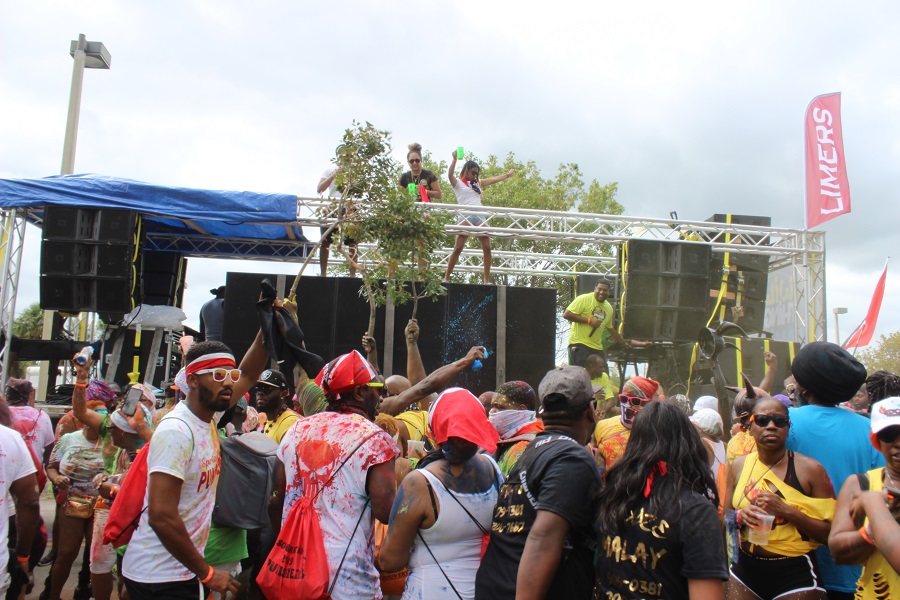
J’ouvert, French for “dawn” or “daybreak,” is one of the most popular Carnival traditions. This block party takes place early in the morning and features lots of alcohol and lively music, but the main event is the march of people covered by colorful explosions of paint and powder, water, oil, flour, mud and clay.
Attendees can often see over-the-top characters like the Blue Devils, Black Devils or Jab Jabs, covered head to toe in color, adorned with horns and spewing fire. Many simpler revelers just put on an old t-shirt and enjoy the occasional splash.
If you’re down for some multi-colored, screaming fun at the break of dawn, then join the J’ouvert merriment early on the morning of October, 9 2021, from 7:00 am to 3:00 pm.
Photo: Mark James
Miami Carnival Road March (Grand Parade and Concert)
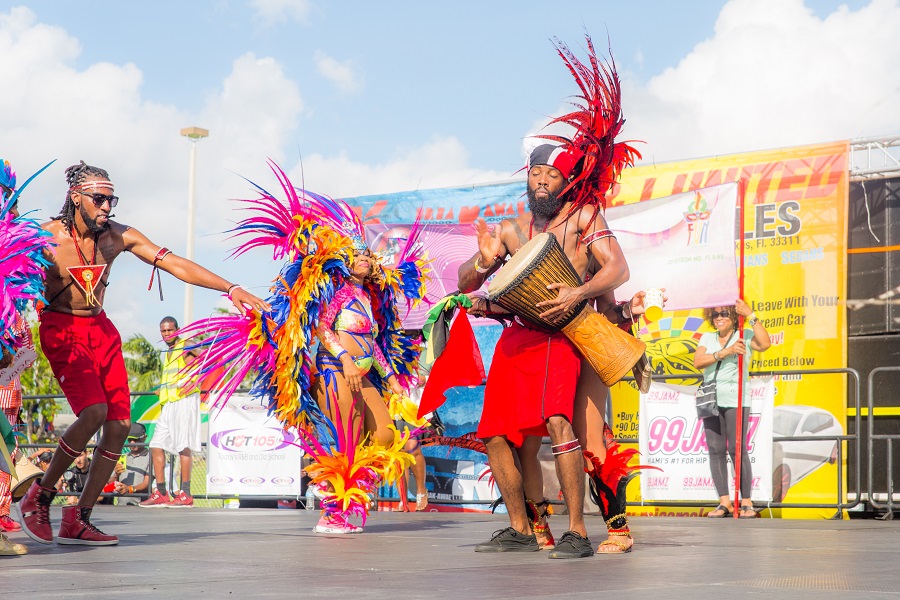
Featuring more than 18,000 participants divided into diversely themed and uniquely extravagant mas bands, the road march or grand parade is the peak of Miami Carnival. The whole event is an extravagant exhibition of colors, lavish costumes, pageantry and make-believe with all bands competing against one another for the title of “Best Band of the Year,” as well as for the crowning of king, queen and best individual costume.
Music trucks playing non-stop island sounds keep everyone entertained, moving and grooving during the road march until the best international Caribbean soca artists, djs and more take the stage at the live concert.
Courtesy: Harris Public Relations
The day-long parade will take place on Sunday, October 10 from 11:00 am to 11:00 pm.
Miami Carnival guarantees fun for everyone, from the participants to the spectators and even the organizers. The island vibes, good music, entertaining and extremely competitive performances, best Caribbean cuisine, and the most beautiful arts and crafts all come together to make Miami Carnival the highly anticipated thrilling celebration of culture that it is.
This year’s celebration marks the 37th year of Miami Carnival and official events will run from Saturday, October 2 to Sunday, October 10. All official Miami Carnival events will take place at the Miami Dade County Fairgrounds, 10901 Coral Way, Miami, Fl.