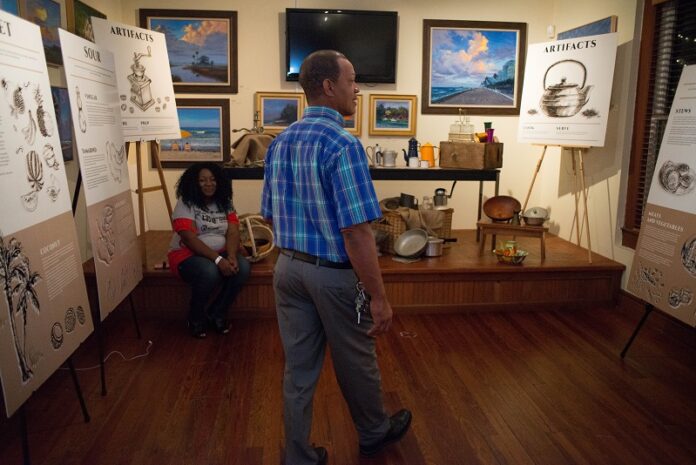
An attendee exploring information and artifacts in the Caribbean Culinary Museum at the 2018 Taste the Islands Experience | Photo by RJ Deed
Jerk, griot, rice and peas, culantro, scotch bonnet peppers and so on, are not elements you typically think about when you think of Caribbean history. But when you’re the producer of the “Taste the Islands” TV series and associated events, that’s exactly what comes to mind.
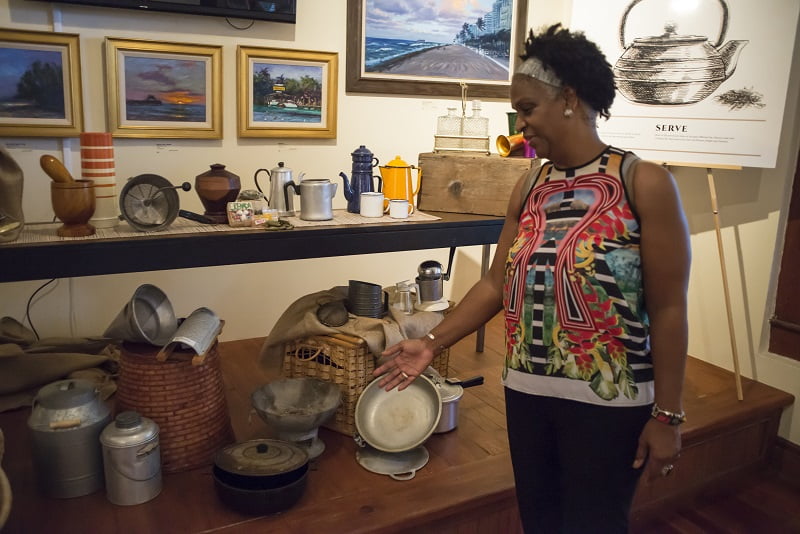
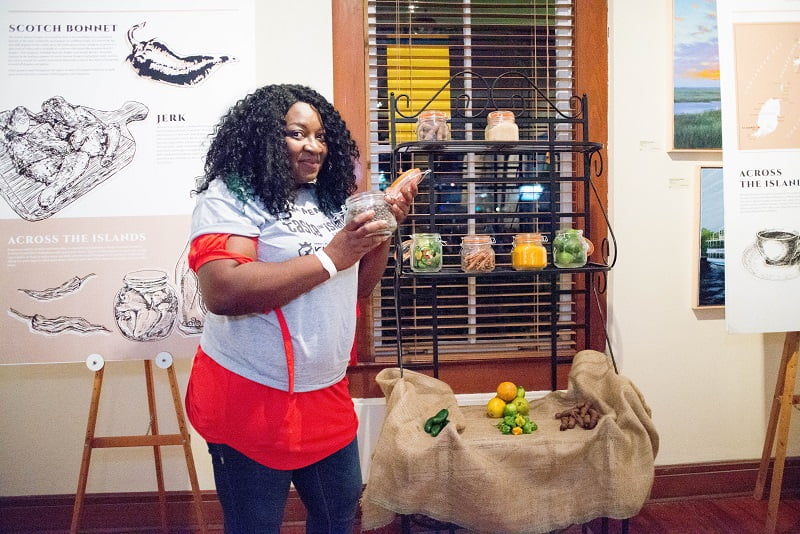
Following their successful execution of the “Caribbean Culinary Museum and Theater” at the “2018 Taste the Islands Experience” (TTIX), the event’s producers are bringing the exhibit to the 2018 “Grace Jamaican Jerk Festival” in Sunrise, Florida on Sunday, November 11. Thousands of patrons will have the opportunity to learn about the history of the spices, staples, drinks, and general flavors of the region, and they can see artifacts from decades past used in food storage, preparation, and service.
Funding for this project is provided in part by the Broward County Board of County Commissioners as recommended by the Broward Cultural Council, as well as the following Funds from the Community Foundation of Broward: Fonda and H. Wayne Huizenga, Jr. Family Trust Fund, Gary J. Scotto Fund and Mary and Alex Mackenzie Community Impact Fund.
Taste the Islands Experience Caribbean Culinary Museum | Photo by RJ Deed
Along with a collection of food and drink related artifacts from the region, the exhibit includes a number of graphically designed panels showing historical information on various Caribbean flavors, their origins, and manifestations. It was conceived and created collaboratively by Calibe Thompson, one of the producers of TTIX, and Marsha McDonald, producer of the “Diversity in Arts” design discussion series.
The “Caribbean Culinary Museum and Theater” will be installed in a month-long exhibit from February 18 through March 16, 2019 at the Lauderhill Museum, supported in part by Commissioner Howard Berger. Curious visitors can see it after that at the Fort Lauderdale Historical Society as part of TTIX 2019. The expanded culinary event will include activities from Friday, April 26 to Sunday, April 28 in multiple locations across downtown Fort Lauderdale.
You can still have fall without pumpkin. ? I wanted to create a fall inspired recipe without the traditional pumpkin and sweet potato flavors. Growing up in the Caribbean, there was no such thing as pumpkin spice. So instead, I’d imagine that I would be making a satisfying, crispy, and flavor packed Spiced Chickpea Salad with Tahini Curry Dressing – so that’s what I created.
I love this salad. As I’ve said before, I’ve never been a huge salad fan and being vegan didn’t really change that. However, I always make exceptions for delicious AND satisfying salads, which usually involves a cooked ingredient (see my Southwest Salad with Baked Seasoned Potatoes). This recipe is no different. The baked crispy chickpeas are a crunchy and satisfying element complementing the savory and sweet notes of the salad. The crispy chickpeas also hold up beautifully against the dressing. No soggy salads over here. And the bold flavors from the creamy Tahini Curry Dressing are the perfect match to the spices baked into the chickpeas.
Because the spiced chickpeas and the curry dressing have such complex and bold flavors, I wanted to keep the salad ingredients fairly simple so the flavors didn’t become too muddied. That being said, this salad is still totally customizable because I think the addition of your choice of nuts or seeds could be a nice add-on or switch out the spinach for your favorite greens. Raw spinach is a personal favorite because it is usually pretty inexpensive, full of micronutrients, and has a mild flavor, which pairs perfectly with the flavors of this recipe.
This salad is also really easy to make. While you’re cooking your chickpeas, you can prep your veggies and make your dressing. I personally really enjoy recipes that allow you to do other things while the oven is doing all the heavy lifting.
If you make it, let me know in the comments! I love getting feedback on my creations ?
Writers and poets from around the world will converge next week in Miami for this year’s Miami Book Fair, from November 11 to 18. And this year’s round-up includes a slew of Caribbean-American authors from every genre, from high literature to mystery novels, and from historians to designers. We’ve rounded up just a few of our favorite must-see authors for your reading pleasure. Get those autograph books ready!
This Jamaican-American author has attracted serious buzz for her first book How To Love A Jamaican, a collection of short stories published just this year. From the close-knit Caribbean communities of New York, to the isolation of Midwestern towns, these stories seek to illuminate the Jamaican immigrant experience, particularly from the eyes of women. Arthurs will be one of the presenters on the Reading Jamaica panel, along with fellow Jamaican authors Geoffrey Philp, Alecia McKenzie and Marcia Douglas.
This Miami-born author with Cuban roots takes a literary angle with his crime fiction. His new collection of short stories Desperate Times Call (published this past September) takes a gritty but intimate look at crime, and the people struggling with its emotional consequences. Duarte presents on the Murder and Mayhem in the Caribbean panel with Trinidadian author Kevin Jared Hosein and Dominican-American academic Manny Duran.
Perhaps no-one has captured the Haitian-American experience quite like the award-wining author Edwidge Danticat. Her most recent book The Art of Death: Writing The Final Story eloquently reckons with her mother’s terminal cancer diagnosis and with death itself, and how other writers have wrestled with it. She will be presenting on multiple panels at this year’s Book Fair, including After Irma, After Maria: Caribbean Women Writing the Storms. She’s joined by fellow amazing authors Jessica Nydia Pabón-Colón, Loretta Collins Klobah and Tiphanie Yanique.
The award winning Guyanese-American poet dives deep into Caribbean literary history with his translation of a once lost work, Holi Songs of Demerara. The book of poems was written by an Indian indentured servant Lalbihari Sharma in 1916, exploring the Indian experience in the once British colony. Mohabir brings the work to modern light with his own poetic vigor and familial insight into Guyanese culture. He will be presenting on the Read Caribbean Presents Three Groundbreaking Poets panel, with Loretta Collins Klobah and Ruth Behar.
Design Expert and TV host Martin Amado breaks down his design process in his new book, One-Day Room Makeovers: How to Get the Designer Look for Less with Three Easy Steps. The Miami native (with deep Cuban roots) is known for his popular show So Flo Home Project, where he dramatically transforms spaces for families with deft styling and stunning DIYs. Now design fans can get the inside scope at this special talk, where the designer will share tips from his book about his unique 3-step approach to interior styling.
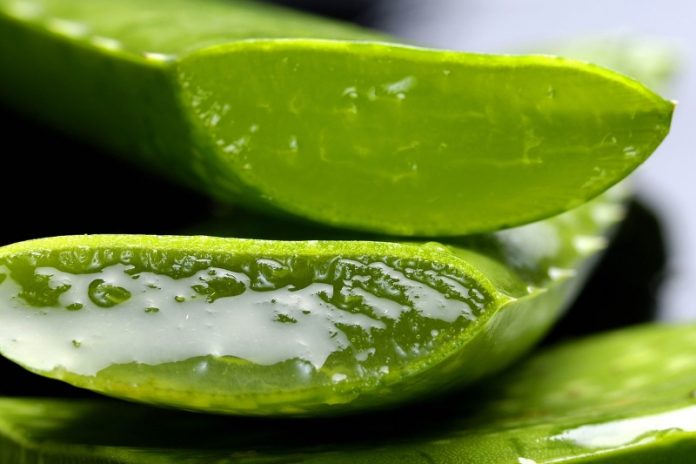
Filled with vitamins, antioxidants, and moisturizing fatty acids, aloe vera is considered the ultimate hair-and-skin superfood. The all-natural aloe gel also makes the perfect DIY ingredient, as its gooey center can be easily extracted. This makes aloe vera the perfect addition to any all-natural beauty routine. So we’ve rounded up our favorite aloe vera applications for the ultimate natural beauty hack.
Hair Mask
A raw aloe vera mask can do wonders for an itchy scale and dry, over-processed hair. Simply extract the gel innards of the aloe vera leaf, and blend it up to create a smooth consistency for easy application. For those with thick hair, consider straining your aloe vera gel first for ultimate saturation into your scalp and hair follicles. Leave mask on for up to 30 minutes, then rinse. You can store leftover aloe vera gel in the freezer, and defrost when you’re ready to use more.
Shaving Cream
No one likes the artificial scents of regular shaving cream. So skip the excessive chemicals and make your own DIY version using aloe vera. Simply apply your blended gel or even an exposed leaf directly over your shaving area. Just make sure you clean your razor thoroughly afterwards, as the gel can get caught in the blades. The aloe vera also has the added benefit of being the perfect aftershave, by soothing irritation and softening your skin.
Brow Gel
All out of your favorite brow gel? Instead, tame those frizzy hairs with little homemade aloe vera gel. Just take a clean mascara wand and dip it lightly in the gel. Then apply the gel over your brows. The gel will hold stray hairs in place while softening the hair follicle. This makes a particularly great beauty hack for those with sparse brows, because aloe vera promotes healthy hair growth.
Moisturizer
Aloe vera makes the perfect all-rounder moisturizer for both your body and your face. Just simply apply your blended gel directly to your skin, giving extra love to dry areas like your elbows and heals. For a quick DIY face mask, mix equal parts aloe vera with coconut oil and apply to your face, letting it sit for a few minutes before rinsing. Aloe vera also smooths mild skin irritations caused by things like acne, sunburns, mosquito bites or rashes.
Make-up Remover
Drugstore make-up removers can be drying on the skin, particularly when you’re trying to remove that killer smokey eye shadow. Instead, use aloe vera juice from the grocery store, or DIY your own juice. Just splash a few drops onto cotton balls to gently wipe away make-up. Apply more as needed. Not only will the aloe vera remove make-up residue, but will also add a layer of moisture.
There’s no question the Caribbean enjoys some of the most delicious food on earth. So it’s no surprise that so many food festivals called the region home. And there is something for every palate, from fine dining dishes made by celebrity chefs from around the world, to hyper-local festival food fairs perfect for the whole family. If you love a great festival, Caribbean food diehards, we’ve rounded up the best Caribbean food festivals for your next culinary adventure.
For Fine Dining Fans: St. Croix Food & Wine Experience, St. Croix
One glorious week in April foodies from around the work heard to this luxe festival, which features some of the finest chefs from across the region and around the world. But unlikely other fancy wine and food fests, this event is deeply tied to the community. Local restaurateurs Kelly Odom and Katherine Pugliese first founded the St. Croix festival to celebrate local talent, which is still the heart of the event. And among all this fining dining, the festival also serves as a non-profit, which raised over $1.5 million for community programs since launching the event. The festival makes a triumphant return in 2019, after the island suffered from two hurricanes.
For Conch Heads: Conch Festival, Turks and Caicos
Yes we could have picked the fabulous Caribbean Food & Wine Festival, which attracts celebrity chefs around the world, but we love how the Conch Festival celebrates this truly unique ingredient. Founded in 2004, the festival sought to bring more attention to the idyllic Blue Hills area, and chose the island’s symbol as the star of the show. Expect conch in every shape and form. This includes conch salad, fritters and stew of course, but also more inventive applications like conch empanadas and conch wontons.
For Cocktail Hour: Saborea! Puerto Rico
Saborea! Puerto Rico serves their annual festival with a dash of fun, filled with cuisine form around the world and plenty tasty libations to match. Among the four-day festivities, the Bubbles & Bites event remains a house favorite, where dishes celebrating local flavors are paired with sparking drinks. Or start your day right with their popular Brunch event, where chefs from restaurants around the world show off their skills. But perhaps nothing can beat their new Saborea Grand Tasting Sunset event, where patrons can enjoy delicious bites under the setting sun.
For The Freshest Catch: San Pedro Lobsterfest, Belize
For lucky patrons in San Pedro, Belize, luxurious lobster is just another local ingredient to add to the pot. Now all of us can enjoy their crustacean gifts at their annual festival, a massive, 10-day block party celebrating the reopening of the lobster season. Patrons can follow the great lobster crawl through the festival’s variety of events, sampling the shellfish in every different form imaginable. Whatever you do, be sure not to miss the lobster catching competition!
For Roots Foodies: Blue Food Festival, Tobago
This may be the only festival in the Caribbean celebrating the region’s iconic ingredient dasheen – the sometimes blue-tinged ground provision use in many classic dishes. Nicknamed “blue food” in Tobago, the Blue Food Festival shows off its multiple applications, as chefs are challenged to transform the ingredient into many appetizers, entrees and even desserts. The whole event enjoys a friendly fair atmosphere, with entertainment, live demonstrations, and a kid’s zone. Plus, one can’t miss the unique curry duck competition.
For Rum Acolytes: St. Lucia Food and Rum Festival
Rum reigns supreme as the liquor of choice in the Caribbean, and the St. Lucian Food and Rum Festival puts the brew front and center. The event hosts the region’s first Caribbean Rum Awards, plus unique mixologist specials, a rum-centric menu, and a show-stopping dinner by a celebrity chef, like this year’s Marcus Samuelsson. Restaurants across the island participate in the celebrations, so the festival makes the perfect excuse for an epic rum crawl, with delicious dishes to boot.
For 50 years, Roger and Ian Lewis have done countless sound checks, tours and recording sessions together. But on November 3, the brothers who co-founded the Inner Circle band in 1968, will share what maybe their most special moment as musicians.
That day, a gala celebrating Inner Circle’s 50th anniversary takes place at the band’s Circle House complex in North Miami. A who’s who of colleagues will be present including early members Ibo Cooper and Steven “Cat” Coore.
Inner Circle completed a four-month world tour in September, encompassing 46 shows mainly in Europe. The trek covered countries like Slovenia, Macedonia and Greece, unfamiliar territories for most reggae acts.
Roger, a rhythm guitarist, is the older of the brothers by two years. He credits the international hit songs, Bad Boys and Sweat (A La La La La Long), for making Inner Circle a perennial feature on the road since the early 1990s when they made an amazing comeback.
“Having those two big songs has got to be the highlight (of our career). Dat take us to places where many other groups might not go ‘cause di people know di songs. Everybody know Sweat, everybody know Bad Boys,” he said.
Bad Boys and Sweat are from the 1992 album Bad Boys which won the Grammy Award for Best Reggae Album the following year. It helped the Lewis brothers establish a state-of-the-art studio in North Miami where A-list stars like Beyonce and Jay Z, P Diddy, Justin Bieber and Shakira have recorded.
Ian Lewis the band’s bass player, notes that on each show, Inner Circle performs a medley of songs saluting Jacob Miller, the gifted singer who led them on roots classics such as Tenement Yard, Tired Fi Lick Weed In A Bush, Peace Treaty and Disciplined Child.
Miller was just 27 years-old when he died in a motor accident in March, 1980, forcing Inner Circle to take an extended hiatus.
With all the success they have enjoyed in the last 25 years, Ian Lewis is proud they retain a proud Jamaican identity.
“When Puffy and dem so-called New York man come here, dem smell di food wi cook…wi bring dem to Jamaica. Sitting here right now, yuh cyaan tell if yuh dey a Havendale or Maxfield or country,” he said. “Yuh nuh feel like yuh dey a foreign.”
But having a great niche, by itself, does not guarantee success. You must also have a good plan to manage the business. Here many entrepreneurs fall short. About 50 percent of all new businesses in the U.S. fail in the first five years. A failure to properly plan and manage the business may prove the culprit. Planning proves key to management. I am sure that you have heard it said: “If you fail to plan, plan to fail.” Planning simply means thinking ahead and trying to anticipate all the important things you need to get done to achieve your goal. We all do this instinctively. For example, the simple act of going to work on a morning requires us to think ahead and work out all the things we must do to get there at a specific time. Just like your day-to-day schedule, you must work out a plan to deal with issues such as:
Questions to Consider
What is your niche and how do you win customers over? (your Marketing Plan)
How much product must you sell to “break-even”, what are the anticipated costs associated with the business and how much capital is needed for start-up? (your Financial Plan)
How will your product be made, when, where and by whom? (Production Plan)
Who is going to manage and lead the business, what key people are needed to make this all work?(Leadership and HR plan)
The above are just some of the issues for which you may need a plan and the following are some ideas to help you get started:
Issues To Look Out For
Planning is common sense. I have heard entrepreneurs say that business planning proves hard for them because they struggle with numbers. While business is based on numbers, planning is based on logic, and you don’t need to be good at math to think logically. What you do need, is to understand certain key business principles and you may have to invest in yourself and get some training, before you invest in the business.
2. Get competent feedback on your plan before you invest capital. Too many entrepreneurs only want to hear positive feedback about their business and many of them rush off to invest, without getting an objective assessment from someone who would challenge their thinking. This usually does not end well.
Write your plan down and update it periodically. I encourage entrepreneurs to make notes of important business ideas, plan details, strategies and obstacles they must overcome. A business plan is a working document that must be modified and updated as time goes by and circumstances change. It is not a one time deal where you write it and forget it.
4. Get technical help where needed. Planning also requires technical expertise and experience, especially where with a large business with complex issues. Some cultures practice passing down successful businesses from one generation to another, as the old owners train and mentor the new. If you don’t have access to this support, you may need to find someone you can trust to provide guidance and advice when you need it. The great business pioneer Sir Richard Branson credits much of his success to surrounding himself with smart, competent business people and listening to them. Sounds like a good idea to me.
In the next segment, we will consider how Processes and People influence our success. In the meantime, feel free to send me your comments and questions at [email protected] and I will do my best to answer them.
The Charles F. Dodge City Center Pembroke Pines has announced legendary reggae stars Tarrus Riley aka Singy Singy, Dean Fraser and the Blak Soil Band, and special guest Jo Mersa Marley will appear in concert on Saturday, November 24 at 8 p.m.
Among the leading ambassadors of modern day reggae in Jamaica, Riley has built a growing catalog and international acclaim for his commanding vocals, intuitive lyrics and vibrant personality. The Blak Soil Band will feature saxophonist and Riley’s musical director Dean Fraser.
Praising Riley’s “wonderfully eclectic mix of roots, soul, and rocksteady,” New Times Broward Palm Beach reported, “The son of Jamaican legend Jimmy Riley, Tarrus has evolved from his Bronx and Florida beginnings as a dancehall DJ to a bonafide superstar across the Caribbean. His arsenal of feel-good tunes, socially conscious musings, and a voice that straddles multiple genres with ease has gained converts stateside too.”
Rolling Stone magazine declared, “Bob Marley would be proud of his grandson Jo Mersa.” By the time he was four years old, Jo Mersa Marley had appeared alongside his father, Stephen Marley, his uncle Ziggy and aunts Cedella and Sharon (a.k.a. Ziggy Marley and The Melody Makers) as part of the group’s rousing concert finales.
Tickets are $45-$65 with a limited number of $125 premium seats. Advance ticket sales are available only through Ticketmaster at Ticketmaster.com, by phone at 1-800-745-3000 and at Ticketmaster outlets. On the day of the show, tickets are available at the Charles F. Dodge City Center Pembroke Pines box office 90 minutes before the show.
There is no charge for self-parking. Valet service is available for most performances on the west side of the main entrance for $17.00.
The Charles F. Dodge City City Center Pembroke Pines is located 601 City Center Way, Pembroke Pines, FL 33025. For more information visit www.charlesfdodgecitycenter.com.
Designer Cholla Williams of Covered by Grace African Designs.
Fashion entrepreneur Cholla Williams is always on the go. As the founder and owner of Covered by Grace African Designs, the Jamaican native constantly travels around Africa searching for unique traditional fabrics and talented tailors to create her one-of-a-kind, custom pieces. Balancing contemporary textiles with modern silhouettes, her clothes have become to go-to for fashion lovers looking for authentic African sensibility. She also curates works by jewelry designers from across the continent, including Ghanaian jewelry designer Aphia Sakyi, whose pieces have been rocked by pop star Janet Jackson (which are also available from Williams’ collection). Covered by Grace will also be hosting the fashion presentation at this year’s Grace Jamaican Jerk Festival in South Florida. We spoke with Williams about launching her brand, her commitment to creatives across the Diaspora, and the lessons she learned along the way as an entrepreneur.
Describe your fashion brand’s central style. What makes your design approach unique?
We use traditional African textiles to make contemporary pieces. Our clients are sophisticated, professional individuals who love their African roots and are looking for ways to incorporate their heritage into their wardrobe. We also offer pieces that are truly representative of African tailoring craftsmanship. There is no one in the world who can read an African fabric like an African tailor. They’re reading the fabric design first, and understand how to preserve the textile’s authenticity and how to make it pop as a garment.
A custom design from Covered by Grace African Designs.
What inspired you to start your own label?
My company was inspired by a trip I took to South Africa. I met many young women professionals like myself who were concerned about bridging the gap among the Diaspora, and how we can do business to tie the two sides together. And I found surprising that, as we spoke about business, everyone was engaged, but the moment we switched and started talking about our blackness, I found that it was uncomfortable for them to talk about. I soon understood that they were still challenged about how their identity in the corporate world. How we can show pride wherever we are? We came to a consensus that if there is one thing everyone loves about Africa, it’s their fabrics. How rich the colors look on our skin tones, and what the different prints represent. After that conversation, I wanted to figure out how I can encourage my daughters to feel a part of their history. Coincidentally I had bought a few pieces for myself, When I got back everyone wanted them. I saw the joy and pride it brought to their faces, touching fabrics that were authentically made in Africa. This idea that I’m wearing something beautiful from the motherland. It was out of that joy that I saw an opportunity.
Describe your company’s model. What main fashion products do you offer?
We are a full service company, focusing on creating one-of-a-kind pieces for our clients. When designing custom pieces, we meet with clients face to face. We take measurements, choose fabrics, and create the designs together. We get those designs made by tailors in Ghana and Senegal. Once the final design is complete and sent back to us, mindful of our clients’ timelines, we do personal fittings with each client, and make adjustments here for final alterations. That’s the level of service we provide from a clothing standpoint. We do have some read-to-wear pieces available on our website. But that’s probably five to seven percent of our business. We primarily focus on custom design, mostly formal or semi-formal. The ready-to-wear pieces are more on the casual side.
Jewelry piece by Ghanian designer Aphia Sakyi, curated by Cholla Williams for Covered by Grace African Designs
How do you attract potential consumers?
We have a very intense marketing strategy. A lot of our business comes from word of mouth. Our reputation for great customer service and open communication has driven a lot of business for us that way. But we also do a lot of targeted social media marketing. I know exactly who my clients are and what they’re looking for. My corporate experience really helped in this matter. We’re very proactive and strategic in our business, so we can market appropriately. We’re already thinking way ahead about potential seasons where our designs would be in high demand, like Christmas or Black History Month. We know what works for us and what doesn’t, and that’s allowed us to streamline our energies both online and face-to-face.
You also have a corporate background as a business consultant. What useful corporate skills were you able to bring to your own company?
I know how to handle my resources, and know not only how to get customers and employees, but also how to retain them. I also value understanding my strengths and weaknesses. I know what it takes to be profitable and what my margins need to be, but I’m not an accountant. So learning how to lean on individuals who support you is so important. The key isn’t to just own a business, but how to truly operate one. I know when to reach out for help, and find those with expertise I don’t have. It’s particularly important to reach out to others in the Caribbean community and across the Diaspora.
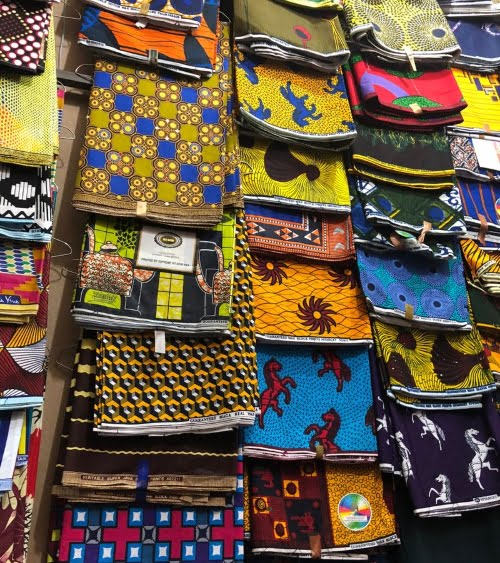
A selection of authentic African textiles to be used for custom pieces
What were the most valuable lessons you’ve learned from your business?
I’ve learned when life hits hard, hit back. That’s carried me through this process and through life in general. No matter what obstacles you face, it’s important to find a way to carry on. And passion never dies, and I’ve learned to let my passions drive my work. I’m constantly thinking about how do I tap into my passion, and how do I move from passion to profit. How do I turn my love for my culture into a business?
What also drives me is giving back. We’re always looking for ways to not just look out for ourselves, but also look out for others. Every year we’ve given back to children. This year we’ve sent a number of kids back to school both here and in Jamaica. We’re also gainfully employing talented African artisans who can now stand on their own two feet. There’s nothing more gratifying than that.
Most rewarding part about your business?
I’ve been in corporate America for over 20 plus years, but nothing compares to the joy of being able to give back. I love helping clients create a design that belongs to them and that honors their heritage. I love being able to take care of my team, and I love knowing that because of me, my tailors’ children are going to school. That because of me, their craft can be celebrated. It’s really what I live for. This is not just another business venture. I’m driven by passion and authenticity.
Faces and other designs carved into cave and river rocks are common across the Caribbean, offering a tangible connection to the Native legacies of the region. (Photo by Ernest Amoros)
The Taino peoples, the Caribbean’s first inhabitants pre-Columbus, have long labored under the illusion of extinction. Any Caribbean child will remember textbooks speaking of the region’s natives as a bygone culture. The Smithsonian seeks to break that narrative with a landmark exhibit called Taíno: Native Heritage and Identity in the Caribbean. Produced by the Smithsonian’s National Museum of the American Indian and the Smithsonian Latino Center, the exhibit explores the Taino’s history and their lasting cultural legacy in the region. The show also highlights the modern-day descendants and their contemporary and passionate efforts to keep Taino traditions alive and vibrant.
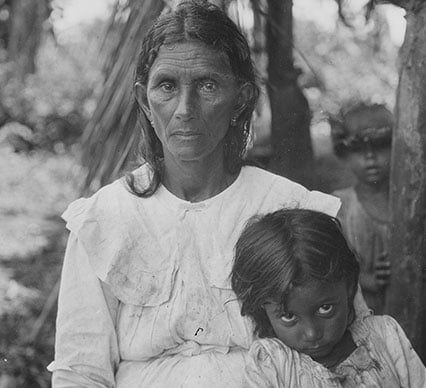
A Native woman (thought to be Luisa Gainsa) and child near Baracoa, Cuba, 1919. Native communities in eastern Cuba today work with researchers to document their history and culture. Photo by Mark Raymond Harrington, 1919. National Museum of the American Indian, Smithsonian Institution. (N04469)
The Taino civilization concentrated through the Greater Antilles, with large populations in Cuba, Jamaica, Hispaniola (today’s Haiti and Dominican Republic) and Puerto Rico. Today, a growing number of people have reclaimed their indigenous roots, preserving traditional practices passed through generations, and advocating for visibility. Such traditions include creating dishes like the “casabe” or “bammy,” a flat bread made from cassava. Tradition building methods were also preserved like the bohío, a structure made from local materials resistant to weather. Others also explore the Taino roots of common words like hammock and hurricane.
“In the last 20 years, a lot of Caribbean folks have said, ‘where’d this movement come from? History books tell me the opposite,’ and yet everybody who is Native has family stories and connections,” says curator Ranald Woodaman in an interview with Smithsonian Magazine. “This is a complicated story because in many ways we are reframing histories like survival and extinction. We’re saying that we can survive through mixture and change.”
To honor both the past and the present, the exhibit ranges broadly, from pre-Columbian sculpture pulled from the Smithsonian archive, to artwork from the popular superhero comic “La Borinqueña,” which prominently features Taino iconography.
The show will run through the end of October at the museum’s George Gustav Heye Center in New York City. If you can’t make it to New York, check out this special chat with the exhibit curators Woodaman and Jorge Estevez of The Museum of the American Indian.





















 I love this salad. As I’ve said before, I’ve never been a huge salad fan and being vegan didn’t really change that. However, I always make exceptions for delicious AND satisfying salads, which usually involves a cooked ingredient (see my Southwest Salad with Baked Seasoned Potatoes). This recipe is no different. The baked crispy chickpeas are a crunchy and satisfying element complementing the savory and sweet notes of the salad. The crispy chickpeas also hold up beautifully against the dressing. No soggy salads over here. And the bold flavors from the creamy Tahini Curry Dressing are the perfect match to the spices baked into the chickpeas.
 Because the spiced chickpeas and the curry dressing have such complex and bold flavors, I wanted to keep the salad ingredients fairly simple so the flavors didn’t become too muddied. That being said, this salad is still totally customizable because I think the addition of your choice of nuts or seeds could be a nice add-on or switch out the spinach for your favorite greens. Raw spinach is a personal favorite because it is usually pretty inexpensive, full of micronutrients, and has a mild flavor, which pairs perfectly with the flavors of this recipe.
 This salad is also really easy to make. While you’re cooking your chickpeas, you can prep your veggies and make your dressing. I personally really enjoy recipes that allow you to do other things while the oven is doing all the heavy lifting.