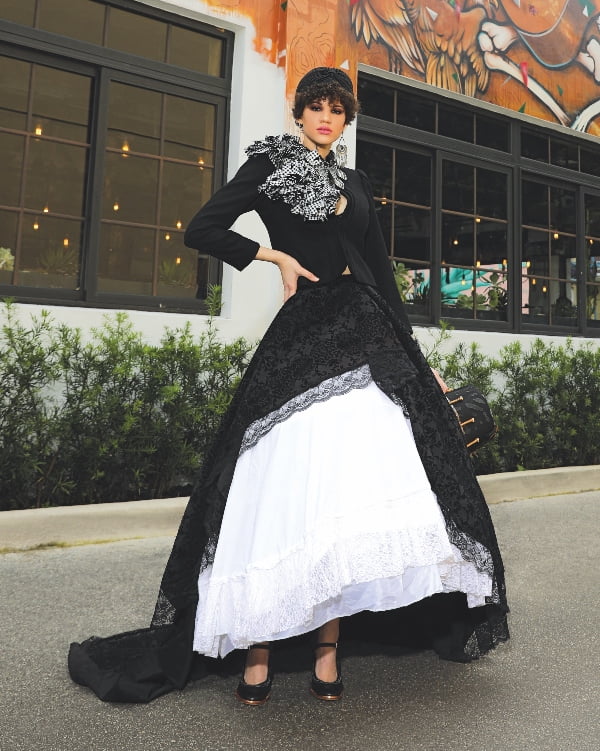
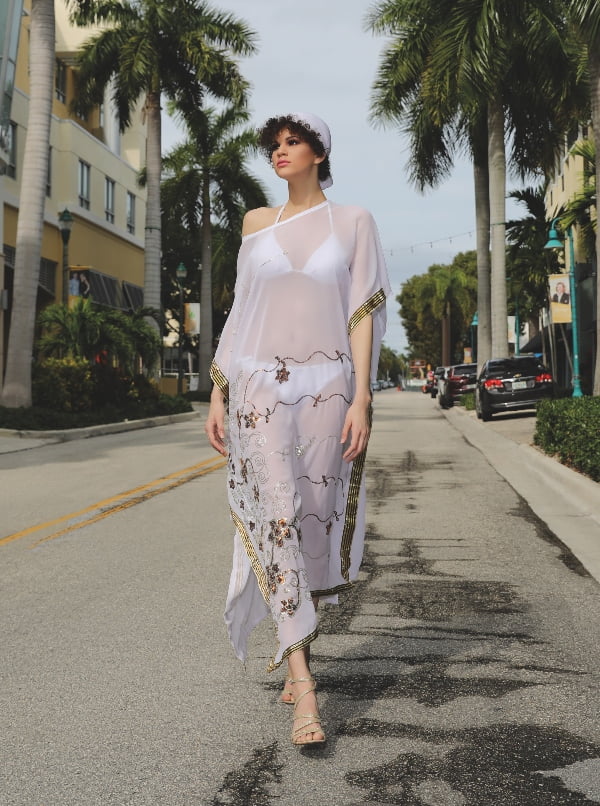
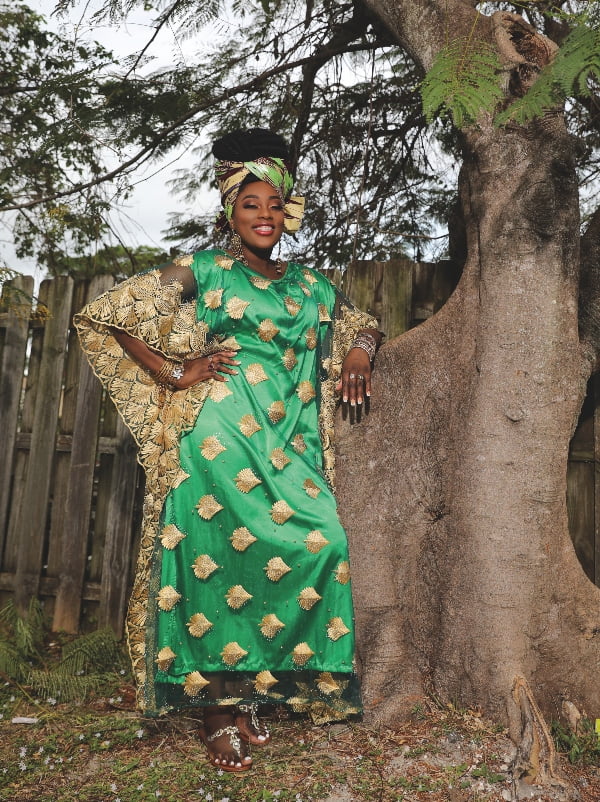
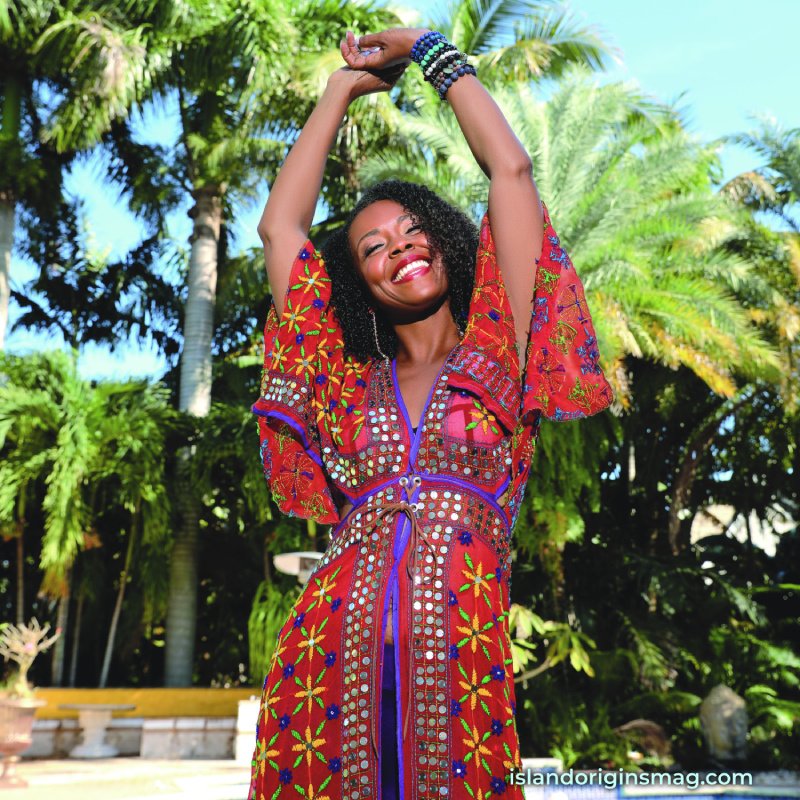
For her Genin Pa Presse collection, Haitian-American fashion designer Glavidia Alexis uses Haitian priestesses as her central muse.
“As a designer, inspiration comes from anything. Our sole purpose is to make it wearable.” So says Haitian-American fashion designer and stylist Glavidia Alexis, whose regal creations bestow an air of ethnic elegance. She muses about even the most abstract sources of stimulation. “I can be inspired by a lizard. Do I like the texture of his skin? Do I like the sebum that he produces? Do I like the color that comes out when he’s mating?”
It took her a while to work up the courage to develop her Genin pa Presse collection. “Its inspiration starts from vodouism and what each entity and spiritual deity represents. And the colors of each look or each collection signifies each spiritual object.”
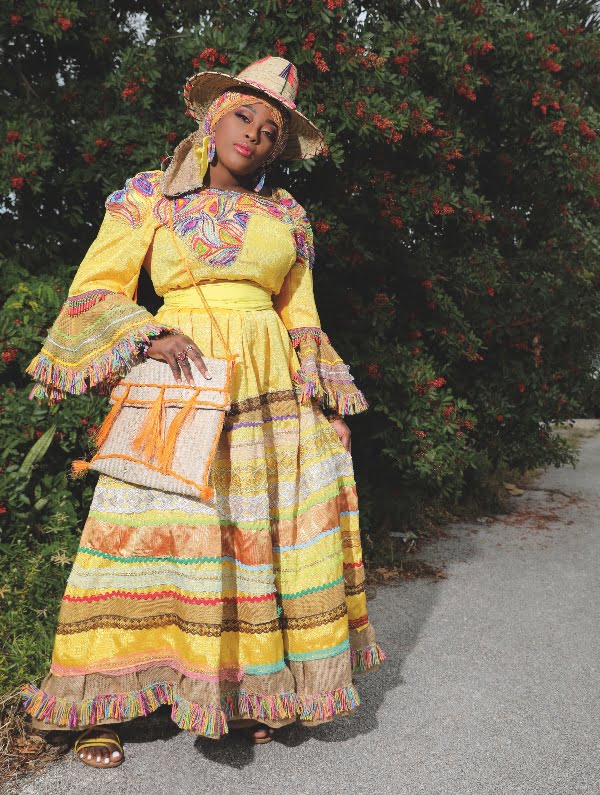
Glavidia’s lemon-hued yellow priestess dress honor Kouzin Azaka, a hardworking, brave farmer spirit who brings good fortune. Congo and Togo colors are interpreted with rich vibrancy and layered textures.
Trained in London and Italy, the daughter of vodou priestess Mambo Vivi was inspired by the elaborate dresses her mother would wear in her role as a spiritual leader. But vodou garb has a conventional aesthetic, and Alexis “didn’t want to be offensive to the traditional silhouettes and colors and shapes.”
Isabella’s skull-embellished, androgynous look, complete with top hat, cane and jacket, is an homage to the powerful male spirit, Bawon. Replicate the vibe in everyday wear with a black, high-waisted skirt with white ruffled top.
In reworking time-honored style, she started at home. She estimates that she may have made nearly 100 dresses for her mother over a three year period. A very supportive Mambo Vivi, who has an impressive social media following, shared Alexis’ looks with her instagram followers, who then began switching up their styles in homage to fashion. “That’s when I knew I had something,” said Alexis. “I think of it as a form of flattery. It was the kind of confirmation that I needed.”
A nod to the lighter garb of a baptismal ceremony, the white kaftan is ideal for a trip out on the water. Necessary dramatic detail was infused in elaborate embroidery.
With the implied approval of their virtual family, Alexis got to work. She took care to think about everyone the collection could represent. Her most elaborate dresses invoke the priestess, but other, more subdued designs represent the wider vodou community including dancers, servers and drummers, for example.
At its core, the collection honors the spirits (loa) at the heart of the ceremony. Alexis refers to the colors and textures, and the essence of deities like Danbala, the creator of life; Azaka, the spirit of the harvest; Ezili Dantor, parallel to the Black Madonna; and Bawon Samedi, father of the spirits. Most Haitians, though, worked in the fields, or enjoyed dancing. The silk and satin appropriate for celebrating the high spirits aren’t quite the right wear for these more mundane activities, so you’ll find cotton and burlap in Alexis’ style files as well.
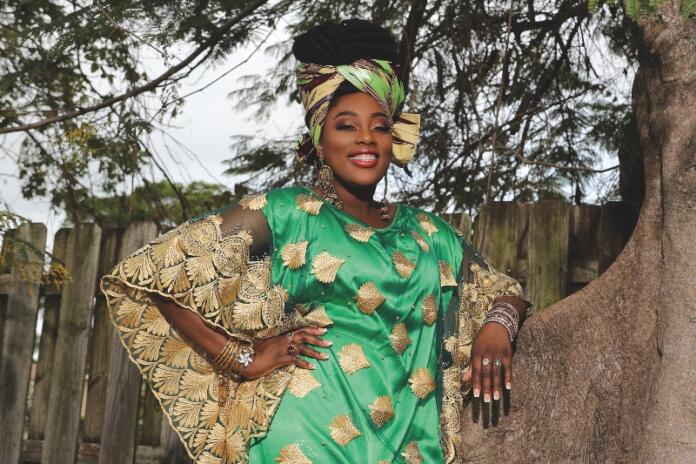
An ornate green and gold priestess dress inspired by Glavidia’s mom honors Danbala (St. Patrick). The rich fabric can be worn at weddings, galas and Vodou ceremonies.
The spirits and the practitioners are reflected in outfits that go from light brunches to fancy dinners, or from a day at the office to a day on the yacht. Though her pieces are often ornate, she encourages people to dress them up or down. “I’m also a stylist so I like my separates to be interchangeable.”
Alexis’ work is a balance between her source of inspiration and the customer she’s creating for. She’d like it if people would dress for the lifestyle they envision without creating a bubble for themselves in their own minds. “You can be inspired by a lifestyle and not be tied to that lifestyle,” she says. Even if you’re dressing up that way.
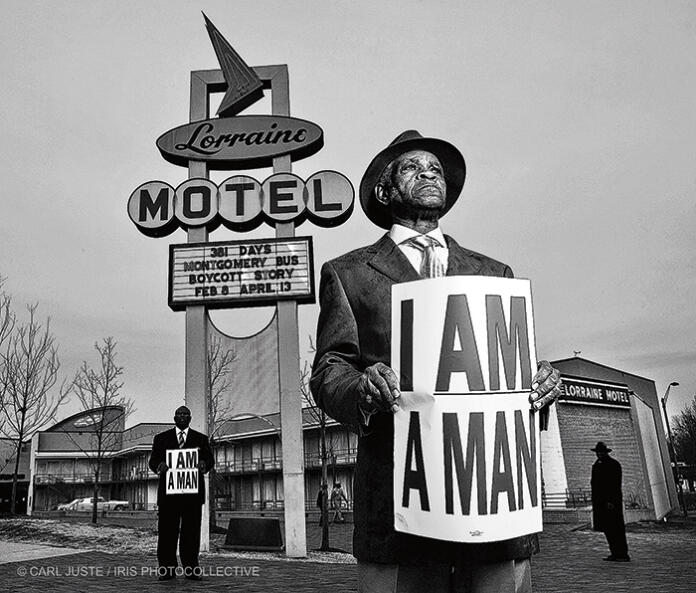
Carl Juste's portrait of striker Elmore Nickelberry, at motel where Martine Luther King Jr. was assassinated.
Filled with breathtaking challenges that have tested our faith and endurance, 2020 has been a year like no other. But, depending on the lens you look through, the pandemic, protests, polarization, misinformation and other maladies we are living through might simply seem like incidental variations on centuries-old themes. Among this turmoil, the tools of an artist can dissect the complexities of the present and connect it to the past. Inspired by their island heritage and history, Caribbean-American artists continue to make Caribbean art during COVID-193, producing work replete with lessons and stories of survival. We talked with four of them about how their creative process has evolved to meet the times and how 2020 has reshaped their sense of purpose.
The pandemic set in just as mixed-media artist Vickie Pierre was completing a residency. “I was deadlocked. I didn’t want to get in my car. I didn’t want to be in my studio,” she said, describing those first few days back in Miami. “Creatively, I was stunted. I didn’t work for about two months.
“Then the murders started happening,” Pierre said, referencing the police killings of George Floyd, Breonna Taylor and others. “And then you’re just left shocked and immobilized.”
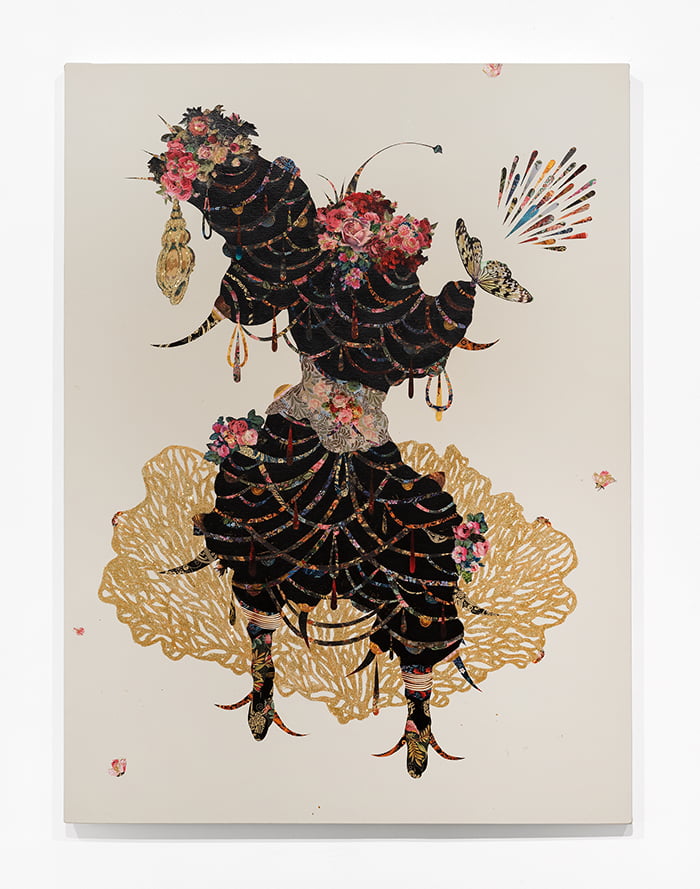
Pierre focused on completing pieces for a scheduled exhibition at the Fredric Snitzer Gallery in Miami. Part of an ongoing series, “Poupées in the Bush” is a surrealistic exploration of abstract Black female bodies adorned with gold leaf, flowers and elements of tribal dress. She also tried to complete works that focused on race, ethnicity and the Caribbean ― but she was stuck.
“My mind was really on what was going on and not really on how to resolve these pieces,” she said. “I realized it was because I needed to do something about that feeling of anger and sadness.”
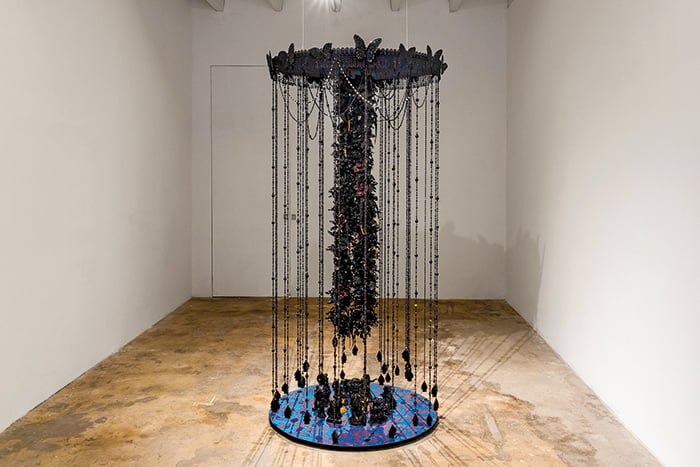
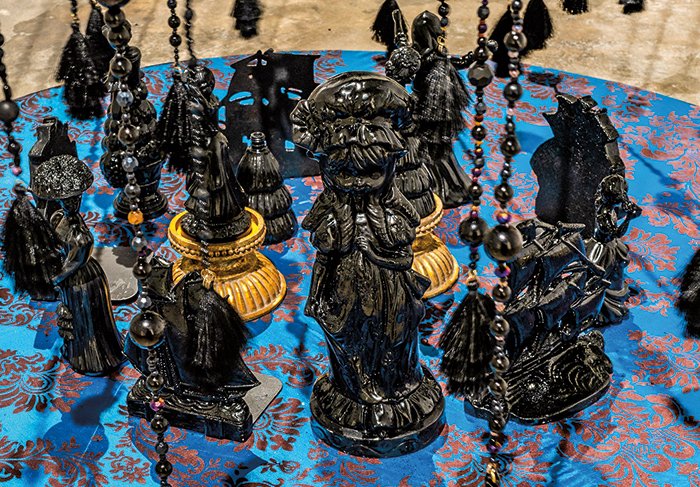
Using repurposed materials from perfume bottles to plastic butterflies, artist Vicki Pierre creates her latest installation “Black Flowers Blossom (Hanging Three).” Courtesy of Fredric Snitzer Gallery, Photography by Zachary Balber
So, she created a new installation: “Black Flowers Blossom (Hanging Tree).” It pulls ideas from her brainstorming notebook and from her thoughts about this tense, painful moment in American history. “I wanted to do a work that spoke to these deaths, systemic racism and historical racism, and how it affects just the general atmosphere,” she explained.
Pierre pulled imagery from multiple historical periods and places as a “nonlinear recognition of what’s going on,” and as representation of “a collective history.” This new direction proved challenging for her, in part, because she’s not comfortable using overt racial imagery. In most of her work, meaning lies just below the surface. Incorporating these more visceral fragments of the past felt necessary, she argued, to show that our identity is shaped, in part, by history.
Details of “Black Flowers Blossom (Hanging Tree).” Courtesy of Fredric Snitzer Gallery, Photography by Zachary Balber
In Pierre’s personal life, that history includes growing up in New York with a Haitian family speaking English and Creole and the new-to-her sense of community pride among Miami’s Haitian residents.
Paper and fabric collage: “It’s the God in Me and I Shall Live This Way Forever”
“I never thought of myself as a Caribbean person. I thought of myself as a New Yorker; I thought of myself as Black. That’s how I existed in New York,” she said. “Coming to Miami, the Caribbean is so prominent. It’s something I’ve sort of slowly integrated into. The funny thing [is], I feel like it was always present in my work in some way, but I never recognized it and acknowledged it as such.”
The phrase “new normal” — a term bandied about to describe the crises of 2020 — never sat well with Miami-based photographer Carl-Phillipe Juste. He has spent a career chronicling society’s most vulnerable as a photojournalist for the Miami Herald and as an art photographer exploring communities around the world.
From where he’s standing, “there is no ‘new normal’ [because] nothing has ever been normal. Normal is the luxury of the rich and the privileged. Most of the people on this planet are not privileged. Most of them probably don’t have a home where they feel safe, or an environment which they can control.”
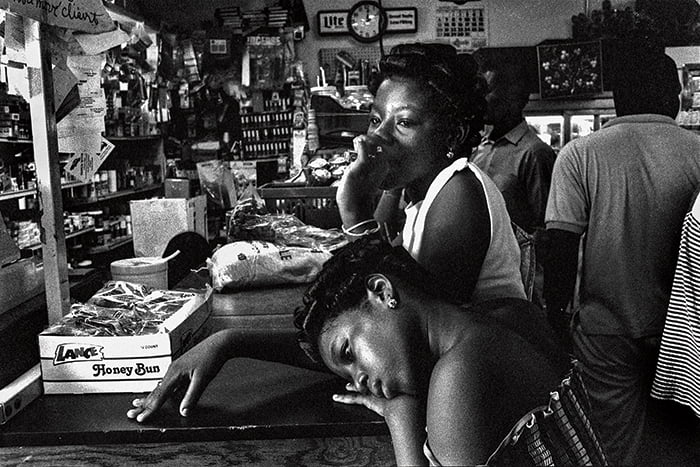
Carl Juste’s photo “Waiting for Change” features two young Haitian girls in the time of Arestide.
Uncertainty is familiar terrain for Juste, who fled with his family in 1965 from political persecution in Duvalier-ruled Haiti. Instead of despair, Juste learned from his parents’ response to upheaval, that we find resilience and hope only when working together. He saw this firsthand watching his parents Viter and Maria Juste become powerful advocates for Miami’s growing Haitian refugee community in the 1980s, in what would become Little Haiti.
The result, for him, became an intense appreciation for the importance of community. “We get to believe the individual is so powerful it can control all circumstances. It cannot. No one comes on this planet alone,” he said. This collaborative spirit continues to feed his work, starting with the Iris Photo Collective ― an organization he founded to bring together artists of color to tell stories about their communities, which are too often ignored in the public eye.
Responding to the unique turmoil of now, he has directed Exile At Home, a series with WLRN and Miami Book Fair featuring still images, video and written narratives collected from people who shared their experiences with COVID-19. Another collaboration, Imagined Visions of Hope, featured small collections of photographs submitted by artists from around the world that the group hopes to exhibit on five continents. Juste is also one of seven photographers from Florida, Oregon, New York and Washington, D.C. contributing to Defiance ― a project inspired by the Black Lives Matter movement, and for which they hope to secure funding to display in February.
Little about 2020 has changed his photography, which looks toward the possibilities of the future even as he dissects the present. “For my process, I’m interested not about me,” he said. “I’m more interested in what other people think about the same subject because then I have something to engage with. I want people to talk to each other. I don’t want people sitting there trying to think how I was thinking or how I was feeling. I don’t go around asking what I am, I go around asking why it is.”
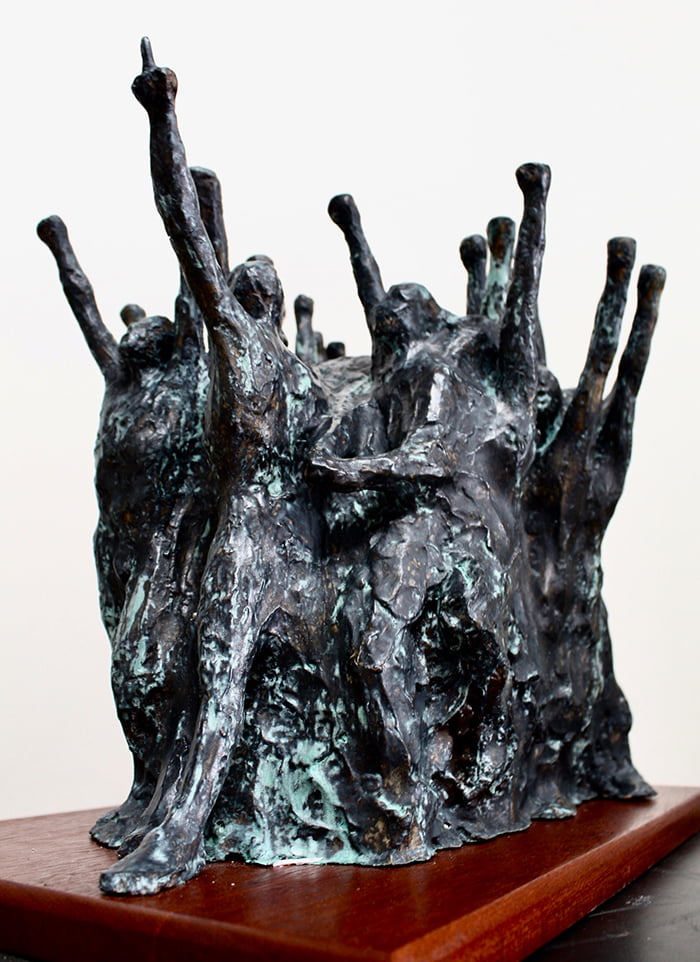
Simmering with frustration and hope, a crowd stands tall with fists raised high in Jamaican artist Basil Watson’s bronze tabletop sculpture, “Boiling Point.” Among them, one figure steps forward and points to a better future, looking back as if urging the others to join him. Depicting the resilience of the human spirit, this piece resonates with current, guttural public cries for change. Incarnating the spirit of 2020, it reflects attitudes toward the nationwide Black Lives Matter protests against police brutality, the public health fight against the COVID-19 pandemic that disproportionately kills Black Americans, and the heated presidential election that exposed the nation’s economic and racial divides.
But Watson made “Boiling Point” in 1986, not 2020. The piece was inspired by the fight to end Apartheid in South Africa.
Watson’s 1986 bronze work, “Boiling Point”
“[These are] things we are discussing today and have discussed for decades,” said Watson, who now lives in Atlanta. “It focuses on protest, on sacrifice, [and] on leadership.” It’s the enduring poignance that inspired him to find funding and a public home for a large-scale version of the sculpture, specifically at a location where victims of police brutality were killed.
Creating such monuments to what Watson calls “the heroic in mankind” has been a central focus throughout his remarkable career as a sculptor, known for his expressive approach to the human figure. His works include public commissions in Jamaica, depicting national luminaries like Usain Bolt and Louise “Miss Lou” Bennett-Coverley.
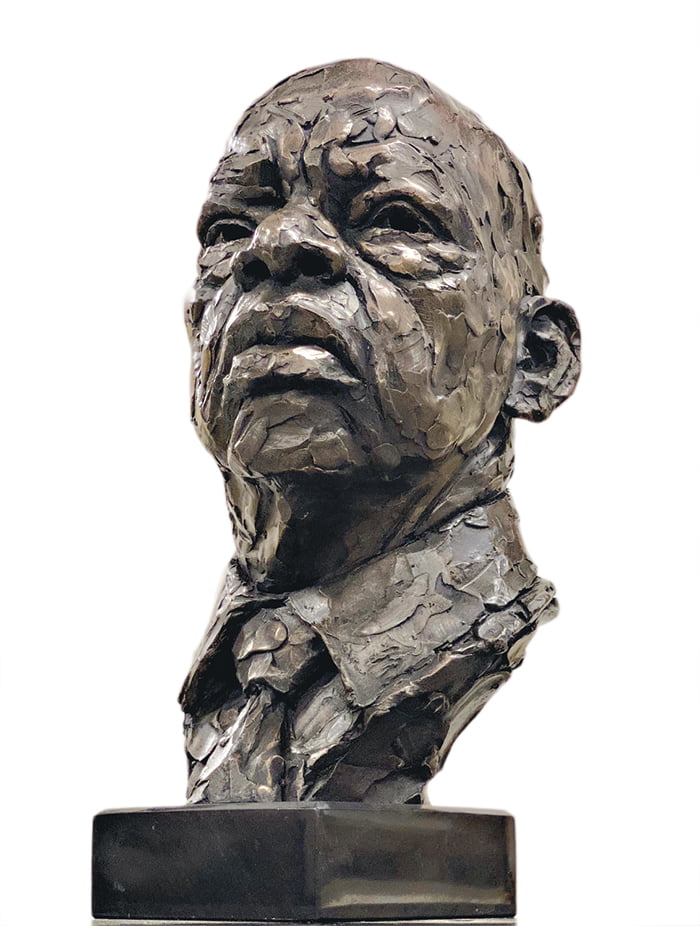
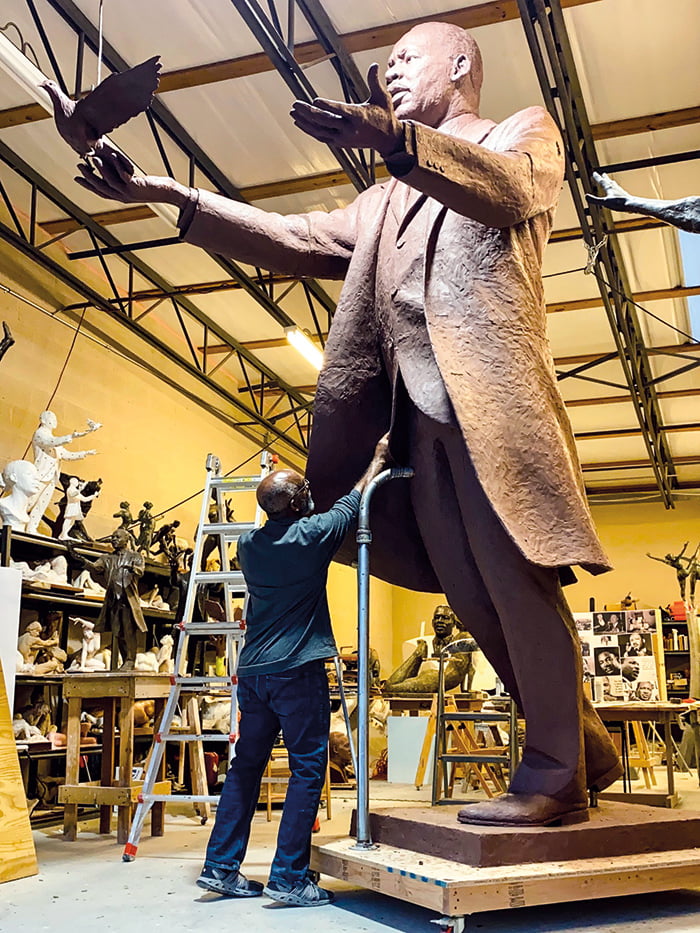
His most recent projects turn to heroic figures from his adopted city Atlanta: from a personal project sculpting a bust of civil rights activist and U.S. Representative John Lewis to a towering commissioned statue of Martin Luther King, Jr., greeting visitors outside the Mercedes-Benz Stadium in Atlanta.
Watson’s bronze bust of celebrated Senator John Lewis.
Such work exploring who we honor, and why, feels perfectly suited for this moment in history. To Watson, American public sculpture has often been valued primarily for its artistic merits detached from intended themes or historical context. Now, a growing movement has demanded public artworks — in particular Confederate monuments — be weighed in their complete social context.
“With all my time at home, with the pandemic and social protests that have been taking place, it has focused my attention on social issues that have been with me for my entire life,” he said. “Martin Luther King Jr., for instance, when he was killed I was [about ] 10 years old. Growing into my teens, the effect of that on the world and Jamaica was strong.”
The artist at work on monument honoring Martin Luther King Jr.
This influence of Watson’s heroes “was always there,” he said. “But I think the recent past has refocused on a lot of those issues. ”
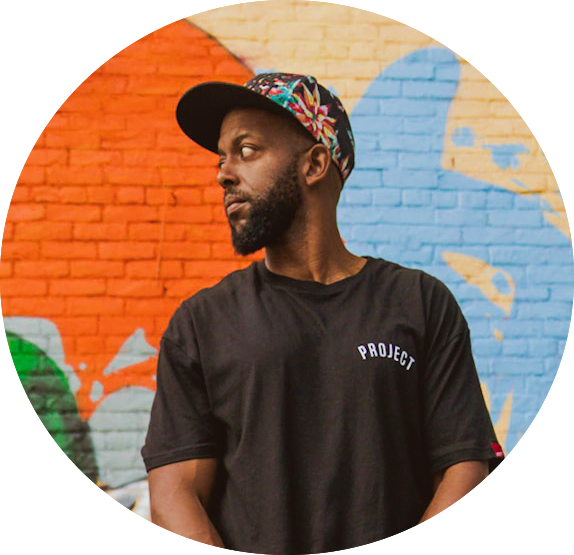
In 2019 (when viral pandemics were only the stuff of cinematic nightmares), painter and muralist Nate Dee found himself visiting his parents’ native Haiti, participating in the Port-au-Prince mural showcase Festi Graffiti. Something clicked as he walked through the event. Surrounded by the vivid hues of Haitian public art, he realized that his parents’ homeland had quietly affected his own artistic approach ― that there is something uniquely profound about artists bringing joyful color to places and people that need it.
“Traditional Haitian art is very vibrant and very bright even when they’re discussing things that are heavy and grim,” noted Dee. In his earliest days as a graffiti artist, the Fort Lauderdale-based painter discovered the power of color, which he translated into his current paintings and murals filled with chromatic, mythical figures.
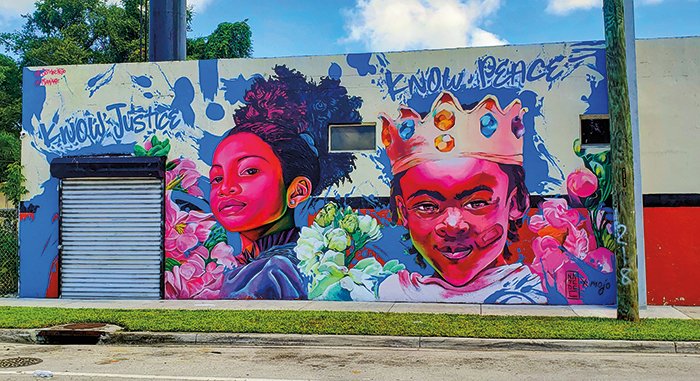
Right now, this feels more true than ever for Dee, whose full name is Nathan Delinois. The color-driven perspective inspired his latest collaborative project with fellow Florida artist, Mojo ― a mural in Miami’s Brownsville neighborhood that they titled, “Know Peace.”
Miami mural “Know Peace” is a collaborative work by Nate Dee and Mojo.
The work offers “a different take on what activism might look like and what resistance might look like,” he explained. “I saw this quote that was something like, ‘Just to be happy in these times is an act of resistance.’ We wanted to create a mural that was a nod to what’s going on, but also focused on the other side of that: holding on to your happiness, holding on to your love and holding on to your joy.”
This year has inspired a subtle shift in Dee’s creative process. He now feels drawn to create more public art rather than small individual paintings because these “would have the biggest impact.” Events like the Black Lives Matter protests have inspired him to reflect on how he approaches themes of identity in his works and the purpose of his public art.
Dee hopes his colorful works draw viewers into reflection on the grand themes of life rather than tying directly to a specific instance in time or making a particular declaration. Yet, the death of George Floyd spurred him to directly address the world. Drawing inspiration from the Spray Their Name campaign in Denver, Dee also designed a print work and donated his profits from it to the cause.
He believes these unique opportunities provided by public art projects spark conversation, whether that’s how a neighborhood views itself or how the work communicates to the larger world. “You’re creating a dialogue among people who aren’t always heard, or who don’t always have access to the conversation,” Dee said. “Public art is a way of organizing and creating open dialogue with people.”
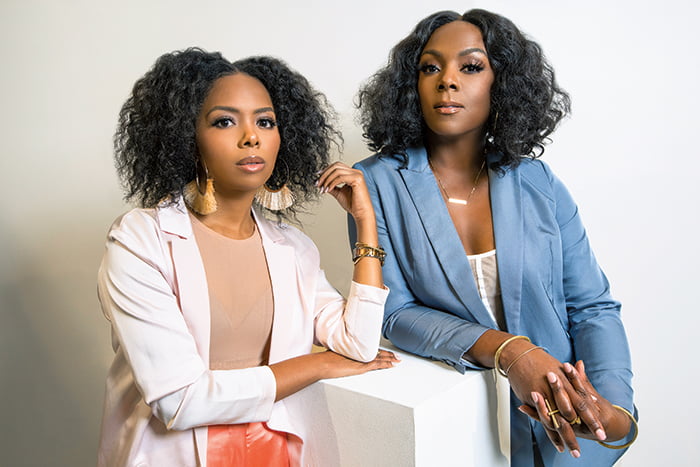
For design partners Tavia Forbes and Monet Masters, creating beautiful living spaces has always been about building relationships. Each client of their acclaimed Atlanta-based design firm Forbes + Masters brings an opportunity to learn a new story. “We really try to get to know them. Where they like to shop for clothes, or where they traveled recently,” explained Forbes. “All of our projects reflect what has been stuck in our clients’ heads.” To create these connections, they’ve learned to leverage their shared Jamaican heritage — and all the confidence, boldness and gregariousness that comes from it — to draw out their clients’ best selves.
“Jamaicans are very expressive, and we definitely got some of those vibes from our families,” said Forbes. “So we’re able to break walls, break barriers, and get them to talk to us in ways that they otherwise wouldn’t have,” added Masters.
Interior design partners Tavia Forbes and Monet Masters of Forbes + Masters. PHOTO: Michael Phillip Scott
This intimate approach comes naturally to both designers, who first developed DIY skills and stylistic sensibilities early on because of their fathers. Forbes, who was born in Mandeville, Jamaica, shadowed her dad at work as a contractor and custom cabinet builder. Masters, who lived both in Los Angeles and Houston, grew up watching her father shape stand-out living spaces. He didn’t just want to live in his home. He wanted to be inspired by it.
“At one point, our living room consisted of green leather sofas and green carpet that matched exactly. We had a fish bowl coffee table that lit up bright blue [and] purple,” Masters said. “You knew it was only about style when the fish died within two weeks. Then it was just the table full of water and rocks.”
Forbes’ laughter spilled over the story. “I’ve never heard this!” This energetic exchange perfectly captures the friends’ creative partnership, as we discussed more engaging stories behind three of their design projects.
Living Room Redux
Photo Credit: Courtesy of Forbes Masters
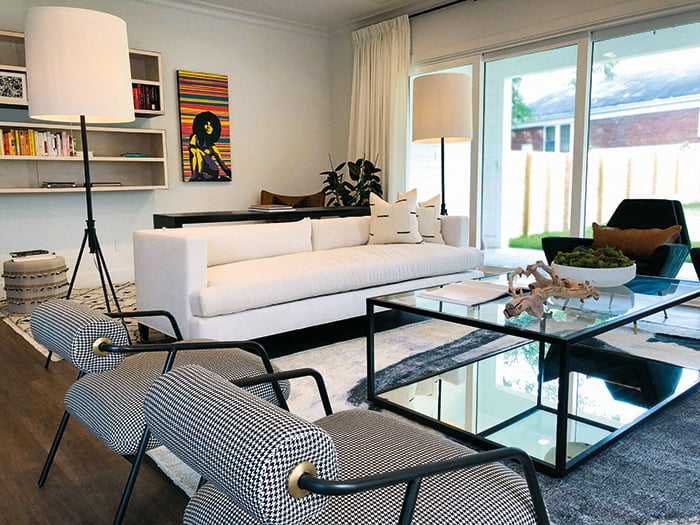
When a young doctor in South Carolina wanted to enliven her living room for entertaining, Forbes + Masters had to charm details out of the shy client. They discovered an eclectic playfulness that shone through in her precious books and art pieces, which they took care to showcase with custom, built-in shelving. To complement these elements, the duo had fun sourcing seating that had unique geometric shapes, but also felt comfortable for guests.
Choosing the right pieces proved tricky, however, as they wanted chairs that would not obstruct views of the backyard. This led to some special finds, like the rolled-back armchairs they reupholstered in houndstooth. “Trying to find a stylish chair that doesn’t take up volume can be very difficult,” noted Masters. “These had a lot of personality and didn’t shoot up high in the air like a balloon chair or wingback would.”
Dining in the Tropics
Photo Credit: Kimberly Murray
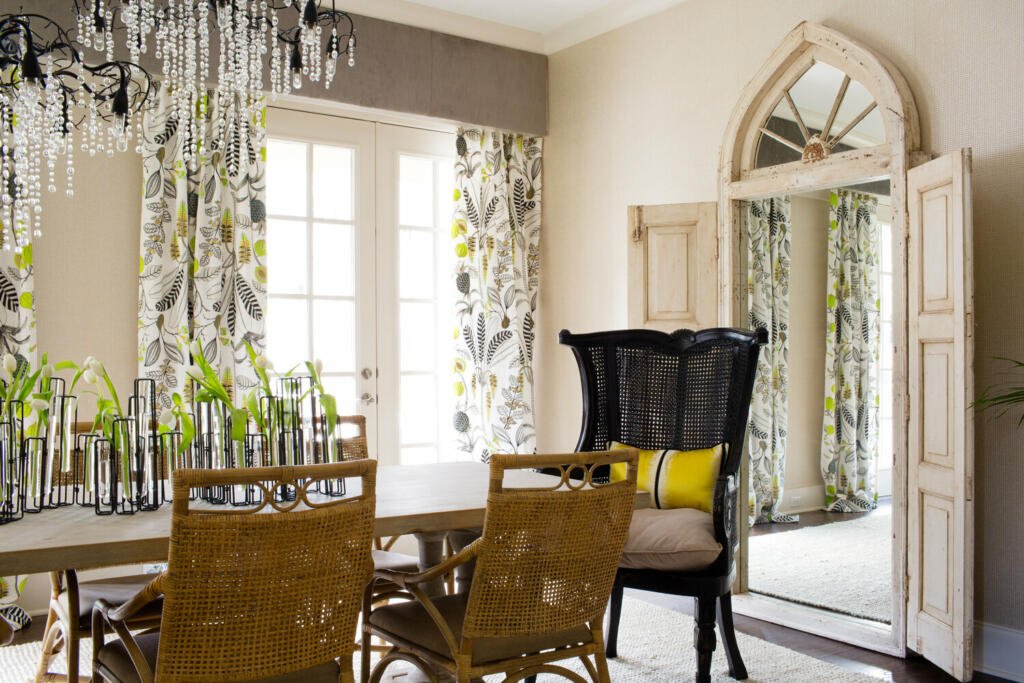
A mother, daughter and grandchild in Georgia wanted a bright, whimsical design for their first formal dining room. Inspired by their clients’ Puerto Rican heritage, Forbes + Masters tapped into the colorful, nature-centric spirit of island living.
The room was fortunately blessed with bountiful light through French doors, which they framed with intricately embroidered drapery featuring a botanical motif. Textured wicker and caned detailing on the dining chairs also helped “hint at that island vibe,” said Forbes. They also chose a grasscloth wallpaper with silver and gold leafing, as the natural hues and soft glimmer “reminded us of sand when you’re on the beach,” Forbes noted.
For statement lighting above, they went hunting for a chandelier that mimicked a cascade of tree branches, but their first find was beyond the budget. For a thrifty-chic solution, they first found a similar, smaller fixture for a fraction of the price, buying two units and painting the champagne-gold hardware a contrasting black hue to play up its organic lines. They then hung both at different levels to command the same attention as the pricier piece.
Photo Credit: Kimberly Murray
Bedroom Beach Fantasy
Photo Credit: Kimberly Murray
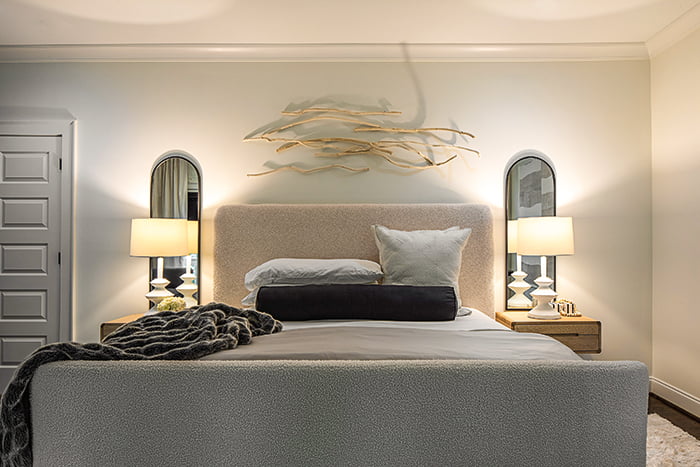
A film executive asked Forbes + Masters to update her bedroom to fulfill her dream of “a beach house in landlocked Atlanta” that matched the monochromatic tones throughout the rest of the house. “She’s never home, so we wanted to create a retreat for her,” said Masters. “We wanted a space that was calming and would still feel natural.”
Photo Credit: Kimberly Murray
Instead of leaning on a more conventional coastal style, the pair used interesting textures to capture the relaxed mood of a seaside escape. On the wall, they created an artistic focal point by framing gauzy, striped Élitis wallpaper with white trim. Plush textiles also invited more relaxation, like the blue velvet on the curvaceous settee and bouclé upholstery on the headboard and bed frame. More texture came through accents like the bleached driftwood above the headboard, and delicate lamps that “looked artistic and handmade,” Masters said. “Like something you would buy near a beach town.”
“God himself says that you have to forgive to be forgiven. I don’t forget what happened. But I do forgive.”
A soft-spoken Haitian immigrant living in New York, Abner Louima was just 30 years old when, on August 9, 1997, police officer Justin Volpe falsely accused him of assault outside a nightclub.
At the 70th precinct station in Brooklyn, Volpe and his fellow officers inflicted an hours-long attack on Abner Louima in one of the most shocking documented cases of police brutality in U.S. history. Louima sustained life-threatening internal, external and psychological injuries. Now, after 23 years, he credits faith, family, and the resilient spirit of Haiti and the Caribbean for making it this far.
“We are survivors. We can overcome any adversity,” he said.
His is a tale as old as time for African Americans. But for newer immigrants in the African diaspora, inherent targeting of Black people at the hands of rogue police officers is a newly familiar phenomenon. This diaspora, having left their homelands in search of the great American Dream, has come to learn that too often Black families in the United States are left mourning the death of targeted loved ones and wondering whether justice will ever be served. Louima recognizes that he’s one of only a few.
“I’m thankful because God wants me alive to speak about my own story. Most of the people that have been victimized really don’t have a chance to speak,” he said. Acknowledging his higher calling, he grants, “If God saved my life, he saved it for a reason.”
In a rare occurrence, Abner Louima’s perpetrators were tried and convicted. In a separate civil case, he was awarded the largest settlement in a police brutality case in New York City’s history — $8.7 million. His abusers were jailed; Volpe is still serving time in a 30-year sentence.
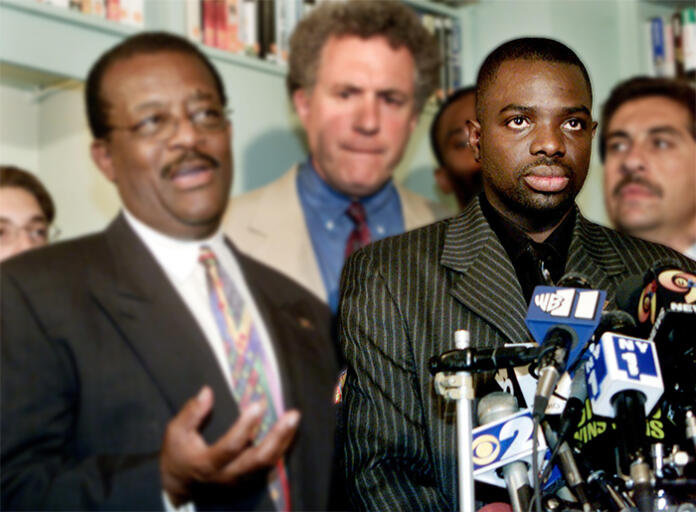
At the time of Volpe’s conviction, Louima became the icon of a movement. Black leaders, like Al Sharpton and Johnny Cochran, and advocates from around the world, rallied around him. An international campaign arose, much like the groundswell that followed the recent murder of George Floyd. Yet even now, a solution remains out of reach.
“I didn’t think that I would be talking about [police brutality] 20 years later, but it seems like nothing will change,” Louima said.
Though faith and family have been his support, dealing with the trauma is an ongoing battle.
“Each time there’s a case of police brutality or police misconduct, it brings back all the memories,” he said. But, “you have two choices. Either you let it affect you, or you deal with it. I have no choice but to deal with it.”
Today, living in South Florida, Louima is a real estate developer and philanthropist. Connecting with fellow survivors has become a central part of his healing process. He finds comfort offering them guidance and support as well as advocating for legal reform to deter future police abuse.
In the immediate aftermath of his own ordeal, Louima said the support of the community, particularly from the Haitian diaspora, “gave me courage.” Still, as long as the problem persists, so will he.
“We have to keep fighting until we get systemic change,” he said. “They are not going to hand it to us. So we have to keep fighting.”
From families to small businesses, all have been disrupted by the COVID-19 pandemic, and many have been left in financial uncertainty. In response, residents can get COVID-19 support in Miami-Dade County, offering pandemic assistance services particularly among the county’s Black, Indigenous and immigrant communities. With support from the federal Coronavirus Aid Relief and Economic Security (CARES) Act and other partners, the county is offering financial aid and social services for the people at its heart.
Family: For families, this includes programs addressing basic living expenses like food and housing. In collaboration with Feeding South Florida, the county hosts weekly drive-thru food pickups at more than 20 community distribution sites. On Saturdays, families can source fresh-picked, locally-grown produce at the Miami-Dade County Auditorium. Those struggling with rent also may receive relief up to $5,000 over three months through Miami-Dade County’s Emergency Rental Assistance Program.
Military: Veterans and current U.S. military personnel also can access housing support if they need it. The Military and Veterans Housing Assistance Program helps cover past due rent or mortgage payments for up to three months, with a maximum of $5,000. Veterans may receive funds for other critical expenses like groceries, medical supplies and baby care products through the Basic Needs Program, which provides vouchers up to $1000 for individuals and $2,000 for families.
Small Business: Businesses in hospitality, transportation, and even arts and entertainment can apply for grants and loans provided through the county. Small business owners with 25 or fewer employees who operate in Miami-Dade are eligible for assistance through earmarked funding. This relief addresses financial needs including employee payroll, supply expenses, utilities and disruption or reopening costs. The Small Business Assistance Forgivable Loan Program, in particular, distributes loans of up to $25,000, with 0% interest and no origination fees.
“The pandemic has placed a shock on our families and businesses, but with these safety nets in place we can bounce back and hopefully come out and make innovations that will allow us to withstand future shocks,” said Miami-Dade Mayor Daniella Levine Cava.
Learn more about how the COVID-19 Pandemic Assistance Program in Miami-Dade county can suppoort at miamidade.gov/covidhelp.
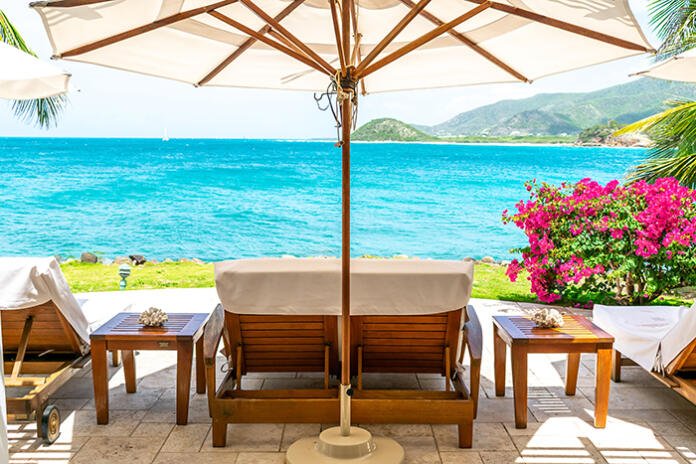
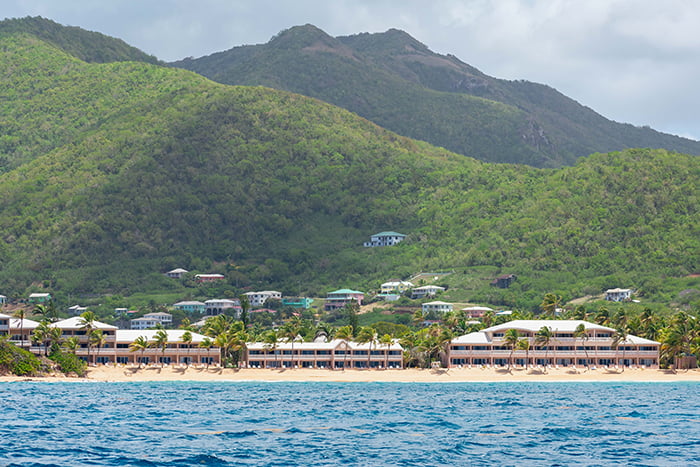
Ocean views at the amazing spa at Curtain Bluff Resort in Antigua.
Photo credit: Steve Bennett/UncommonCaribbean.com
Quarantine fatigue combined with the public’s increasing ability to cope with the constraints of post-COVID life have more people longing to escape to the warmth of the West Indies this winter. COVID-19 Caribbean travel at present, however, is anything but business as usual. Borders to many destinations remain closed. Entry protocols and quarantine requirements also vary throughout the region — as do restrictions on visitor activities in certain places.
So how best can you navigate the new normal of COVID-19 Caribbean travel while still enjoying the islands? Here’s a look at what to expect when exploring these select tropical shores.
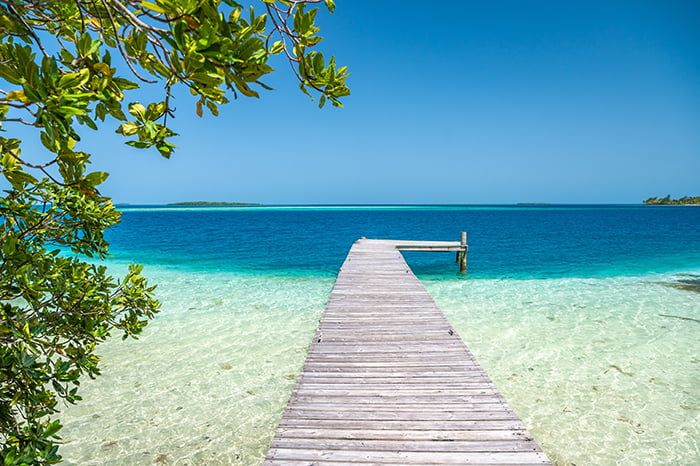
Belize
Photo Credit: Patrick Bennett/UncommonCaribbean.com
For a quick and breezy getaway, it’s hard to beat Belize right now. Recently relaxed entry requirements mean that visitors no longer need to quarantine upon arrival. No application is necessary to visit either. Assuming you arrive with proof of a negative COVID test, or test negative at the airport, then you’re free to roam — mostly.
This is because the government of Belize still advises travelers to use businesses that are part of their Tourism Gold Standard Program, which means they adhere to all health guidelines related to COVID-19. Such services include hotels and resorts, tour operators, attractions, rental car companies, taxis, restaurants and gift shops.
Visitors are strongly encouraged to limit their fun in Belize to businesses-certified operations under the Tourism Gold Standard Program. All are clearly listed in the convenient Belize Health App, which all visitors must download and initiate within 72 hours of arrival in the country.
Curaçao
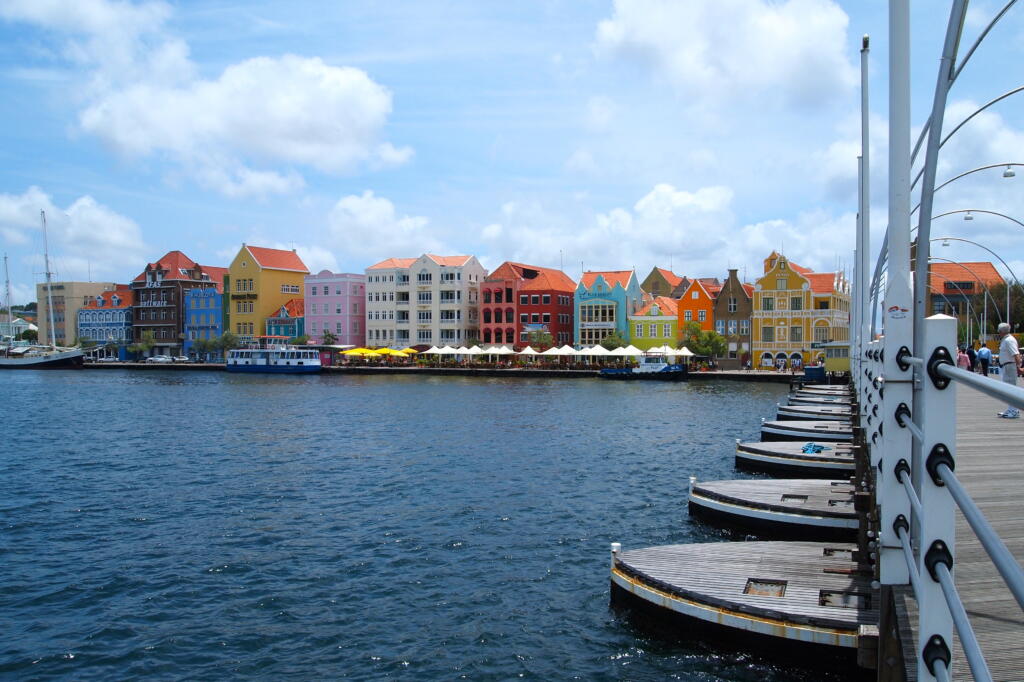
View of the skyline along the Punda side of Curaçao’s capital city, Willemstad.
For added freedom of movement along your Caribbean travels, Curaçao is another great option right now. The guidelines here allow you to rent a car and experience the island as usual, assuming you wear a mask in public and maintain the same six feet of social distance we’re all advised to follow here in the United States.
Before you can visit Curaçao though, U.S. travelers must complete some mandatory tasks. First, you need to complete an online digital immigration card and digital Passenger Locator Card, available at dicardcuracao.com. You will need to fill out these documents at least 48 hours prior to departure and carry a hard copy with you during your stay. Travelers are required to show printed proof of a negative result from a certified COVID-19 test upon arrival. Tests must be taken within 72 hours of travel, and results must remain on your person during the entirety of your stay. You’re also required to upload a copy of your negative test result to the website.
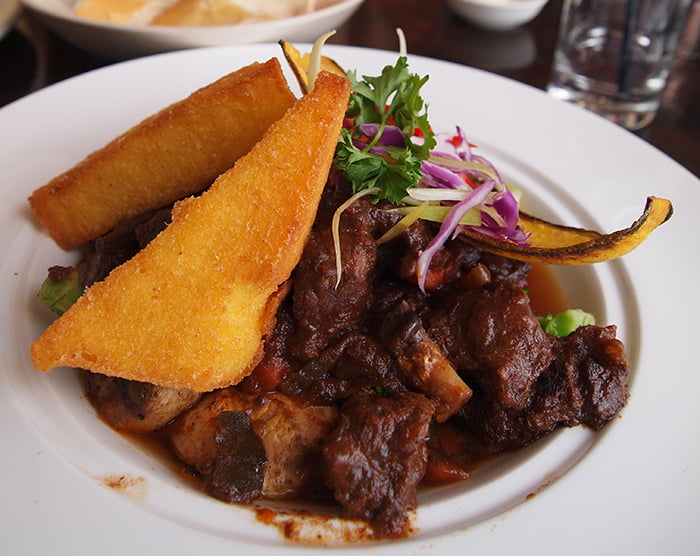
No visit to Curaçao is complete with a taste of local dishes like Karni Stobá. Photo Credit: “Steve Bennett/UncommonCaribbean.com
To cover any health concerns, the Government of Curaçao requires visitors to be adequately insured for medical care, including possible quarantine extended stays. During this pandemic, however, travel health insurance is a smart decision no matter where you visit.
Antigua and Barbuda
Antigua’s luxury escape, Curtain Bluff Resort, which reopened Oct. 24. Photo credit: Steve Bennett/UncommonCaribbean.com
If a more extended Caribbean escape is what you have in mind, Antigua and Barbuda may be just what you’re looking for. The twin-island nation is offering a Nomad Digital Residence (NDR) visa program that lets visitors live and move freely within the country for up to two years.
Ideal for professionals and students with the flexibility to work or study remotely, the NDR program carries fees of $1,500 for single applicants, $2,000 for couples and $3,000 for families of three or more persons.
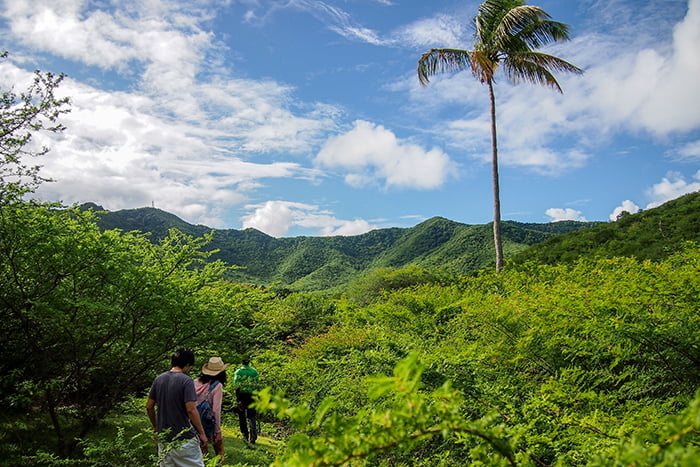
Hiking through the Bolans area of Antigua showcases that there’s much more to this special destination than its 365 beaches. Photo credit: Steve Bennett/UncommonCaribbean.com
All visitors to Antigua and Barbuda must have proof of a negative COVID test taken within seven days of arrival. The only exception applies to kids 12 and under, who are not required to be tested. At-home test results are not accepted, and travelers must complete a Traveler Accommodation form prior to travel.
Jamaica
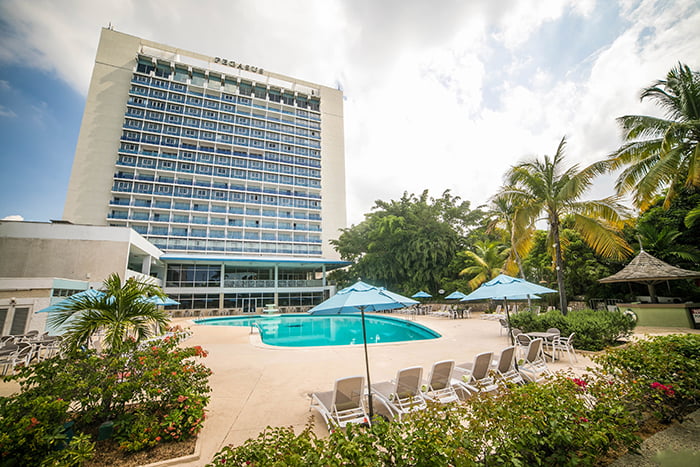
Select guest rooms at the Jamaica Pegasus in Kingston have been converted into office suites to accommodate digital nomads. Photo credit: The Jamaica Pegasus
“Resilient Corridor” is the buzzword travelers must know when visiting Jamaica these days. There are actually two of them. One extends from Negril along the north coast to Portland. The other encompasses the New Kingston Business District. If you’re visiting Jamaica, that’s where you’ll be.
While roaming freely throughout the island is not currently an option, visitors can explore within the Resilient Corridors with limited restrictions. For instance, all taxi transportation must be with operators licensed under the Tourist Board Act. As well, visitors are required to stay at hotels that have received COVID-19 compliant certification. You’re not allowed to hop around to different hotels either—a policy that would help streamline contact tracing should the need arise.
As with Antigua, your length of stay can be quite extensive in Jamaica. Select hotels have launched “workation” packages to give digital nomads the unique opportunity to live, work and play in paradise. The Jamaica Pegasus Hotel in Kingston, for instance, offers a workation package for a 30-night minimum stay, with rates starting at just $3,499—a savings of more than 70% off.
More so now than ever, we need to show some love and support for our creators across the Caribbean diaspora. So, why not support unique Caribbean brands while treating that special someone in your life? With this in mind, we rounded up a handy guide of 10 amazing Caribbean gift ideas for the whole family. From hand-crafted rum to chic accessories, all these Caribbean gift ideas are available online for purchase.
A New Kind of Wild, Zara González Hoang
Inspired by her father’s experience moving from Puerto Rico to New York as a child, author and illustrator Zara González Hoang’s moving and colorful tale for children captured the spirit of the adage, “Home is where the heart is.” penguinrandomhouse.com
I am A Promise, by Shelly-Ann Fraser-Pryce
A retelling of Jamaican Olympic gold medalist Shelly-Ann Fraser-Pryce’s uplifting journey to stardom, the charming picture book encourages young readers to stay steadfast with determination to achieve their dreams. akashicbooks.com
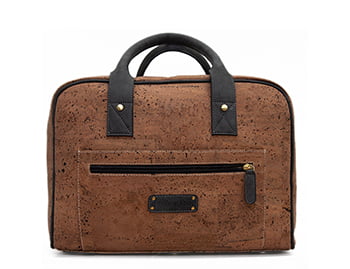
Fitted with sustainable cork and lined with faux leather, the Friday Bag is compact and water-resistant. Jamaican-born designer and founder Sonja M. Salmon created this completely vegan luxury carry-on for the avid globetrotter or weekender.
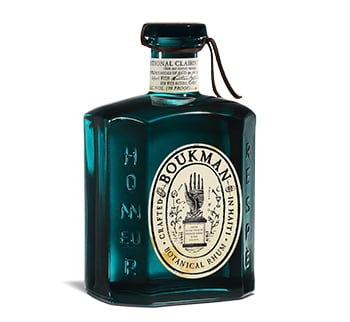
Bottled in Haiti and infused with fresh cane juice, barks, citrus peel, and seven botanicals, this dry craft rum makes a delicious addition to holiday festivities. Served best on the rocks with an orange peel, or stirred into classic cocktails.
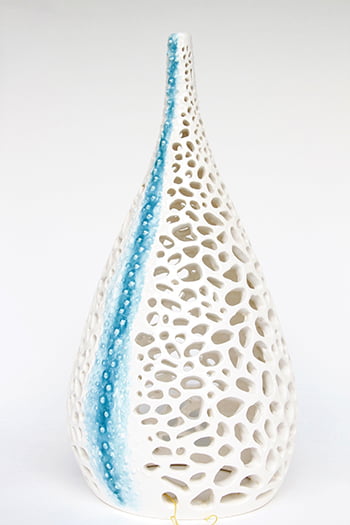
A part of the Urchin Collection, this pendant light by Jamaican ceramic artist Victoria Leigh Silvera makes a great addition to any home, featuring organic details inspired by Caribbean marine life.
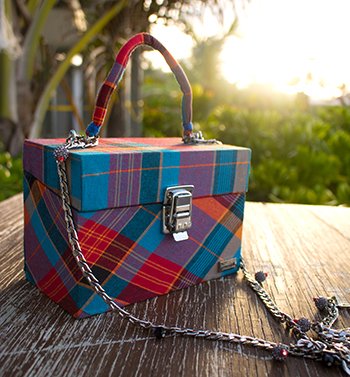
Cop this cute tote handmade in the U.S. Virgin Islands. The design features a classic Caribbean madras print, velvet-lined interior, detachable chain strap, and subtle glass bead and gem embellishments.
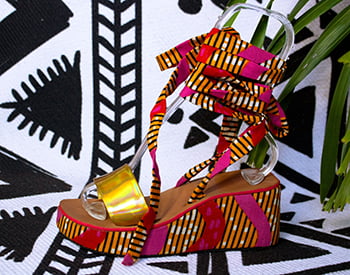
Territory Six: Tropic Spiral Holographic Ankara Sandal
Made for the modern fashionista, add the Tropic Spiral Holographic ankara sandal to your shoe collection! This stylish wedge features a shiny holographic accent, ankara print and ankle-tied straps.
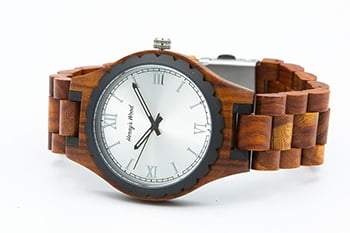
Made from 100% reclaimed wood, this lightweight, fashionable and eco-friendly watch by the Jamaican brand features a stylish rosewood design that’s fitted with a stainless steel back case and buckle.
Eternalize your love with the Forever With You band ring by Trinidadian jewelry designer Josanne Mark. Permanently etched with your significant other’s fingerprints, this luxurious memento carries intimate sentiments.
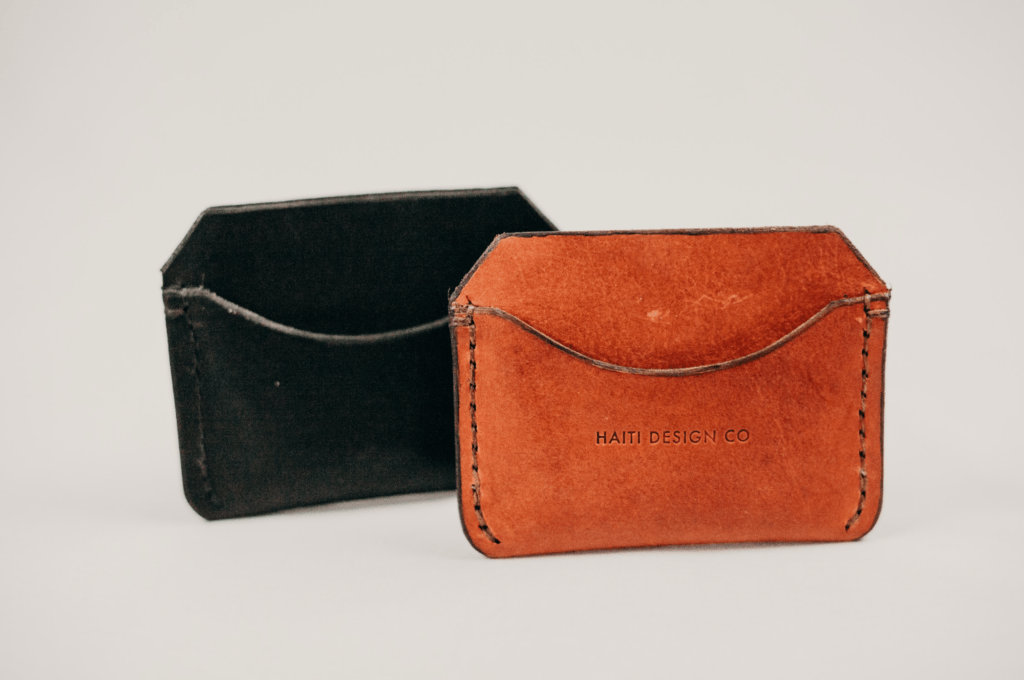
Haiti Design Co. is founded on the premise of community empowerment. Pieces such as this simple, but timeless and well-crafted, leather card holder is just part of the company’s mission to foster entrepreneurship among local artisans.
Act of God — these three words universally strike at the heart of every small business. In contracts and insurance policies, the dreaded phrase describes the unpredictable chaos that can be conjured by the forces of nature, laying waste to even the best-laid plans. Caribbean-American small businesses, particularly those in South Florida, are no strangers to weather catastrophes. The prolonged economic crisis caused by COVID-19, however, is unprecedented. “It’s brought a high level of uncertainty to the market, especially in areas that are common among Caribbean entrepreneurs such as hospitality, retail, and food and beverage,” says Kurt Dyer, a Jamaica-born business adviser and vice president of strategic operations at Fortune 500 construction firm, Lemartec.
Kurt Dyer
He argues that businesses can endure such trying times with a willingness to sacrifice and adapt. For Caribbean-American small businesses navigating this uncharted territory, Dyer breaks down the essential steps to regroup and reevaluate. “In a very real sense, business is like being at war,” he explains. “You have to be thoughtful, weighing the pros and cons of advancing or retreating. But if you don’t take these things into consideration, then you become a casualty.”
Cut Overheads
Faced with reduced revenue, many Caribbean-American small businesses turn to emergency loans to continue forward. Dyer advises first curtailing operational costs before assuming debt. “You need to evaluate how you manage your business and look for efficiencies,” he says.
For renters, he recommends calculating the potential benefits of breaking the lease. Removing such a major expense from the books may be worth paying the penalties for leaving early. But first, “know your terms,” he advises. “What are your exit clauses? Then do a cost-benefit analysis to understand what you are going to lose.” In addition, “a great CPA (Certified Public Accountant) can help you find tax benefits from your losses.”
To reduce cash outflow, Dyer also advises that owners renegotiate with suppliers for payment flexibility. “If they normally give you a 90-day credit, ask if they can extend it to 120 days,” he suggests. “For them, it’s always better to have a paying customer than a non-paying one.”
Perhaps the hardest cut — but the most necessary — is to personnel. Dyer acknowledges this is an emotional choice for tight-knit small businesses. However, furloughing employees now is better than losing the business forever. “You are doing them a disservice when you keep them and can’t afford them,” he notes. “You then won’t have a business to which they can return.” Instead, Dyer advises that owners focus on individuals that best serve their current needs. “You want to have someone in your shop that can help you navigate this storm.”
Adapt Your Business Model
With continued social distancing protocols, it’s far from business as usual for those who normally operate based on face-to-face interactions. “If you still hold the mindset that the fundamental tenets of your business remain the same after COVID-19, you’re going to fail,” advises Dyer. “Businesses that survive have to readjust their business model to meet the market.”
Many operations can find alternate revenue streams by using social media to market and sell to their customers. Others can pivot to more socially distant operations. For example, Dyer has seen businesses like restaurants successfully transition from on-site service to delivery and curbside pick-up. “They are now in a better position for the future because they had to adapt,” he says. They also may have expanded their possible customer base.
Reach Out for Advice
When looking for new ways to innovate, it’s important to connect with knowledgeable people for guidance. They could be more experienced entrepreneurs in the same field, or those with specialized skills — from building online sales platforms to applying for grants. “Because during a crisis, alliances matter,” says Dyer. “There’s wisdom through counsel.” Chambers of commerce are a fruitful resource, offering workshops where members exchange strategies.
Risk-Proof for the Future
Dyer predicts that market instability will extend well into 2021 as COVID-19 cases continue to rise. Despite recent breakthroughs in vaccines, wide scale inoculation won’t be possible for at least a year. In response, businesses need to manage their risk exposure.
In the short term, this means preparing for more closures. “If you’re in an environment where they’ve had shutdowns in the past, plan for a shutdown (again),” he notes. Preserve any operational adjustments made for social distancing, so you can reenact them quickly, as needed.
This is a good time to reevaluate contracts for additional protections. “If you didn’t pay attention to your lease agreement before, you sure are going to pay attention now,” jokes Dyer, who recommends discussing business interruption clauses with landlords. He suggests examining how your business insurance specifically addresses losses due to a pandemic. It’s also a great time to seek better terms from vendors, like discounts for quicker payment cycles.
Thinking about the big picture, Dyer sees the positive potential of reinventing in response to the pandemic; these current challenges could become opportunities in disguise. “It’s about taking the lessons we learned forward,” he said. “You’re always trying to get lighter and more agile during a time of crisis. But it’s also in these times when we become the most innovative.”
From the first descendants of indentureship who settled across Antillean islands, a rich community has emerged with a distinctive artistic expression all its own. This has become most pronounced in the realm of performance. Indo-Caribbean artists have hybridized and creolized traditional folk dance and music, fusing the Old World and new. Today, Indo-Caribbean artists living in America give voice to the diaspora, bringing visibility to their community and advancing Caribbean culture across the nation’s stages.
Denyse Baboolal
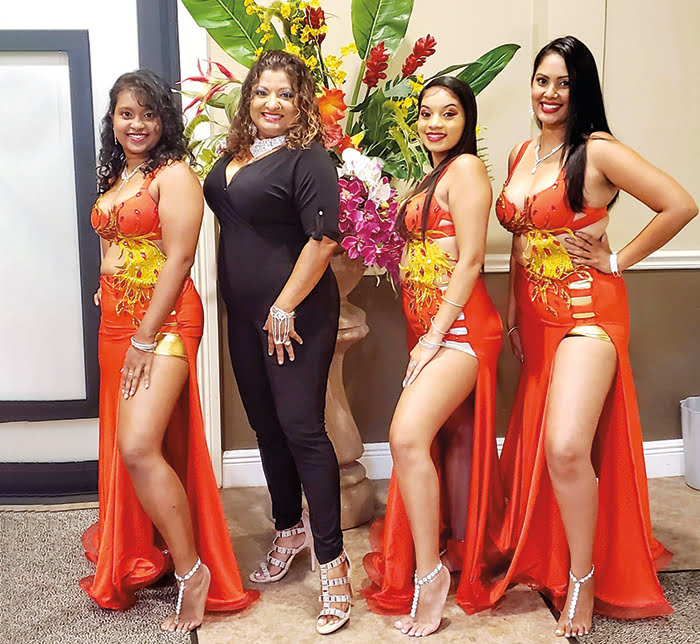
(L-R): Dancer Vedasha Roopnarine, founding director and choreographer Denyse Baboolal, and dancers Ilicia Dow and Rose Sahade.
Culture and community are intimately intertwined for Trinidadian native Denyse Baboolal, the proud founder and director of Jayadevi Arts Inc.—the first Indo-Caribbean arts nonprofit in the southern United States. Based in South Florida, Baboolal has become an essential advocate for nurturing Indo-Caribbean culture in America. For more than two decades, she has performed and choreographed both Indian and Indo-Caribbean dance forms across the country.
“We try to show them that India has Bollywood, but in the Caribbean, we have chutney,” Baboolal said of the unique Caribbean style informed by Latin and African influences. “At shows, we say, ‘This is our version of Bollywood,’ so they see the difference of where our roots started and where we are today.”
What differentiates Jayadevi Arts from other Indo-Caribbean cultural groups is their celebration of art forms from across the wider Caribbean diaspora. Every year at the Phagwah spring festival celebrations, also known as Holi, Baboolal said she showcases “not only Trinidad and Guyana, but also Jamaica, Suriname, and Belize. We represent Indians from all segments of the Caribbean.”
Jayadevi Arts also regularly performs at political events throughout South Florida. In addition to carrying the torch to the next generation, Baboolal hopes this visibility underscores the community as a distinct group with specific needs. “We want to be able to go into the political arena to say, ‘Hello, we’re Indo-Caribbean.’ When we tick on ‘Other’ and we write ‘Indo-Caribbean’ on the Census, this is who we are. And we need to be recognized.”
Mohamed A. Amin
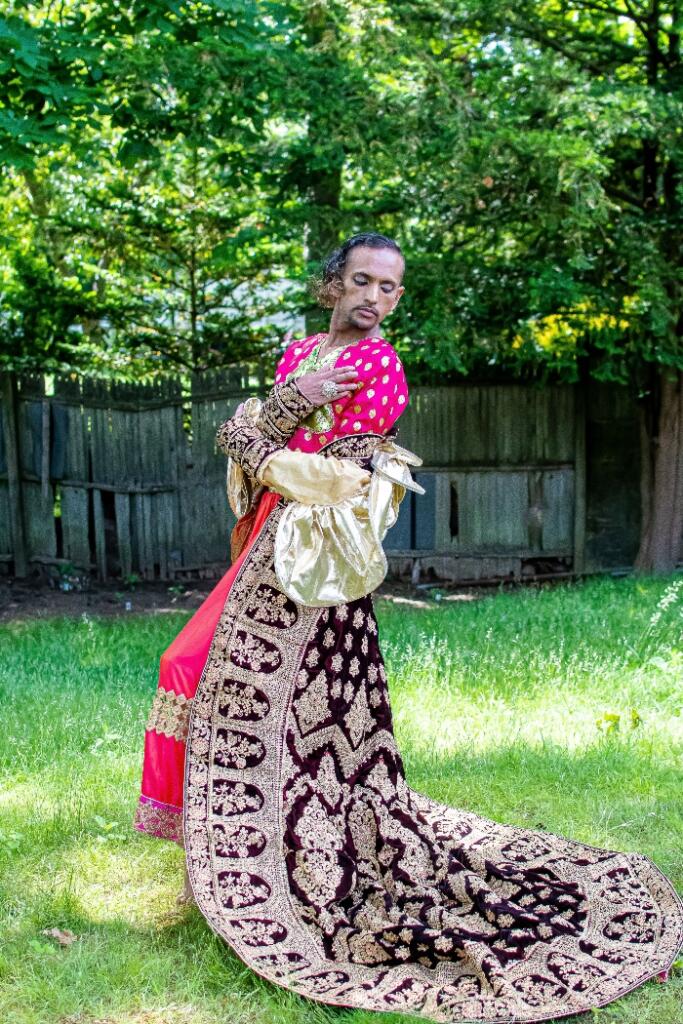
Caribbean bacchanal and drag performance fuse to magical effect for pioneering New York-based dancer and choreographer, Mohamed A. Amin. Performing both under his stage name International Dancer Zaman and his drag persona Sundari, Indian Goddess, the proudly gay, Muslim and Indo-Guyanese star has become an icon of nightlife in Queens, N.Y., and the LGBTQ Caribbean community.
The drag persona Sundari is a regular star attraction during the city’s pride celebrations, dancing at the historic Stonewall Inn and the Queens Pride Parade and Multicultural Festival. In 2018, she made history becoming the first drag queen to perform on the main stage at the 30th Annual Queens Phagwah Parade, joining the acclaimed Tarang Dance Group. “It was a historic event for not only our LGBTQ community, but for the Indo-Caribbean diaspora as well,” Amin said about the landmark performance.
International Dancer Zaman. PHOTO: Aarti’s Photography
When dancing to Bollywood and soca hits as Sundari, Amin is usually bedecked in jewelry and lush traditional dress. Beyond the glitz and glam, however, this alter ego has a deeper purpose for Amin—proving that LGBTQ identities and Caribbean culture are not mutually exclusive and that they can be synergetic. “Our Indo-Caribbean community has a long history of LGBTQ identities infused in our culture,” Amin said. “Over the past 10 years, I have used my identity via dance to remind our community of this history that has been forgotten, that became socially and culturally unacceptable.”
He’s also a volunteer of the Queens-based Caribbean Equality Project, an LGBTQ advocacy group founded by his brother, Mohamed Q. The organization’s mission was inspired by Amin’s own survivor experience from LGBTQ violence. “Though LGBTQ artists’ visibility was once slim to none, setting a gender equality standard in my artistic practice has created a wave of transformation within our community in Queens.”
Artist performing as drag persona, Sundari, Indian Goddess. PHOTO: Padma Photography, Raj Singh.
Going on two decades as a performer, Amin remains committed to his art’s empowering impact. “Whether it’s at a senior home, rally, cultural community event or at a wedding, it’s a great blessing to share our rich Indo-Caribbean culture with others.”
Levi Ali
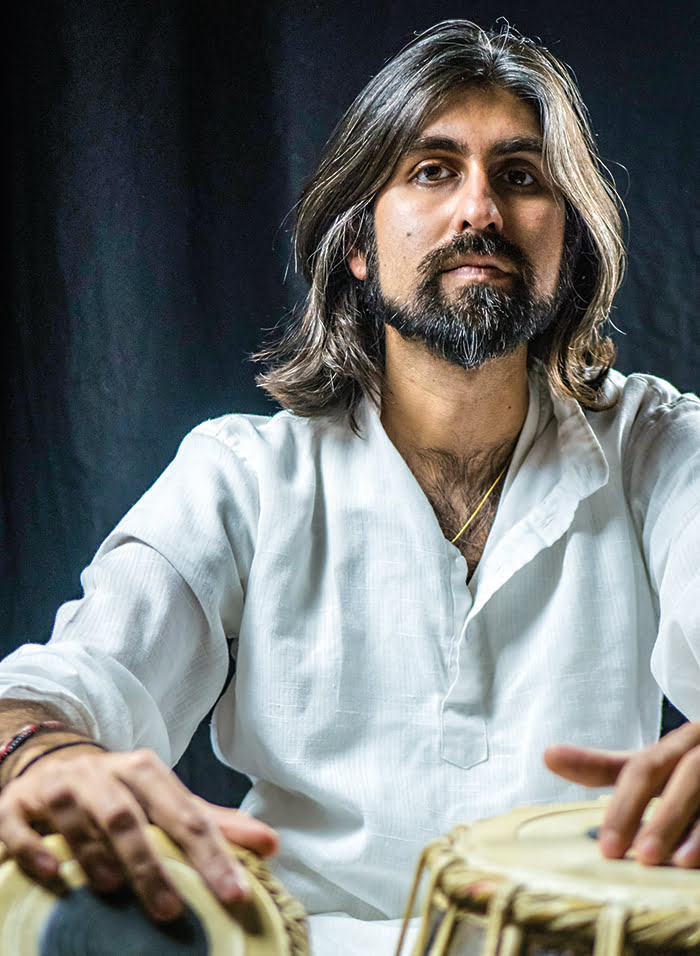
Connecticut-based drummer Levi Ali is on a mission. The Trinidadian-American percussionist, a master at Caribbean tassa and Indian-style tabla, is spreading the gospel of the drums. With a father who toured as a reggae bass player, music is in his blood.
Levi Ali. PHOTO: Matt Weston
Ali’s forays into drumming began with heavy metal and punk rock bands. He first became interested in the Arab hand drum, the doumbek, at a belly-dancing performance in his hometown of Tucson, Ariz. After moving to Boston, Mass., as an adult, he began to study the ubiquitous South Asian tabla drum. “My friend’s dad had to personally bring me the tablas from India,” recalled the musician, “because when he tried to mail them, the customs officers would cut them open.”
A 2008 trip to Trinidad and Tobago unlocked the power of tassa, the Caribbean Indian snare drum worn around the body. Along all his journeys, both geographical and artistic, tassa holds the most special place in his heart. “What’s cool about Trinis is that we took what we had from India to Trinidad, and that’s blossomed into its own unique art form that I would consider the pinnacle of drumming.”
Levi Ali. PHOTO: Bruce Mount
Across the Northeast, Ali now plays among a group of South Asian artists at local gigs and festivals. Outside of Caribbean-oriented events such as carnivals, Ali is generally the only Indo-Caribbean drummer. “It’s a whole culture that’s gone unnoticed,” Ali said. “The subcontinent could learn a lot from us about how to adapt and change culture to fit your new surroundings.”
HASSAN GHANNY is a writer and performer based in Boston. His writing has been featured in The Boston Globe and WBUR.
“Having gone through it, a presidential [campaign] is literally building the plane while you’re flying it at the same time. You never have all the resources you need when you need them. You have to be resourceful.”
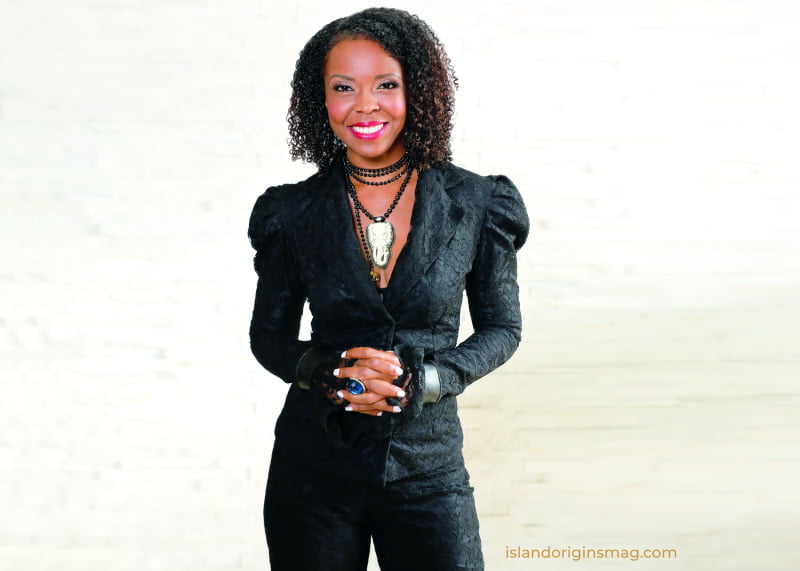
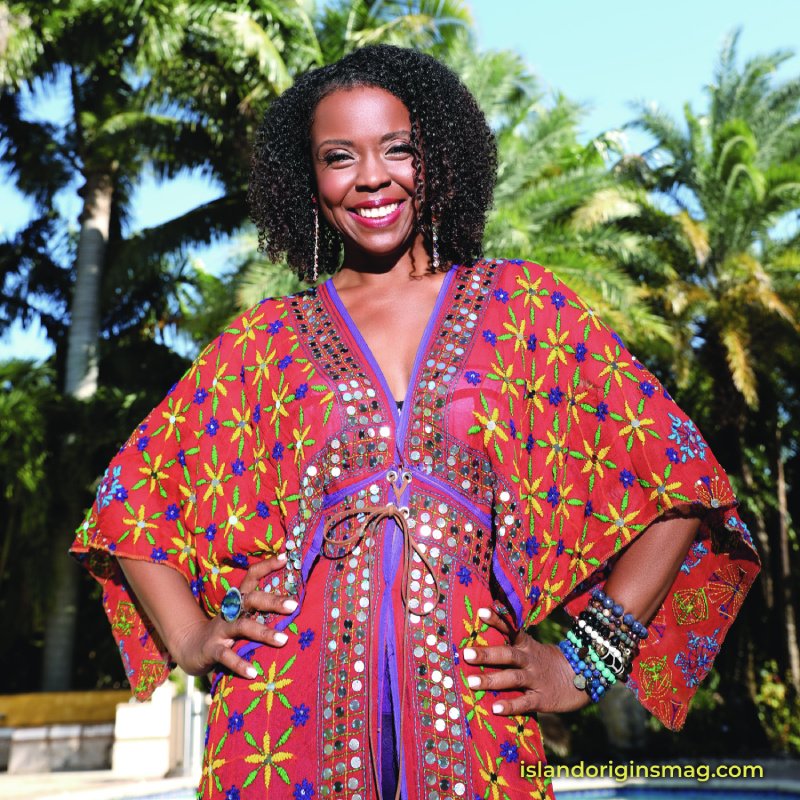
Following the 2020 political season, Karen Andre is taking a well-deserved breath. She coordinated efforts in the Biden for President campaign as senior advisor for Florida and senior advisor for National Faith Outreach. Her next chapter begins in the new Biden-Harris administration with a role as special assistant to the president for presidential personnel.
The Haitian American born in New York and raised in Florida had been a state-level political operative in various roles since 2004. She was a senior adviser to Andrew Gillum leading up to his 2018 Democratic primary win for Florida governor. She was even a presidential appointee in the Obama White House. But after some time in private business and sitting out the 2016 race, she realized that the 2020 election might be the most consequential in her lifetime. Duty called her back to Florida.
We spoke with Andre and some of her organizing allies about their 2020 campaign work in Florida, a convoluted state with a liberal-leaning south and conservative-rooted north. We discussed where Caribbean Americans fit into their efforts — as targets and leaders — as well as the experience of helping to shape a historic election.
Karen Andre. Photo by David I. Muir
Managing Power and Responsibility
Looking back, the disappointing result of the election in Florida wasn’t a surprise to Andre. There are lessons learned in each cycle that the Democratic party at large has not retained. Clearest among these for her is that outreach to Black and minority communities, the party’s most reliable base, seems like an afterthought each election season. If you only call when you need something, how strong can the relationship really become?
“There are some in the state that still don’t get it in terms of investments that they need to make in our communities,” said Andre, who got into politics to positively influence lawmakers. “The local operatives [do], but when we’re on a presidential campaign, which is now a national entity, that’s like a mother with 50 children.”
With so many groups competing for attention, it can be difficult to be heard.
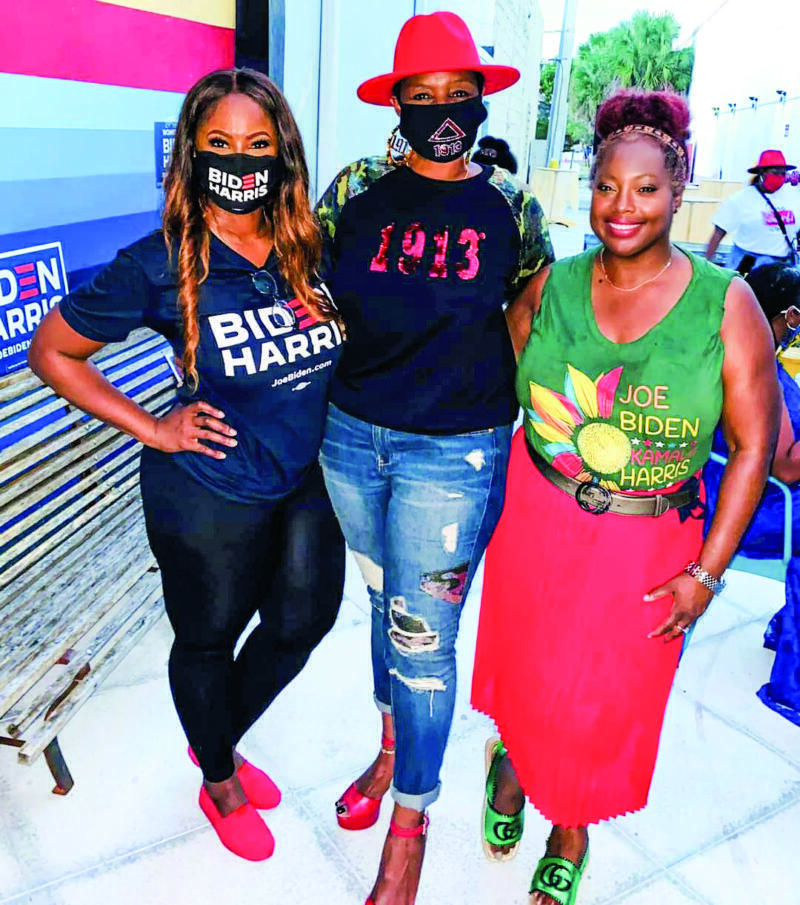
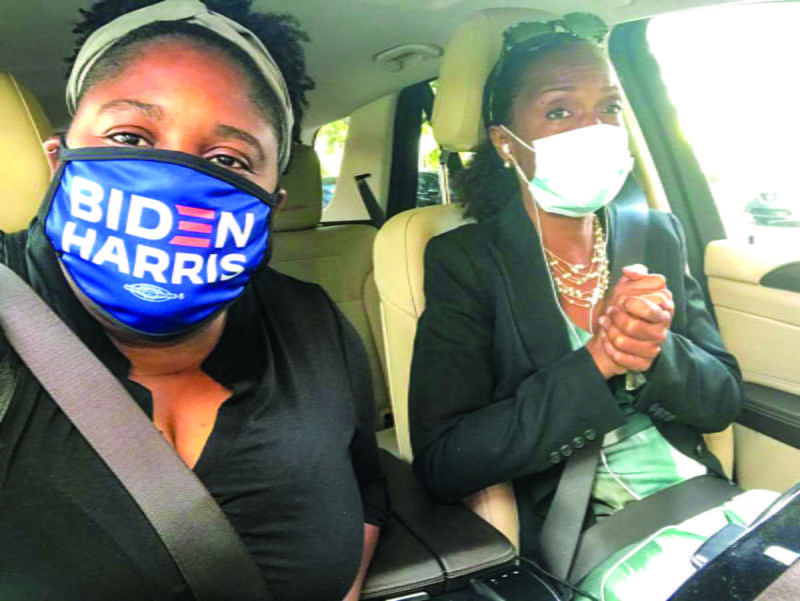
Given the duty of staffing the entire Florida operation, Andre handpicked cohorts for Caribbean voter outreach. Thamar Harrigan, Biden for America’s director of Haitian outreach in Florida, for example, fit snugly into her role connecting with her own community. Andre tasked Sophia Nelson, a Jamaican living in South Florida, with reaching Anglo-Caribbean voters.
Sophia Nelson – Caribbean American Outreach Director for the 2020 Biden of America campaign
It’s these well-connected warriors that made the best inroads. But they, too, recognized glaring strategic communication issues. In this cycle, Nelson said targeted minority outreach started just about a month before Election Day.
“Campaigns have to do better,” she said. “These communities want to be engaged but the engagement started too late.”
While Andre agrees, her opinion mirrors her thoughts on general market communication. “It’s very much a two-way street.”
She points to people like Miami developer and policy advocate Barron Channer and Lauderdale Lakes Mayor Hazelle Rogers. They “win,” she said, because they lead the charge.
“The people who advocate the most effectively don’t wait for the campaign to come calling. They decide who they like [and] engage them.”
Channer, CEO of Woodwater Group, a private investment firm with holdings in real estate and technology, is vocal about a proactive approach to politics.
“Support [should] be focused on helping those that embrace your core agenda and can be trusted to do so after they have won,” he said.
He advocates for establishing paths of least resistance into Caribbean communities. “Collective advocacy would bring more power to the individual agendas of those from Dominican Republic, Haiti, Jamaica, Trinidad and so on.”
Harrigan said optimistically that in this cycle she observed steps being taken in the right direction and saw that representation matters.
“The Biden-Harris campaign built a team of staffers that looked like our communities,” she said. “The reason we saw commitments to the Haitian community, a first for any campaign — ever — was a direct reflection of the number of [Haitians] on the campaign.”
Black Girl Magic
Karen Andre. Photo by David I. Muir
The 2020 election cycle placed Andre squarely in the midst of an epic convergence of feminine energy. The influence of women “was magic,” she reflected.
“I’m a big history buff,” she said. “And it was thrilling to be at the intersection of these historic moments.”
Andre remembered the “thrill” of meeting Harris in person. But her first interaction with the vice presidential candidate was a surprise assignment from Harris’ chief of staff Karine Jean Pierre, a fellow Haitian American.
With only a few minutes notice, “I get a text from Karine one morning saying you’re about to get an invite to brief the senator — Excuse me?!” Andre shared, jokingly.
Inside the campaign, she was energized. From Jamaican-Indian-American Kamala Harris being elected vice president and political powerhouse Jean Pierre being chosen to lead an all-female senior communications team for the White House to the women building campaign connections in Florida — Andre described a synergistic and supportive cadre.
“People assume that women, or Black women, in power can’t get along, and when I tell you — it’s been nothing but a love fest.”
For Harrigan, Florida’s crew, in particular, comprised amazing women from the Caribbean community materially contributing to the broad conversation. And none from within that group was more well regarded than Andre herself.
Thamar Harrigan (left) – Haitian American Outreach Director for the 2020 Biden of America campaign – with Karen Andre
“She’s always everyone’s fiercest advocate,” Harrigan said. “She works hard, but still manages, in the midst of it all, to remember to bring others into the room. She is a teacher, mentor, sponsor and champion to many. Ask anyone in the civil engagement / political supply chain and they have their own Karen Andre story where she opened a door for them.”
Nelson agreed.
“The political world is cutthroat, so teamwork, at times, is viewed more so as, ‘How does this benefit me?’” she said. “I am happy that was not the climate that Karen fostered. [She] was the needed voice, a champion and steady leader.”
A Mission Driven Life
The service-minded description of Andre by Harrigan and Nelson reflects her personal mission statement.
Her motto is, “I am because we are.”
“No matter how high I go, if it’s just me up there, it’s no fun,” Andre said.
Even her entree into politics was mission-driven.
“As an attorney who went off to law school with dreams of being a forceful advocate for social change, I realized — It’s these people that sit in these seats of power making these laws that may not always reflect the best decisions for us,” Andre said. “So I decided to help elect better lawmakers.”
The Democratic party became a natural home for Andre based on its stated values, including “protecting the rights of the least among us, the most marginalized, the voiceless.” They are ideals reflected in many Christian Caribbean homes. For Andre, they aligned with her personal faith and the values of her Haitian mother, a political activist in both Haiti and Haitian American communities.
“There are parts of my Haitian Heritage that I think are universal to the African diaspora,” she said. “A fierce sense of pride and independence, feeling empowered to create my own destiny, a sense of devotion to uplifting for the better.”
These qualities have served her well, both in her political and private career.
Until her role in the new administration pulls her back to Washington from South Florida, Andre said, she’s enjoying low-key days, island-colored sundresses, comfortable sandals and the occasional rum punch.